Compression algebras and phase recovery
Retain the supplied heat-fixed subspace, its bounded compressed word operators and the norm-closed unital commutative algebra they generate. These constructions are made only after their source commutativity and boundedness arguments. The unitary U restricts to a unitary U
 on the heat-fixed spaces, since it intertwines the heat semigroups. Define the realized algebra as the norm closure of the corresponding conjugated generators.

Searchable transcription
Theorem D.1 (Character and phase-measure recovery). The map α(B) = U0BU −1
0
is an isomet-
ric unital star-isomorphism AZ →A. It induces a homeomorphism

Searchable transcription
h : Spec(A) −→Spec(AZ),
h(χ) = χ ◦α.
For the source phase measure , the measure
 has the same barycenter evaluations. Full support of
 implies full support of

Searchable transcription
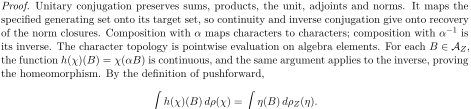
Proof. Unitary conjugation preserves sums, products, the unit, adjoints and norms. It maps the
specified generating set onto its target set, so continuity and inverse conjugation give onto recovery
of the norm closures. Composition with α maps characters to characters; composition with α−1 is
its inverse. The character topology is pointwise evaluation on algebra elements. For each B ∈AZ,
the function h(χ)(B) = χ(αB) is continuous, and the same argument applies to the inverse, proving
the homeomorphism. By the definition of pushforward,
Z
h(χ)(B) dρ(χ) =
Z
η(B) dρZ(η).
Thus the original vacuum-state barycenter identity transports exactly. If is a nonempty open set in the realized character space,
 ) is nonempty and open. Full support gives


This theorem transports full support after it has been established by the supplied cyclicity and separating-vector argument; probability normalization and compactness alone do not prove it. The character-dependent hierarchy is read from the same compressed whole-word element before character evaluation. Reading selected factors separately would replace ) by a different expression unless the required product identity has first been proved in this algebra.
Countable dense families, exceptional null sets and the original continuity upgrade remain part of the realized phase construction. An almost-everywhere property transfers to an almost-everywhere property by ; extending it to every character requires the supplied full-support and continuity argument. In particular vacuum uniqueness and rank-one ground-space recovery are retained in their original scope. No new phase is chosen by the frame section, and no change in phase measure is hidden in a normalization. The selected trace field remains centered with respect to the same selected vacuum.
Source: Shadow Theory and the Wilson Yang–Mills Construction: A Source–Readout Reconstruction. Both papers belong to one Zenodo record. No external funding.