Extension across collision sets
Why collision data must be retained. Separated correlations alone do not specify a distribution on a collision diagonal: two extensions can differ by a distribution supported there. The raw record consequently includes the subtraction windows, finite Taylor orders, collision charts, normal directions and forest choices used by the construction. The readout is the resulting Taylor-subtracted pairing for those devices.
Cancellation is established inside each combined shell expression before its integral norm is bounded. Absolute summability then justifies Fubini and passage through the finite forest overlaps. Integrating separately divergent pieces would destroy that argument. The finite cutoffs and compatible projections below show how to handle arbitrary labels using the same prescribed extension. What is recovered is thus a complete extension with declared devices and finite horizons, not independence from arbitrary alternative subtraction prescriptions.
21.1 Collision extensions with specified subtraction data
The contact conclusion is a Euclidean distributional extension using the same reader and a specified subtraction system. Let be a real linear isometry, with Haar volume on finite-dimensional
 . An admissible forest records compatible collision groups, local continuation charts, support windows, finite Taylor orders and projection choices. For each such forest and compact smooth chart test the construction gives an integrable Taylor-subtracted pairing, equal to its prescribed annular expansion with absolute summability in integral norm. Finite ordered iterations of centered collision groups have the same property. Away from total collapse, annuli recover the punctured correlation. On permitted isometric collision planes containing the collision directions the endpoint has the stated finite total test order. Devices carry the hierarchy’s actual rotation action; projection bases are the OPE reader prescription. A real system basis and compatible positive thresholds exist simultaneously. Contact values are therefore attached to these devices and forest conditions, not asserted independent of all subtraction choices.
For a nonempty group

Searchable transcription
Nfull
g
= {x : xj = 0 (j /∈g),
X
j∈g
xj = 0},
Ng = P −1Nfull
g
.
Searchable transcription
Admissibility requires Nfull
g
⊂ran P, so P is an isometry of these normals.
Their orthogonal
complements contain collapsed configurations and the centroid. Omitting one member identifies
the full normal space linearly with (R4)|g|−1, the omitted coordinate being minus their sum; hence

Searchable transcription
dim Ng = 4(|g| −1) =: νg.
(CE1)
Disjoint groups have orthogonal normals. Centroids of disjoint nonempty proper groups differ almost everywhere in the normal variables: equality is the kernel of a nonzero linear map, nonzero by opposite vectors at one member of each group. Its proper linear kernel has Haar measure zero. This supports almost-everywhere shell identities without assigning punctured readings on a coincidence plane. With orthogonal projection , normal Taylor terms are

Searchable transcription
Tg,jf(x) = 1
j!Djf(x −πgx)[πgx, . . . , πgx].
For fixed 0, let the prescribed radial smooth
 equal one near zero and vanish for normal norm at least 2
 . Put

Searchable transcription
m
X
Tg,s,mf = χs(πgx)
j=0
Tg,jf,
Rg,s,m = 1 −Tg,s,m.
(CE2)
Searchable transcription
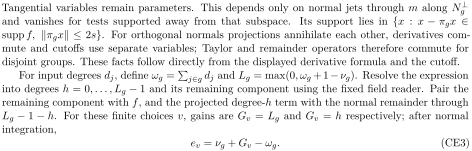
Tangential variables remain parameters. This depends only on normal jets through m along N⊥
g
and vanishes for tests supported away from that subspace.
Its support lies in {x : x −πgx ∈
supp f, ∥πgx∥≤2s}. For orthogonal normals projections annihilate each other, derivatives com-
mute and cutoffs use separate variables; Taylor and remainder operators therefore commute for
disjoint groups. These facts follow directly from the displayed derivative formula and the cutoff.
For input degrees dj, define ωg = P
j∈g dj and Lg = max(0, ωg +1−νg). Resolve the expression
into degrees h = 0, . . . , Lg −1 and its remaining component using the fixed field reader. Pair the
remaining component with f, and the projected degree-h term with the normal remainder through
Lg −1 −h. For these finite choices v, gains are Gv = Lg and Gv = h respectively; after normal
integration,
ev = νg + Gv −ωg.
(CE3)
The remaining branch has 1, including
 = 0. A projected branch has
 At shell radius
 1, Taylor remainder supplies the additional order
 , giving

Searchable transcription
aevaLg−h = a.
(CE4)
For 1 the cutoffbound uses only
 and the product is exactly one. The remaining branch meets only shells up to the fixed geometric reserve, where its
 is bounded. This is the near/far integrability gain.
![A uniform local chart retains a partition Q into disjoint nonempty parts, length s > 0, collapsed
offset, linear resizing frame A and a closed stage in a fixed bounded resized set. Part radii Ri ∈
(0, 1] scale their normal directions.
A common detector collar B ∈(0, 1] contains the normal
extent and subtraction halo, with 2s ≤B; nonsingleton radii are at most a fixed multiple of s.
Require B ≤clearance(P
j dj), decreasing with degree and hence covering all projection degrees.
The continuation of other groups, centers and fields is constant along each current part’s normal
directions. Ancestor-subtracted expressions are thus retained as exterior continuations with their
cancellations intact. Refine a nonsingleton i by proper partition U on an angular annular patch,
with new radius a and other radii fixed. Compose A with normal multiplication by a/Ri, identity
on N⊥
i . Then
| det A′| = | det A|(a/Ri)νi.
(CE5)](/publications/source-lift/yang-mills-reconstruction/math/p393-018936.svg)
Searchable transcription
A uniform local chart retains a partition Q into disjoint nonempty parts, length s > 0, collapsed
offset, linear resizing frame A and a closed stage in a fixed bounded resized set. Part radii Ri ∈
(0, 1] scale their normal directions.
A common detector collar B ∈(0, 1] contains the normal
extent and subtraction halo, with 2s ≤B; nonsingleton radii are at most a fixed multiple of s.
Require B ≤clearance(P
j dj), decreasing with degree and hence covering all projection degrees.
The continuation of other groups, centers and fields is constant along each current part’s normal
directions. Ancestor-subtracted expressions are thus retained as exterior continuations with their
cancellations intact. Refine a nonsingleton i by proper partition U on an angular annular patch,
with new radius a and other radii fixed. Compose A with normal multiplication by a/Ri, identity
on N⊥
i . Then
| det A′| = | det A|(a/Ri)νi.
(CE5)
Engineering fields contribute ( , and continuation gain contributes (
 ; together these are exactly (
 . Keep both the old stage and its normally collapsed, cutoff-bounded part, since Taylor supports may enter the halo. Orthogonality preserves other normals. The continuation remains locally continuous: Taylor acts within the detector collar and the angular patch separates distinct part palettes.
The lifted contact source is the isometric plane together with its normal spaces, Haar volume, ordered forest, fixed reader projections, cutoffjets and resizing frames. CE2 is its test readout, paired with the matching projected field component; CE5 transports its volume and CE3–CE4 preserve its scale price. Retaining subtraction jets exposes the contact data lost by restricting to punctured configurations. Restriction of the eventual extension recovers the punctured reading; contact recovery additionally requires these actual devices, not only the punctured observable.
Collision-plane and normal-jet recovery. The contact record includes the actual isometry  , Haar volume
 , admissible forest, fixed homogeneous field projections and all cutoffand continuation choices. For its horizontal coordinate copy write
 and
 with
 = 1 and

 . Equip this copy with the transported inner product and volume

Searchable transcription
(JE)∗dxE. These are horizontal coordinates, not an integration over additional redundant directions.
Define
P Z = PQE,
NZ
g = JENg,
πZ
g = JEπgQE,
fZ = fQE,
χZ
s = χsQE.

Searchable transcription
Then (πZ
g )2 = πZ
g , πZ
g JE = JEπg and dim NZ
g
= νg.
Orthogonality and the zero-measure co-
incidence kernels are transported by the same isometry.
In particular the omitted-coordinate
parametrization used for CE1 is only linear; its coordinate Lebesgue measure is not silently substi-
tuted for the induced Haar volume.
The chain rule gives, for horizontal arguments JEui,

Searchable transcription
DjfZ(JEx)[JEu1, . . . , JEuj] = Djf(x)[u1, . . . , uj],
T Z
g,jfZ(JEx) = Tg,jf(x).
Searchable transcription
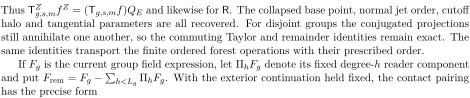
Thus TZ
g,s,mfZ = (Tg,s,mf)QE and likewise for R. The collapsed base point, normal jet order, cutoff
halo and tangential parameters are all recovered. For disjoint groups the conjugated projections
still annihilate one another, so the commuting Taylor and remainder identities remain exact. The
same identities transport the finite ordered forest operations with their prescribed order.
If Fg is the current group field expression, let ΠhFg denote its fixed degree-h reader component
and put Frem = Fg −P
h<Lg ΠhFg. With the exterior continuation held fixed, the contact pairing
has the precise form

Searchable transcription
Lg−1
X
Cg(Fg, f) = ⟨Frem, f⟩+
h=0
⟨ΠhFg, Rg,s,Lg−1−hf⟩.

Searchable transcription
An empty sum at Lg = 0 is retained. Transporting each component, test and horizontal volume
gives CZ
g (F Z
g , fZ) = Cg(Fg, f) on the source’s admissible charts. In the projected branch, Lg =
ωg + 1 −νg, so explicitly

Searchable transcription
(νg + h −ωg) + (Lg −h) = 1,
(νg + h −ωg) + (Lg −1 −h) = 0.
These recover respectively the near-shell power and far-shell power 1, while the remaining branch has exponent at least one. For resizing
 ), its lifted frame is
 its determinant in transported orthonormal coordinates is det
 The unchanged engineering and continuation factors then recover CE5’s total (
 , including the old stage and collapsed cutoffhalo. Consequently this lift preserves the stated contact devices and scope before the subsequent shell summability argument.
21.2 Uniform contact budgets and shell refinement

Searchable transcription
For a current partition Q of g choose

Searchable transcription
τQ = 3|g|−|Q|,
εQ = τQγ,
γ > 0,
(τQ + 1)γ ≤1.
A proper refinement increases the part count, so

Searchable transcription
2εQ′ + γ ≤εQ.
(CE6)

Searchable transcription
For chart continuation bound Bw, frame Aw, and all recorded radius registers Rj(w), including
unchanged ones, put
Bw(ε) = | det Aw|Bw
Y
i∈Q
Ri(w)−ωi Y
j
Rj(w)−ε.
(CE7)

Searchable transcription
A dyadic restriction of part i to shell number ni supplies 2−niγ; an unrestricted part supplies one.
With NQ = (2 + P
j dj)(|g|−|Q|), every permitted projected/remaining choice and shell restriction
has an integrable complete integrand F:
Z

Searchable transcription
E
∥F(x)∥dx ≤C∥f ◦Aw∥CNQBw(εQ)
Y
2−niγ.
(CE8)
i∈Q
|i|>1
The constant is uniform after geometric reserves, degree bounds and continuation estimates are fixed. The norm is taken after combining the finite subtraction expressions, preserving their cancellations. Under refinement the child’s budget is the parent’s at , multiplied by (
 . CE4 and its bounded far-shell counterpart make the Taylor-adjusted factor at most a reserve constant times
 for every 0
 1. Choose


Searchable transcription
(a/Ri)γ+εQ′a−εQ′ = aγR
−(γ+εQ′)
i
.
CE6 absorbs the radius loss in the parent’s surcharge. Other shell factors stay unchanged, and each new annulus contributes the summable . Proper partitions strictly decrease
 , giving finite induction and the derivative count
 The shells are

Searchable transcription
ψg,a = χa(πgx) −χa/2(πgx),
an = 2−n,
supp ψg,a ⊂{a/2 ≤∥πgx∥≤2a}.
Searchable transcription
Their telescoping identity is
X
n<N
ψg,an = χ1 −χaN .
(CE9)
For tests supported at normal norm at most one and any nonzero normal point, multiplying by this right side is eventually equality in a whole neighborhood, including every derivative used by the finite Taylor operations. On the compact unit normal annulus group labels by equal positions. This is a proper partition since total collapse is absent. Subcentroids in a part coincide; those in different parts are distinct. The latter is open, and the finitely many proper partitions/subgroups give an open cover. Choose a smooth finite partition of unity subordinate to it. Its rescaled angular factors times give
 summing to
 . On each compact mask support differentpart subcentroids have a positive minimum distance at radius one, hence distance at least
 after rescaling. This supplies reader separation also for all subgroups used in subsequent refinement. The lifted shell record retains the full radius register, finite angular atlas and combined Taylor expression. The annular reader CE9 is eventually exact offthe collapsed normal plane; CE8 pays its integral norm before summing. CE6 proves that refinement preserves that paid budget, so iterated readout recovers the same tested pairing rather than separately bounding terms whose cancellation supplies integrability.

Searchable transcription
Exact budget and annular-mask recovery.
Retain each radius register as a separately named
entry in the contact source, even when its value is unchanged by a refinement. The section and
readout keep these entries, Bw, the frame determinant and all input degrees fixed. Thus BZ
w(ε) =
Bw(ε), and the transported horizontal norm gives
Z
EZ ∥F Z∥d(JE)∗xE =
Z
E
∥F∥dxE,
∥fZ ◦(JEAwQE)∥CNQ = ∥f ◦Aw∥CNQ.
Here derivatives and operator norms on the horizontal copy use the transported orthonormal frame. This recovers CE8 with its complete combined integrand; individual unsubtracted terms are not substituted for in this equality.
For a proper refinement set . Then
 3 and
 3, whence

Searchable transcription
2εQ′ + γ ≤(2τQ/3 + 1)γ ≤τQγ,
t = γ + εQ′ ≤1,
εQ −εQ′ ≥t.

Searchable transcription
Consequently for 0 < Ri ≤1 the parent’s extra surcharge obeys R
−(εQ−εQ′)
i
≥R−t
i . Every other
retained radius register contributes a factor at least one to this surcharge ratio. Combined with
the exact identity

Searchable transcription
(a/Ri)ta−εQ′ = aγR−t
i ,
X
n≥0
(2−n)γ =
1
1 −2−γ ,
Searchable transcription
this explicitly recovers the radius absorption and convergent shell price used in the finite partition
induction. No unchanged register is removed to obtain this estimate.
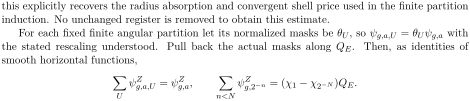
For each fixed finite angular partition let its normalized masks be θU, so ψg,a,U = θUψg,a with
the stated rescaling understood.
Pull back the actual masks along QE.
Then, as identities of
smooth horizontal functions,
X
U
ψZ
g,a,U = ψZ
g,a,
X
n<N
ψZ
g,2−n = (χ1 −χ2−N )QE.

Searchable transcription
The normal distances are preserved by JE, so the same positive cUa separates all prescribed different-
part subcentroids. The source retains the eventual equality of germs offN⊥
g , including every finite
jet entering later operations. This retains the actual angular partition and shell readers, rather
than only their support bounds.
21.3 Uniform Taylor bounds and absolute contact resolution
On a fixed compact unit annulus, with derivatives of bounded through
 +1, normal rescaling by
 gives

Searchable transcription
(
am+1,
0 < a ≤1,
am,
a > 1.
(CE10)
∥Rg,s,mf∥Cn after rescaling ≤C∥f∥Cn+m+1
The parent scale obeys
 , with the fixed normalized support bound. All derivatives through
 of
 , have a common bound by compact smoothness. The rescaled normal Taylor polynomial is bounded by
 max(1
 ; the rescaled original function has uniform derivatives on its compact support and is zero as a germ beyond it. Leibniz gives the far bound. For
 1 the cutoffis identically one near the annulus, so integral Taylor remainder gives
 . Otherwise 1
 , and multiplying the rough bound by (3
 proves the same near bound. Fixed normalized angular mask derivatives add only a constant. This proves uniformity in

The normal Taylor estimate also intertwines exactly with the horizontal copy: its rescaled
norm and its parameter family , are unchanged. In the near branch the normalized integral Taylor remainder is

Searchable transcription
Z 1
m
X
aj
j! Djf(b)[yj] = am+1
m!
0
(1 −t)mDm+1f(b + tay)[ym+1] dt,
f(b + ay) −
j=0
with normal and
 tangential. Differentiating this formula in the normalized coordinates uses at most
 +1 derivatives. When the cutoffis not identically one, the retained alternative 1
 converts the rough near bound to the same power
 ; the far branch retains
 . Hence CE10 transports with exactly its two regimes and a constant uniform in the subtraction length and fixed normalized angular masks.
For the explicit CE8 induction, the singleton partition has no normal direction left: apply continuity, the permitted continuation bound and bounded resized support. Otherwise choose nonsingleton , decompose its election into the finite projected/remaining choices
 , and apply CE9 after normal Taylor operation and the angular partition. Each resulting term equals the refined forest expression with the continuation that regroups its children into
 and applies its fixed projection or remainder. This is a linear-expression identity before hierarchy evaluation or integration. The refined partition has smaller
 and retains offsets, length and normal constancy. Its subcentroid palette is admissible by angular separation and the common collar. The inductive estimate and CE10, with CE3–CE7, give

Searchable transcription
Cv∥f ◦Aw∥CNQBw(εQ)aγ
n
Y
2−njγ.
(CE11)
j∈Q
j̸=i

Searchable transcription
Empty annular stages give zero; nonempty ones have exactly the refined geometry. Finitely many
sectors and components preserve uniformity. Because P
n≥0 aγ
n = (1−2−γ)−1, their complete terms
are absolutely summable in integral norm. CE9’s eventual germ equality and proper-normal Haar-
null exceptions identify the sum almost everywhere with the unsliced expression. More precisely the
terms sum in the Banach space L1(E; X), since the sum of norms is finite. Absolute integral-norm
summability also supplies the almost everywhere pointwise sum; uniqueness identifies the same
integrable function, without an unproved dominating function. Continuous integration gives

Searchable transcription
Z
Fv =
Z
Fv,n,
X
Z
∥Fv,n∥< ∞.
(CE12)
∞
X
n=0
n

Searchable transcription
Use CE11 directly for a specified shell; sum the finite choices for CE8. If all choices of the election
occur, the exact root formula is
Z
F =
X
∞
X
Z
Fv,n.
(CE13)

Searchable transcription
v
n=0
Searchable transcription
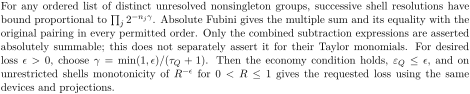
For any ordered list of distinct unresolved nonsingleton groups, successive shell resolutions have
bound proportional to Q
j 2−njγ. Absolute Fubini gives the multiple sum and its equality with the
original pairing in every permitted order. Only the combined subtraction expressions are asserted
absolutely summable; this does not separately assert it for their Taylor monomials. For desired
loss ε > 0, choose γ = min(1, ε)/(τQ + 1). Then the economy condition holds, εQ ≤ε, and on
unrestricted shells monotonicity of R−ε for 0 < R ≤1 gives the requested loss using the same
devices and projections.
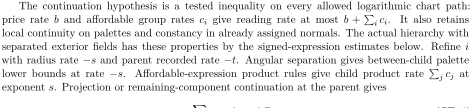
Searchable transcription
The continuation hypothesis is a tested inequality on every allowed logarithmic chart path:
price rate b and affordable group rates ci give reading rate at most b + P
i ci.
It also retains
local continuity on palettes and constancy in already assigned normals. The actual hierarchy with
separated exterior fields has these properties by the signed-expression estimates below. Refine i
with radius rate −s and parent recorded rate −t. Angular separation gives between-child palette
Affordable-expression product rules give child product rate P
lower bounds at rate −s.
j cj at
exponent s. Projection or remaining-component continuation at the parent gives
X

Searchable transcription
j
cj + (t −s)Gv.
(CE14)
For the remaining component support forces ; the full finite projection remainder through
 1 gives
 = 0, use coarsening with zero gain. The projected degree-
 reader
gives . The common detector collar makes these operations admissible on the actual moving palettes.
The lifted resolution source retains the complete combined integrand as an object, its finite election, shell indices and inherited continuation. CE10 transports its test norm; CE11 pays every refined term; CE12–CE13 recover the unsliced pairing by continuous integration. Absolute Fubini proves compatibility of permitted resolution orders. The reader does not split the cancellationbearing source into independently integrated monomials. CE14 records the exact continuation gain that subsequent refinements must retain.
Absolute-resolution recovery in the tested norm. Let be the isometric horizontal output copy (the identity when the tested output is scalar). The lift on integrands is

Searchable transcription
(UF)(JEx) = UXF(x),
∥UF∥L1(EZ;XZ) = ∥F∥L1(E;X),
Z
Z
EZ UF = UX
E
F.

Searchable transcription
The finite election, normal Taylor operation, angular multiplication and prescribed regrouping
all intertwine with this lift. Hence each complete annular term, before taking its norm, satisfies
F Z
v,n = UFv,n. The same holds for an empty stage, whose term is zero. Set

Searchable transcription
Kv = Cv∥f ◦Aw∥CNQBw(εQ)
Y
2−njγ,
r = 2−γ ∈(0, 1).
j∈Q
j̸=i
CE11 and the isometry give the quantitative common tail estimate

Searchable transcription
F Z
v −


L1
≤Kv
rN
1 −r,
QX
Z
F Z
v =
X
Z
Fv,n,
N−1
X
n=0
F Z
v,n
n≥0

Searchable transcription
where QXUX = 1. The identification of the limit with F Z
v
uses the transported eventual germ
identity and Haar-null exceptional sets. This proves recovery of CE12 in norm as well as after
integration. Summing the finite v gives precisely CE13.
For k successively resolved groups, retain the full multi-index (n1, . . . , nk) and its complete
combined term. Its norm bound is Krn1+···+nk, with the fixed common constant supplied by the
successive estimates. In particular

Searchable transcription
X
n1,...,nk≥0
Krn1+···+nk =
K
(1 −r)k ,
X
max nj≥N
Krn1+···+nk ≤kKrN
(1 −r)k .
The rectangular sums therefore recover the original pairing, and absolute Fubini permits every resolution order allowed by the recorded forest. The bound concerns complete subtraction terms only. For the empty list the recovery is the original integral without a shell sum. Finally the choice  = min(1
 + 1) leaves
 ) for the same full radius register and the same devices.
21.4 Continuation inheritance and the global contact distribution

Searchable transcription
The refined scalar price is exactly B′
w = Bw(a/Ri)Gv.
Its rate b + (t −s)Gv matches CE14.
On a subtraction halo choose an original-stage point differing only in Ni, as guaranteed by the
halo definition; for the remaining branch take the same point.
Normal constancy permits this
evaluation. Orthogonality leaves every other palette and expression unchanged. Substitution of

Searchable transcription
the child product with its fixed component treatment into the old tagged product is the refined
reading. The old path inequality gives b + (t −s)Gv + P
refined cj, proving the inheritance in CE11.
Continuity follows on the original-stage and normally collapsed-stage closed pieces and glues on
their agreeing restrictions, including continuations with previous Taylor cancellations; the auxiliary
continuation is thus justified at each step.
For explicit recovery of that inheritance, denote the old continuation by and the finite childregrouping/component map by
 The refined continuation is the actual composition

 , with all other tagged arguments fixed. Its lifted version is the same composition of the intertwined maps, so

 )). Here
 denotes the product of the relevant horizontal sections. For a path with radius rates
 , the scalar price identity is

Searchable transcription
Bw′ = Bw(a/Ri)Gv,
rate Bw′ = b + (t −s)Gv,
rate Cw′ ≤b + (t −s)Gv +
X
refined parts
cj.
All three are unchanged by section/readout. In the remaining branch retain the support condition  and the complete finite remainder;
 = 0 retains coarsening with gain zero. In the projected branch retain its actual degree
 and
 . A halo evaluation is transported from the same original-stage point differing only in
 . Since
 preserves orthogonality, this move leaves every other palette unchanged. The two closed-piece continuation maps agree on their intersection before and after transport, so their glued continuous map is the same refined reading. Thus subsequent refinements inherit the actual cancellations as well as their rate bound.
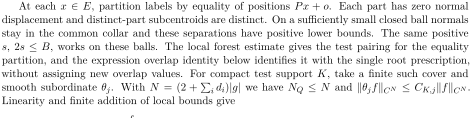
Searchable transcription
At each x ∈E, partition labels by equality of positions Px + o. Each part has zero normal
displacement and distinct-part subcentroids are distinct. On a sufficiently small closed ball normals
stay in the common collar and these separations have positive lower bounds. The same positive
s, 2s ≤B, works on these balls. The local forest estimate gives the test pairing for the equality
partition, and the expression overlap identity below identifies it with the single root prescription,
without assigning new overlap values. For compact test support K, take a finite such cover and
smooth subordinate θj. With N = (2 + P
i di)|g| we have NQ ≤N and ∥θjf∥CN ≤CK,j∥f∥CN .
Linearity and finite addition of local bounds give
Z

Searchable transcription
E
|Ks(f)(x)|dx ≤CK∥f∥CN ,
supp f ⊂K.
(CE15)
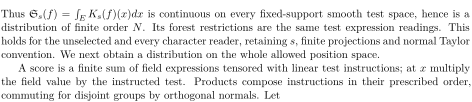
Searchable transcription
Thus Ss(f) =
R
E Ks(f)(x)dx is continuous on every fixed-support smooth test space, hence is a
distribution of finite order N. Its forest restrictions are the same test expression readings. This
holds for the unselected and every character reader, retaining s, finite projections and normal Taylor
convention. We next obtain a distribution on the whole allowed position space.
A score is a finite sum of field expressions tensored with linear test instructions; at x multiply
the field value by the instructed test. Products compose instructions in their prescribed order,
commuting for disjoint groups by orthogonal normals. Let
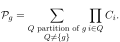
Searchable transcription
Pg =
X
Y
i∈Q
Ci.
Q partition of g
Q̸={g}
For singleton is the actual field tensored with identity. For


Searchable transcription
Lg−1
X
Cg = −
h=0
reshape(readerg,h)Pg Tg,s,Lg−1−h,
Sg = Pg + Cg.
(CE16)
This finite recursion uses only smaller groups. Its fixed centroid reader acts on fields, and its right Taylor factor on tests; for = 0 the correction is empty. Rearrangement is precisely the
Source: Shadow Theory and the Wilson Yang–Mills Construction: A Source–Readout Reconstruction. Both papers belong to one Zenodo record. No external funding.