retains both bound families, compact coordinates and the two refinement maps. Recovery preserves (CV1), finite-coordinate convergence and idempotency, transporting the quotient identification with the same detector and smearing dependencies.
18.8 Exact null quotient and compatible diagonal orders
Full-rank detector pairs separate the quotient: a label null against every continuum spectator has zero detector readings and belongs to the limiting kernel. Thus
 continuum-null labels of degree at most
 = ker
 (CV2)
This finite-dimensional quotient retains real and signed structures and is the detector/differentiation quotient. Transported finite differences agree with the raw generic table. Taylor and next-difference arguments extend smoothly across coordinate ties while full positions remain distinct. Density of generic tuples makes that extension unique, yielding smooth with the same
 and separated smearing limits. Raw compactness alone supplies no tie value. The previously established full fixed-volume mesh Cauchy limits identify the auxiliary subsequence with these
 ; restoring the full mesh changes none of them. Only the outer period subsequence remains. For nested refinements
 , the diagonal
 ) is increasing:
 and
 + 1. For each fixed stage
 , its tail lies in the range of
 . Apply separately to mesh and period orders, preserving every fixed-stage bound and limit on the same final table. If each successive order refines its predecessor, take its diagonal mesh and period sequences separately. Finally, countably many further stages can be imposed without combining incompatible choices. The derivative construction removes the coordinate-projection restriction on the raw table. The lift retains null kernels, quotient structures and nested subsequence maps. Recovery preserves (CV2), unique smooth extension and both diagonal orders, keeping all later services attached to this table.
Compact table and exact quotient recovery. For each finite degree carrier keep the coefficient section and recovery
 fixed during extraction, with
 . The framed projection and its recovered limit are

Searchable transcription
bPN,p,d = jdPN,p,dpd,
bPd = jdPdpd,
bP 2
d = bPd,
pd bPdjd = Pd.

Searchable transcription
Finite-dimensional convergence commutes with these fixed maps in the inner mesh and outer period
limits separately. In the section norm, ∥bP −bQ∥= ∥P −Q∥on the horizontal image, so the source’s
less-than-one projection comparison preserves the stabilized physical kernel dimension. Redundant
vertical coefficients remain in ker bPd and carry no extra physical quotient dimension. The complete
quotient readout is explicitly

Searchable transcription
pd : EZ
d / ker bPd −→Ed/ ker Pd,
[ζ] 7−→[pdζ],
jd : [u] 7−→[jdu].
Searchable transcription
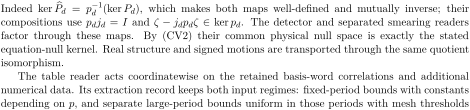
Indeed ker bPd = p−1
d (ker Pd), which makes both maps well-defined and mutually inverse; their
compositions use pdjd = I and ζ −jdpdζ ∈ker pd. The detector and separated smearing readers
factor through these maps.
By (CV2) their common physical null space is exactly the stated
equation-null kernel. Real structure and signed motions are transported through the same quotient
isomorphism.
The table reader acts coordinatewise on the retained basis-word correlations and additional
numerical data. Its extraction record keeps both input regimes: fixed-period bounds with constants
depending on p, and separate large-period bounds uniform in those periods with mesh thresholds
allowed to depend on The normalized integral identity preserves (CV1), and preserves the generic-position estimate

Searchable transcription
|SN(x + he) −SN(x)| ≤An|h|/r,
|h| ≤r,
with the same constants in the applicable regime. Thus the countable compact coordinates, their exceptional early completions, and all active fixed-period limits are recovered on the same two selected orders. In particular later period selection does not discard the fixed-period tables outside that selected period sequence.
Finally retain the nested mesh and period maps as part of the source record. For each fixed stage and
 there is a tail index
 ) such that
 )), with
 . Every fixed-stage eventual estimate and limit therefore survives each diagonal, separately in mesh and period. The unique smooth extension from generic tuples is then recovered by the same derivative reader on collision-free configurations. Since the full fixed-period mesh limits were already established, this auxiliary extraction reads those same
 ; the final theorem retains only the selected outer period order.
18.9 Uniformly bounded symmetric projections, the calibrated equation image and the differential quotient
The construction of the common compact extraction and the field quotient is completed by three further passages of the supplied text. They are given in full, in the order of the input. The first constructs the finite-cutoffprojections and their uniform bound.
Here is the construction and uniform bound for those finite-cutoffprojections. At degree let
 be the image of the free equation ideal under the exact calibrated label map already constructed. This is a subspace of the single fixed coefficient space
 , although it varies with
 . Choose once a linear coordinate isomorphism
 , with Euclidean norm on its source, and let
 be orthogonal projection onto
 . Put

Searchable transcription
FK = I −WπKW −1.
(CVP1)
It kills , and
 for every
 . Moreover

Searchable transcription
∥FK∥≤∥I∥+ ∥W∥∥W −1∥,
(CVP2)

Searchable transcription
independently of K, since ∥πK∥≤1. Thus no conditioning estimate on a moving basis of KN,p is
required.
When K is invariant under the signed label action Vs and coefficient conjugation, average FK
to
QK = 1
X
s∈S
VsFKVs−1,
PKx = 1
2{QKx + QK  ̄x}.
(CVP3)
|S|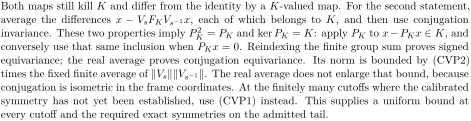
Searchable transcription
Both maps still kill K and differ from the identity by a K-valued map. For the second statement,
average the differences x −VsFKVs−1x, each of which belongs to K, and then use conjugation
invariance. These two properties imply P 2
K = PK and ker PK = K: apply PK to x−PKx ∈K, and
conversely use that same inclusion when PKx = 0. Reindexing the finite group sum proves signed
equivariance; the real average proves conjugation equivariance. Its norm is bounded by (CVP2)
times the fixed finite average of ∥Vs∥∥Vs−1∥. The real average does not enlarge that bound, because
conjugation is isometric in the frame coordinates. At the finitely many cutoffs where the calibrated
symmetry has not yet been established, use (CVP1) instead. This supplies a uniform bound at
every cutoffand the required exact symmetries on the admitted tail.
The projection maps are therefore idempotent and uniformly bounded before extraction. Their limits are idempotent as well, at each fixed period and in the outer limit. Their kernel dimensions stabilize in both limits. Indeed, if are idempotents and
 1, the map
 sends ker
 into ker
 injectively: if
 and
 = 0, then

Searchable transcription
∥u∥= ∥(Q −P)u∥≤∥Q −P∥∥u∥,
(4)
so = 0. Interchanging
 and
 gives injections in both directions and therefore equal kernel dimensions in the fixed finite-dimensional coefficient space. Norm convergence of the projections makes their distance less than one on the admitted tail in each limit. This is the kernel stability used below; it does not identify kernels without the detector and equation-image arguments.
The second passage restores the full-mesh order after the compact extraction.
In the present construction the full fixed-volume mesh limits were already established by the two-level Cauchy argument. The auxiliary mesh subsequence just used therefore converges to those same . To see explicitly that this restores the required smeared order, fix a token word and one compactly supported separated test
 . For each suitable period
 , let
 ) be its lattice smeared moment. The full-mesh result gives
 . The extracted table gives, along its mesh subsequence
 ), a limit
 ), followed by the stated volume limit of
 Cofinality of
 also gives
 ). Uniqueness of a complex limit therefore identifies
 ) at each suitable
 . Substitute this equality into the retained volume-limit identity. The result has the full mesh order followed by precisely the same volume subsequence as the final table. This argument restores the smeared convergence assertion; it does not claim that every auxiliary structure originally extracted on a mesh subsequence has been extended to all meshes.
The third passage, which the input places under two headings of its own, specifies the calibrated equation image and then the inclusions and derivatives on the physical quotient.
18.10 The calibrated equation image and its silent representatives
We specify the finite-cutoffchange of coefficients used in the preceding projection construction. This also explains why its kernel directions are silent in continuum tests. Fix a degree, its coefficient frame, and a second sound local section , such as the marked equation section. Write
 for the coordinate vectors and
 1 for the fixed cost of signed motions and coordinate decomposition in this frame. The local insertion transport constructs columns
 satisfying

Searchable transcription
|ej −uj|coeff≤(2c2)−1.
(CVR1)
The columns are combined by the signed and conjugate averaging already used for local sections, rather than by an unsymmetrized matrix. Explicitly, if ) are the averaged coordinates of the inverse motion of
 , then

Searchable transcription
Px =
X
s,j
χs,j(x) suj,
x =
X
s,j
χs,j(x) sej,
X
s,j
|χs,j(x)| ≤c|x|coeff.
(CVR2)
Here a conjugating motion conjugates the coordinate as well, so the combined map is complex linear. The fixed motion bound is . Subtract the two sums and apply (CVR1):

Searchable transcription
|x −Px|coeff≤1
2|x|coeff,
|P −1y|coeff≤2|y|coeff.
(CVR3)
Indeed the first inequality makes injective; finite dimensionality makes it surjective, and applying the first inequality to
 gives the second. These bounds hold uniformly in the period on the eventual mesh tail.
For precision about the purchase of (CVR1), put stencil
 stencil, where
 is the original section. At stage
 , write
 for the support exponent,
 for the number of columns, and
 0 for the purchased derivative-credit bound of
 . The transport estimate gives

Searchable transcription
L1/8
N−1|ej −uj|coeff≤2(1 + qN)YN,
YN = 2 + e81hN (bN + qN + 2|X|).
(CVR4)

Searchable transcription
The delayed length requirement is precisely 2(1+qN)YN ≤L1/8
N−1/(2c2), which proves (CVR1). It is
bought together with bN ≤bβN, not inferred from a limit after selecting the columns. The common
error price can be taken to be

Searchable transcription
EN = 4(1 + qN)YN + e81(hN+2)ZNζd,N/uN,
ZN = (aV + 2aT )
X
j
θ−fj
N ,
(CVR5)
Searchable transcription
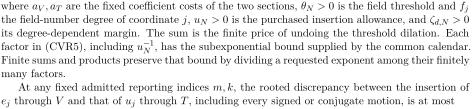
where aV , aT are the fixed coefficient costs of the two sections, θN > 0 is the field threshold and fj
the field-number degree of coordinate j, uN > 0 is the purchased insertion allowance, and ζd,N > 0
its degree-dependent margin. The sum is the finite price of undoing the threshold dilation. Each
factor in (CVR5), including u−1
N , has the subexponential bound supplied by the common calendar.
Finite sums and products preserve that bound by dividing a requested exponent among their finitely
many factors.
At any fixed admitted reporting indices m, k, the rooted discrepancy between the insertion of
ej through V and that of uj through T, including every signed or conjugate motion, is at most

Searchable transcription
Cd,m,kENe−sN/8,
Cd,m,k = exp{(am/ak)4τk + 5} a−d
k
ζd,k/4esk/8.
(CVR6)
Here is the explicit vacuum treasury derived in the denominator estimates above. These are fixed finite constants after the reporting indices are chosen. Expand any subexponentially priced coefficient row by (CVR2). The finite number of terms and their subexponential coordinates, together with (CVR5), absorb at most
 eventually. Thus the entire discrepancy has rooted bound tending to zero, with a remaining exponential factor
 . Its fixed stencil, gauge invariance and continuity make it eligible for the separated spectator product and smearing argument below. Let
 be the terminal coefficient isomorphism and
 the marked embedding of free labels into terminal coefficients. The calibrated equation image is exactly

Searchable transcription
KN,p = T PT −1B(Id).
(CVR7)
If , set
 . Then
 ). The actual insertion through
 with coefficient
 is therefore exactly zero against physically separated spectators on a sufficiently fine mesh, by the local marking identity. The uniform radius for that assertion was proved by the finite-basis maximum in the equation-lift construction. Formula (CVR3) preserves the subexponential price of
 , and (CVR6) compares this exactly silent insertion with the original insertion of
 . Consequently every subexponentially priced row in (CVR7) tends to zero against every separated test. This is the kernel cancellation used in (CV2) and (QD3); it follows from the actual calibrated map and a local identity, rather than from dimension counting alone.
18.11 Inclusions and derivatives on the same physical quotient
The differential system is constructed using all spectator tests on this quotient. Let be the finite coefficient space and
 the null subspace in (CV2). A test reading means: put the distinguished label at any chosen slot, put arbitrary other labels in all remaining slots, multiply the correlation
by a smooth compactly supported test whose support lies in the separated configuration space, and integrate. Denote it by ), including the spectator data in
 . The family of all these linear functionals has common kernel
 . For a smooth table this follows from uniqueness of continuous kernels as distributions on the open separated set; a nonzero value has a neighborhood and a compact bump detecting it.
At finite mesh , a derivative insertion is the actual forward difference

Searchable transcription
δaIb(o) = a−1
N {Ib(o + ea) −Ib(o)}.
(QD1)
In the finite torus sum, translating the distinguished summation variable gives the exact summationby-parts identity

Searchable transcription
a4n
N
X
r
ψ(aNr) ⟨δaIb(ri) spectators⟩= a4n
N
X
ψ(aNr −aNei,a) −ψ(aNr)
aN
⟨Ib(ri) spectators⟩.
r
(QD2) Translation is a permutation of the finite torus, so this is true even at its seam. Once the physical period contains the compact support and its one-step thickening, both potentially nonzero terms have their actual cover coordinates. Taylor’s theorem makes the test quotient converge uniformly to , on one fixed separated compact. The separated correlation bound controls the remainder in the cell integral. Take the mesh limit at that fixed suitable period first, and then the retained volume limit. This proves the derivative test limit in the same mesh-then-volume order as the hierarchy; no uniform count of lattice points over all periods is needed.

Searchable transcription
The coefficient approximations used for both inclusion and (QD1) have subexponential top-
coordinate cost: for every ε > 0, their pullback to the terminal frame is eventually bounded
by exp(εsN), where sN is the calendar scale. For bounded reference coefficients this follows by
multiplying the backward column bounds: their logarithm is P
i<N log Ci.
The calendar gives
log Ci ≤ε log Li/2 after a fixed level, so the tail is at most ε(sN −sk)/2; the finite head is absorbed
into εsN/2.
The relay estimates extend this cost statement to the actual inclusion and finite-
difference approximations.
Here is why their errors vanish against every test. A local rooted discrepancy bound with reporting spacing chosen arbitrarily small after fixing its requested tolerance, gives a separated correlation bound
 . Choose that reporting spacing below the physical separation, place the spectator insertions in distinct cells, and apply the reflection-positive product estimate, leaving the discrepancy in its own cell. Its compactly smeared sum is the integral of a step function, bounded by this quantity times the test supremum and the volume of one fixed enlargement of its support. Hence it tends to zero. This also applies to an exactly silent separated remainder with zero bound.
One must control approximations before assuming their coefficients bounded. Write for the finite projection and
 for an approximating coefficient. Normalize its null remainder by

Searchable transcription
zN,p = xN,p −PN,pxN,p
1 + ∥PN,pxN,p∥.
(QD3)
It lies in the finite projection kernel. The normalized projected part has norm at most one and therefore the subexponential cost just proved. Multiplication by the reciprocal denominator costs at most one, and subtraction preserves subexponential cost by spending 2 on each summand. The relay’s equation cancellation then gives
 0 for every test. This is precisely the normalized remainder required by the detector argument: it proves boundedness and recovery of the projected limit using the stable finite detector, without presuming boundedness of the unprojected approximant. The detector identifies its limiting responses with one vector in

Apply this recovery to an inclusion from horizon to
 , and to (QD1) from
 to
 + 1, first on a fixed basis of
 . Choose representatives of the recovered vectors and extend linearly. This gives linear maps
 and
 satisfying, simultaneously for all spectator tests,

 (QD4)
The same approximating coefficient family is used for every spectator; separate choices for different tests would not define a field. If , the right sides of both equations (QD4) vanish for every test, including the differentiated test, which still has compact separated support. Thus
 and
 . The quotient maps

 (QD5)
are consequently independent of the chosen representative. Their pointwise kernel identities follow from (QD4): inclusion gives equality of two continuous kernels, and integration by parts gives the ordinary derivative of the smooth kernel. Integration by parts is legitimate on the separated open set because the test support is a compact subset of that set. Extend the product of test and kernel by zero outside; it is smooth with compact support, so its total directional derivative integrates to zero.
Faithfulness against all spectators now proves every compatibility law. Inclusion is injective, since its zero class has exactly the same readings as its input. Inclusions compose and the identity inclusion is the identity, since both sides have identical readings. Differentiation commutes with inclusion, because it differentiates the same smooth kernel in either horizon. Two derivatives commute by the ordinary mixed-derivative theorem. The derivative of the unit is zero: the unit removes its insertion slot and the resulting kernel is independent of that coordinate. Permuting insertion slots transfers these identities from the distinguished first slot to every slot by the linear permutation chain rule.
Finally conjugation commutes with real directional differentiation. For a signed orthogonal motion , its coordinate derivative transforms by

Searchable transcription
∂b(f ◦s) =
X
a
sab(∂af) ◦s.
(QD6)
Apply the already established reality and signed covariance identities to the kernel, differentiate on the separated neighborhood, and use faithfulness again. It follows that the quotient inclusions commute with both symmetries and that the quotient derivatives obey (QD6). This establishes the differential structure on the actual null quotient used in reconstruction, with no extra representativedependent operation.
Source–readout formulation. This subsection is the central instance, for fields, of the method’s descent theorem. The source is the coefficient space of labels; the readout is the family (
 of all spectator readings; the equivalence it induces, Eq =
 , has classes
 ; and the physical field space is the image
 . Theorem 18.3 verifies that this equivalence is a congruence for the operations of the target (inclusion, differentiation, conjugation, signed motions), which is exactly what is required for the readout to determine an autonomous field calculus. Three kinds of non-canonical data occur and are kept apart: the projections
 choice of complement to a subspace; any other bounded symmetric choice gives the same quotient), the representatives
 (defined modulo
 ), and the column family
 (a presentation of the calibrated map). What is canonical, and what the lift recovers exactly, is the quotient with its operations. What is lost by the readout is precisely
 , and Proposition 18.2 identifies the

Searchable transcription
finite-cutoffshadow of that loss as the calibrated equation image (CVR7). In the frame realization
the insertions are gauge-invariant cylinders, so LZ
ψ = Lψ and NZ
d = Nd; the reflection quotient
theorem (Theorem C.1) then applies to the same classes.
The three formal statements used in this description are the following.
Lemma 18.1. is an idempotent with ker
 , signed and conjugation equivariant, with norm at most (CVP2) times the finite average of

Proof. The paragraph following (CVP3) proves that kills
 , that
 , and hence idempotence and the stated kernel. It also proves both equivariances by the finite group and real averages and gives their norm bound. The operator in the present statement is that same finite average, so those conclusions apply without a second projection choice.
Proposition 18.2 (Silence of the calibrated equation image). Every subexponentially priced row in tends to zero against every separated test.
Proof. For put
 ). The insertion through
 with coefficient
 is exactly zero against physically separated spectators on a fine enough mesh, by the local marking identity (with the uniform radius from the finite-basis maximum of the equation-lift construction). (CVR3) preserves the subexponential price of
 , and (CVR6) compares this exactly silent insertion with the original insertion of

Theorem 18.3 (Operations descend to the physical quotient). There are linear maps
 ) and
 with, simultaneously for all spectator tests,

Searchable transcription
Lψ(Kd,eb) = Lψ(b),
Lψ(Dd,ab) = −L∂i,aψ(b).

Searchable transcription
They map Nd into Ne and Nd+1, so

Searchable transcription
ιd,e[b] = [Kd,eb],
∂a[b] = [Dd,ab]
are well defined on , independent of representatives and of the choice of
 . Inclusions are injective, compose and are the identity for
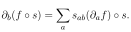
 ; derivatives commute with inclusions and with each other; the derivative of the unit is zero; conjugation commutes with real directional differentiation; and for a signed orthogonal motion

Searchable transcription
∂b(f ◦s) =
X
a
sab(∂af) ◦s.
Proof. Apply the recovery just described to a basis of , choose representatives of the recovered vectors and extend linearly; the same approximating coefficient family is used for every spectator. If
 both right sides of (QD4) vanish for every test (the differentiated test still has compact separated support), which gives the mapping of null spaces. The remaining laws follow from faithfulness: two classes with the same readings against all spectators are equal. For instance inclusion preserves all readings; differentiation in either horizon differentiates the same smooth kernel; mixed derivatives commute by the classical theorem; the unit removes its slot. Integration by parts is legitimate because the test is compactly supported in the open separated set. Slot permutations transfer the identities from the first slot.
Source: Shadow Theory and the Wilson Yang–Mills Construction: A Source–Readout Reconstruction. Both papers belong to one Zenodo record. No external funding.