measurable uniformly Cauchy functions have Cauchy probability integrals, since integral differences are bounded by uniform differences. Finite polynomial restoration preserves comparison by finite-dimensional continuity; the common positive unmarked denominator permits quotient limits. The lift retains these capture identities, masks and probability priors. Literal readout preserves the full-domain sup bounds and hence normalized fixed-level expectations without continuity across masks.
For the realized fixed-level readers, surjectivity of gives

Searchable transcription
sup
z |fn(π(z)) −fm(π(z))| = sup
U
|fn(U) −fm(U)|.

Searchable transcription
Thus uniform Cauchy comparison, including every fixed mask, is exactly preserved. Prior push-
forward recovers each coefficient integral and its uniform-difference bound. To state the quotient
step quantitatively, let Nn be an integrated restored coefficient and Dn ≥d∗> 0 its unmarked
denominator. If |Nn| ≤MN, then

Nn
Dn
−Nm
Dm
 ≤|Nn −Nm|
d∗
+ MN|Dn −Dm|
d2∗
.
The recovered numerator, denominator and lower bound are identical, so the same estimate transports the normalized limit. Section recovery returns the full-domain insertion functions before integration, with their fixed translation, conjugation and normalization. This establishes recovery of fixed-level expectations using the original masks and law.
15.23 Exact unmarked density and component regrouping
Fix a forest, probability Haar in its gauge coordinates and common output. Packed addresses record store, finite warning set and labelled lists. The prescribed store layout maps these to molecules; roster, warning ownership and lists give a left inverse, and recover every layout-admitted molecule. Omitted addresses have zero activity. Summable vertex tariffs bound finite-subset products by the exponential of their sum, justifying integration and finite boundary averaging. Restricting to the injectively encoded addresses preserves summability. Neutrality with fixed forest makes  = levy
 deducted
 independent of store/boundary replacement; each of
 boundary choices has tribute
 . Integrating the expansion and then summing the finite boundary choices gives the store’s exact cut entry. Full sector coverage yields

Searchable transcription
push(R; V ) = OX
X
p
receiptX(p).
This is a density relative to output probability Haar. Partition actual enlarged supports into connected components. Grounds are disjoint, and union reconstructs the molecule. Compatibility, exact flag coverage and component layout/eligibility/flag-read tests are equivalent to union approval: flags in another ground cannot enter a component. Plant output flags into component data and apply its own eligibility. Local data and selected regular keys agree on its ground with union data; locality and disjoint-ground independence, including boundary averages, therefore give

Searchable transcription
[
p∈A
p
= 1{compatibility,exact flag coverage}
Y
p∈A
aX(p).
receiptXFailed union approval either fails coverage or makes a component factor zero, so all zero cases are included. Union is the inverse of component decomposition; every compatible family outside the
image has zero contribution. Absolute reindexing proves

Searchable transcription
push(R; V ) = OX
X
A finite
1{compatibility,exact flag coverage}
Y
p∈A
aX(p).
Gaussian chart masses and kernel normalizers are positive; remaining scalar factors are exponentials or positive powers, hence 0. This extensive scalar remains outside the gas before coupling reset. The frozen data in this identity are the store and the boundary choice after the gauge slice is fixed; the threshold, width and selector belong to the fixed paid chart. The comparison of these expressions uses the common drafts, principal covariance matrices and Gaussian densities constructed earlier in this section, together with the bill and protected-mean comparison and the four vertex cases. For a marked product it uses the same comparison with its finite marker coefficient retained. The next subsection states how these addresswise comparisons pass through the common source, its products and the reset; the signed line estimate (LCN11) gives the corresponding parameter control. No varying discrete approval predicate is differentiated. In the realized record the frozen pair (store, boundary choice) is a column of the primitive datum of Section 13.24, and the change of background between compared expressions is the horizontal lift of Section 15.5. The lift retains address inverses, planted data and scalar normalization. Recovery preserves the component bijection and exact flag tests; absolute majorants justify reindexing and recover the unnormalized density identity. Let
 be the permitted packed-address set and
 the molecule addresses with nonzero receipt. Record the encoding
 and roster-reading inverse
 . On these data
 and
 ; discarded addresses carry the prescribed zero reader. The connected-component map and inverse union are another pair of discrete inverse readers, retaining warning ownership, ground incidence and exact flag coverage. Their realizations therefore recover these identities before summation. For the realized output readout
 , the retained absolute majorant permits the exact pullback

Searchable transcription
push(R; ·) ◦πc = (OX ◦πc)
X
A finite
(1permitted ◦πc)
Y
p∈A
(aX(p) ◦πc).
The scalar reader retains neutrality and the original boundary count, so its contributions are still
 and its positive extensive factor stays outside the gas. Section recovery returns the unnormalized density relative to the same probability Haar prior, including all coverage-failure zero cases. This supplies exact recovery of the address and component regroupings together with their normalization.
15.24 Comparison of the complete common source
Fix period, order and budget
 of order at most
 at the common temperature, with addresses and trial tori fixed first. Regular comparison means common sparse summable
 -seminorm envelopes and addresswise seminorm convergence; forced comparison uses uniform norms instead. These are stronger than pointwise comparison of the total action; the distinction permits the subsequent products and reset operations. Local Gaussian comparison along every healthy configuration/test sequence implies uniform derivative comparison by a violating-sequence argument. At fixed torus choose
 1+dist(
 ) and pay conversion
 by using tolerance
 . Sparse stream envelopes multiplied by
 remain valid. The forced stream uses order zero and its own sparse integral envelopes. In particular, the ultrafilter statements used to express local Gaussian limits here imply ordinary sequential convergence, since every free ultrafilter on every bad subsequence would give the same contradiction. Path terms have coefficients
 1 on low, cubic,

Searchable transcription
quartic and loop terms. Weighted path arrays compare and scalars have common bounded limits.
The identity
anFn −a′
nF ′
n = an(Fn −F ′
n) + (an −a′
n)F ′
n
preserves sparse envelopes and addresswise convergence. Frame transport and averaging cost fixed turnFee( ) Rim(
 ); divide tolerance accordingly. Thus the negative log stream and path terms give full regular-source comparison, with hard-source forced comparison on the same canonical enumeration. The enumeration used to place these terms in the common dictionary is the same for both histories. Finite trial panels eventually lie in one finite label set and cutoffs exceed all its labels, so panels agree. Removing selected regular terms and summing their site contributions preserves comparison with fixed selection weights. Trial pullback through the padded shape, of radius
 , maps a healthy neighborhood into the all-healthy trial torus and costs

Searchable transcription
M = 2B. order(1 + z)B. power B. order.
Use tolerance . Finite trial/site sums with fixed ray weights give ornament regular comparison and failed-trial forced comparison. Site correction is selected regular contribution minus its identity value minus failed trial. Healthy identity evaluation and subtraction give its uniform comparison. The complete source consists of unselected regular plus ornament, and original hard minus frame-averaged site correction, on common disjoint labels. The lift retains trial panels, padded maps, weights and enumerations. Recovery preserves these exact assemblies and fixed-parameter seminorm costs, recovering comparison of the labelled source rather than only its total function.
The complete-source reader retains each summand’s tag in the disjoint union: negative logarithmic stream, low/cubic/quartic/loop path term, unselected regular term, ornament, original hard term and site correction. Coefficientwise lifting preserves their scalar signs and finite frame weights. For a trial shape map , its recovered pullback is simply

Searchable transcription
(f ◦θ) ◦π = f ◦(θ ◦π).
The source domain retains the same healthy-neighborhood preimage, and section recovery returns the original trial reader. Its derivative bound therefore uses the same , while frame transport uses the same turnFee(
 ) Rim(
 ). The eventually common panel is kept as a fixed finite address set before removal or summation. Its identity-value reader is recovered at the identity section. Hence the selected-minus-identity-minus-failed site correction and the two complete-source parts are recovered term by term, with their original sparse envelopes and seminorm tolerances. The disjoint labels preserve comparison of the full source arrays through these assemblies.
15.25 Marked products through forced reset
A marked family ) has sparse bounds on
 and comparison of value and derivative along arbitrary configuration sequences at prescribed parameters. Compared unmarked logarithms become constant marked families. Their factors
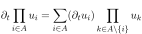
 1 compare by mean-value bounds on a common bounded interval, with a fixed exponential envelope multiplier. Extend all families by zero through the same embeddings. A forced atom is a finite product of these factors times the common eligibility indicator. The identity
Searchable transcription
∂t
Y
i∈A
ui =
X
i∈A
(∂tui)
Y
k∈A\{i}
uk
compares both atom and marked derivative. The shared zero-one eligibility factor preserves differences without continuity assumptions. Sparse product bounds control finite-subset sums; further
widening is the same zero extension. Evaluate at zero to obtain the forced marked-reset comparison, bounded by its marked envelope. The lift retains parameterized factors, shared indicators and embeddings. Recovery commutes with finite product differentiation and zero extension; sparse majorants preserve the summed comparison used in the two-history output limit.
For a fixed forced address , write its eligibility as
 ). The exact parameterized reader and its derivative are

Searchable transcription
HA(t, V ) = χA(V )
Y
i∈A
ui(t, V ),
∂tHA = χA(V )
X
i∈A
∂tui
Y
k̸=i
uk.
The recorded predicate is independent of . Composition with physical readout therefore commutes with this derivative at each fixed input; section composition recovers both expressions, including
 = 0. For the two histories the same
 multiplies their value and derivative differences, so its absolute value at most one preserves the comparison. The zero-extension maps retain each address and its inverse on the image. The sparse product majorant then controls the same summed readers after realization, giving exact recovery of the forced marked reset and its derivative envelope on the original configuration domain.
15.26 Analytic control of omitted insertion terms
One estimate needed in the continuum comparison is obtained by scaling all restored insertion errors with a single complex parameter. For holomorphic on
 2, bounded by
 Cauchy’s derivative estimate on radius-
 2 disks centered on [0
 1], each of which lies strictly inside the radius-
 disk, gives
 (IC1)

Searchable transcription
Retain the normalized moment
R (P(U))t d priorj(U)
Stampj,t(P) =
ZN
,
with the same original positive Wilson denominator at all levels. For served = restore(
 set
 ) = restore(
 ) and
 ) = Stamp
 )). Then
 , and
 (0) removes both errors. Retained estimates give holomorphy and integrability on
 = brisk(
 2, spending two exponent units without changing geometric support. Transport to fixed
 preserves served bounds and integration. Continuous finite-dimensional coefficient extraction commutes with that integral. The root estimate gives

Searchable transcription
|f(z)| ≤Bk,t := exp{| Sitek | treasuryk +n(x + y + 2)}
toll(wk, t)
.
Here counts insertion slots and the toll uses positive root weights. All volume dependence is at the fixed reporting level
 ; there is no exponential cost involving the increasingly fine level
 Applying (IC1) proves

Searchable transcription
| Stampj,t(P) −Stampj,t(restore(0, 0))| ≤
Bk,t
brisk(Bj)/2.
(IC2)
The lift retains error inputs, supports, common denominator and the actual transport chain. Recovery preserves their complex scaling and coefficient integrals, so (IC1)–(IC2) hold with the same reporting-level treasury and exponent margin.

Searchable transcription
The uniform omission estimate uses exact transport and the common analytic disk; it does
not require intermediate mixed-pin representations to converge. Explicitly lift the restored family
coefficientwise as bP(z) = LjP(z). The retained readout gives

Searchable transcription
R [ bP(z)]t dμZ
j
ZN
= Stampj,t(P(z)).
\
Stampj,t( bP(z)) =
This identity holds throughout the same open disk: the paid majorant supplies every integral and the recovered error scaling leaves masks and supports fixed. Its two endpoint values are recovered by the section. The actual finite retained-kernel composition preserves this entire scalar function while moving its bound to reporting level . Thus the holomorphic derivative estimate, endpoint difference and factor brisk(
 2 are identical after realization. The normalization reader keeps
 fixed, and the bound keeps the explicit
 Site
 cost. Recovery of (IC2) consequently uses the analytic family itself and its exact transport, with no additional convergence assumption on intermediate mixed-pin representations.
Source: Shadow Theory and the Wilson Yang–Mills Construction: A Source–Readout Reconstruction. Both papers belong to one Zenodo record. No external funding.