for smooth
 mass(
 depending only on
 , independently of chain length. The normalized finite-sum proof of the scalar lower estimate is retained in the cumulative-filter argument (QF1)– (QF4). At aliases
 lift(
 mass(
 ), inverse-linear coordinate decay of the principal factor and the extra upper bound give

Searchable transcription
| smoothv(ql)| ≤Cj
Y
a
(1 + | lift(l)a|)−j,
Searchable transcription
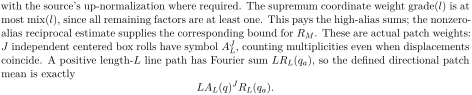
with the source’s up-normalization where required. The supremum coordinate weight grade(l) is at
most mix(l), since all remaining factors are at least one. This pays the high-alias sums; the nonzero-
alias reciprocal estimate supplies the corresponding bound for RM. These are actual patch weights:
J independent centered box rolls have symbol AJ
L, counting multiplicities even when displacements
coincide. A positive length-L line path has Fourier sum LRL(qa), so the defined directional patch
mean is exactly
LAL(q)JRL(qa).
Searchable transcription
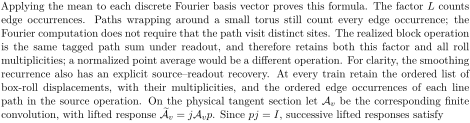
Applying the mean to each discrete Fourier basis vector proves this formula. The factor L counts
edge occurrences.
Paths wrapping around a small torus still count every edge occurrence; the
Fourier computation does not require that the path visit distinct sites. The realized block operation
is the same tagged path sum under readout, and therefore retains both this factor and all roll
multiplicities; a normalized point average would be a different operation. For clarity, the smoothing
recurrence also has an explicit source–readout recovery. At every train retain the ordered list of
box-roll displacements, with their multiplicities, and the ordered edge occurrences of each line
path in the source operation. On the physical tangent section let Av be the corresponding finite
convolution, with lifted response e
Av = jAvp. Since pj = I, successive lifted responses satisfy

Searchable transcription
(jA1p)(jA2p) = jA1A2p,
p e
Avj = Av.
Thus Fourier evaluation after recovery gives exactly the scalar smoothing recurrence above, with the same terminal value and mass recursion. Applying this equality to each finite Fourier basis vector recovers the patch mean, including , even on wrapping paths. The norm used for these smoothing bounds is the transported physical-section norm; the recovery does not add a bound on vertical frame directions. Scalar color-independent multipliers retain the original color identity factor. Hence neither source lifting nor recovery changes the smoothing stage, the alias coordinate, the history length independence of the bounds, or the occurrence counts.
11.5 Uniform reciprocals and carried residue differences
A real lower bound must be extended to a common complex collar before inversion. Suppose is holomorphic with
 on a complex cube of width
 and
 on the real cube of width
 , with
 0 and
 0. For

Searchable transcription
r = min(η/4, θ, cη/(8C)),
For in the width-
 cube, the radius-
 2 ball about
 stays in the original cube. Apply Cauchy’s estimate along the line from
 to
 , using
 on that ball. This gives
 2. Thus
 2 and the reciprocal is holomorphic and bounded by 2
 ) on a collar independent of
 . This proves the reciprocal step used for the scalar factors without inferring complex nonvanishing merely from real positivity.

Searchable transcription
With χ(z) = eiz −1, set
λM(p) =
X
a
[Mχ(pa/M)][Mχ(−pa/M)],
BM,L,l(p) = L2λM((p + 2π lift(l))/L).

Searchable transcription
On real momentum λM(p) = P
a |Mχ(pa/M)|2, and the bounds, uniform in M, are c2
−|p|2 ≤
λM(p) ≤c2
+|p|2. For l ̸= 0, choose a coordinate attaining grade(l). The source lower alias estimate
and holomorphic upper estimate are respectively (c−ζ)2 grade(l)2 and C grade(l)2, where grade(l) =
1 + maxa | lift(l)a|. The preceding lemma gives a common collar with |B−1
M,L,l| ≤C′ grade(l)−2. The
principal alias satisfies BM,L,0 = λLM and is not inverted on a collar containing zero.
Put mix(l) = Q
a(1 + | lift(l)a|) and decayj(l) = mix(l)−j. Then grade(l) ≤mix(l), so

Searchable transcription
grade(l)u decayj+u(l) ≤decayj(l).

Searchable transcription
Furthermore, 4 X X n∈Z (1 + |n|)−2 l mod L decay2(l) ≤ < ∞.
Centered representatives are injective, so each one-dimensional finite sum is bounded by the full integer series, and the finite four-dimensional sum factors coordinatewise. This proves the decay summation used in the earlier feed and high-alias estimates, without paying a factor equal to the number of residues. Hence no factor
 is paid. For
 0, the displayed absorption inequality follows by taking the
 th power of grade
 mix. A secured fine-difference word
 contributes
 grade(
 , its toll
 , and a uniformly bounded residue phase, because the residue coordinates have size at most
 and
 Im
 . Its symbol contributes decay
 ). For
 2 the residue sum costs
 . Alias permutation proves periodicity; reflection/conjugation gives real coefficients, and a narrower collar gives the priced Fourier rows. The regular coefficient and symmetry arguments supply these secured bounds for the actual pilot and wire symbols.
The scalar average bounds follow directly because extends with value
 and is nonzero on
 2: there is no zero on that disk because
 = 1 requires
 to be a real multiple
 . Compactness gives
 . Geometric summation yields
 min(1
 ) when
 2. For real
 with
 , finite centered sums give
 , then
 and 1
 , and
 ), whence
 1. This proves the principal lower estimate with leading constant one.
For centered nonzero alias , the chosen cube gives
 Im

 2, with
 4 and odd
 3. Separate the real shift 2
 from
 Re
 to obtain these inequalities. The identity
 ) gives
 2), hence inverse-alias decay. At
 = 0 the finite sum bounds
 by
 ; centering costs at most another
 Coordinate products supply the four-dimensional bound. The remaining alias work concerns the Laplacian denominator and the summation of the chosen decay weights.
For actual carried cross-row differences, write a fine site as centered residue and coarse displacement. A positive step has carry
 exactly at lift(
 , and zero otherwise. The identity lift(
 ) = lift(

introduces the phase in the advanced residue. Subtracting the original gives the alias multiplier
 1; iteration gives the product for any word of fine differences. Fourier inversion identifies the priced symbols with these actual carried differences. This identity follows from the real
sums, rather than treating a residue wrap as an ordinary shift within the same copy. Intersecting the finitely many widths for words of length at most 2 and enlarging their costs gives one table with cross-row bound
 , uniform over flights at the fixed smoothing indices. The regular coefficient bounds and inverse-third-power estimate below provide the analytic bound for these secured symbols. The lift retains the same residue and carry records, so it does not turn wrapping into an uncarried shift or invert the excluded principal zero.
11.6 Laurent exterior division
Set 1 and let
 be exterior multiplication by
 on degree-
 forms. For a lattice monomial
 sets its
 -coordinate to zero. Define
 by summing the monomials with that coordinate 0
 1 for
 0, and minus those with coordinate
 1 otherwise, retaining the other coordinates. Telescoping gives

Searchable transcription
qsJsex = ex −Esex.
Searchable transcription
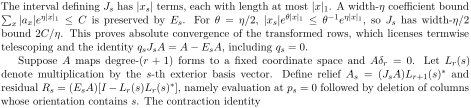
The interval defining Js has |xs| terms, each with length at most |x|1. A width-η coefficient bound
P
x |ax|eη|x|1 ≤C is preserved by Es. For θ = η/2, |xs|eθ|x|1 ≤θ−1eη|x|1, so Js has width-η/2
bound 2C/η. This proves absolute convergence of the transformed rows, which licenses termwise
telescoping and the identity qsJsA = A −EsA, including qs = 0.
Suppose A maps degree-(r + 1) forms to a fixed coordinate space and Aδr = 0.
Let Lr(s)
denote multiplication by the s-th exterior basis vector.
Define relief As = (JsA)Lr+1(s)∗and
residual Rs = (EsA)[I −Lr(s)Lr(s)∗], namely evaluation at ps = 0 followed by deletion of columns
whose orientation contains s. The contraction identity

Searchable transcription
Lr+1(s)∗δr+1 = qsI −δrLr(s)∗,
δr(p) = δr(p|ps=0) + qsLr(s)
gives : multiply by
 and cancel where nonzero, then extend by continuity to its zero hyperplane. Also
 = 0 by exterior nilpotency. Apply the four axes in order to the preceding residual. Columns containing a processed axis vanish thereafter, and a previously zero column remains zero. Since every positive-degree orientation contains an axis, the final residual is zero. Adding reliefs gives
 with positive analytic width and finite explicit losses, uniform over every family with a common input coefficient bound. Evaluation gives
 on every period. Conversely all-period identities give the symbol cycle by Fourier uniqueness; one period alone is insufficient.
Transposition gives the corresponding left lift. For the two-sided lift of a two-form row retain both all-period cycle conditions = 0 and

 = 0. First choose

 , put
 and lift


 . Here
 has degree-four target. The top-degree left-cycle argument gives
 = 0, since

 = 0 and the next exterior space is zero. Right-lift
 to
 . Then

 obeys

 . A final right lift
 gives

 . Every operation is a finite composition of these analytic lifts, exterior derivatives, sums and transposes, hence preserves familywise exponential coefficient decay. This is the exterior
factorization used for the fund; refined block-length powers remain separate quantitative estimates. Under the source readout, exterior operators and their ordered compositions use the transported section. No pointwise quotient by at zero is introduced, and the two-sided correction is retained rather than replacing it by an arbitrary one-sided lift. The recovery can be expressed degree by degree. For the original degree-
 coordinate space
 , use its declared source section
 and readout
 , with
 . On a form space with no redundant frame coordinates

Searchable transcription
these can be the identity; on the potential space they are the tangent maps already constructed.
Put
edk = jk+1dkpk,
eB = j3Bp3,
eA = j2Ap2.

Searchable transcription
Use the transported section inner products for adjoints.
Then the ordered source composition
satisfies
ed †
2 eB ed2 = j2(d∗
2Bd2)p2 = eA,
p2 eAj2 = A.
Here is the section adjoint, and the equality is on the declared sections. The coefficient operations
 act before realization on the same Laurent coefficient arrays, retaining every orientation and signed interval. Recovery therefore returns their termwise telescoping identities, including the zero hyperplanes. The section norm is transported from the physical coordinate norm, so the coefficientwidth losses and their familywise uniformity are unchanged. This provides an explicit recovery of the two-sided factorization and does not assert coercivity or an adjoint identity in unused vertical directions.
11.7 Regular two-form metrics and precision-preserving amendment

Searchable transcription
For a train v of scale M,
the real-momentum factors za below are nonnegative.
Set
za = seedQM(p, a) seedQM(−p, a) and λM
= P
a za.
Retain h0 = halo(v), la = lid(v, a),
ra = drain(b, v, a) and

Searchable transcription
z(1)
a ra
laga
.
ga = la + λMra,
h = h−1
0
−
X
a

Searchable transcription
Here z(1)
a
is the same factor at scale one. The identity z(1)
a h0 = zala gives, by common denominators,

Searchable transcription
λMh =
X
a
z(1)
a /ga.
(Q2)
The vault diagonal on orientation is
 and pulse is its reciprocal, with off-diagonal entries zero. Their analytic definitions give
 (0) = 1, without a separate harmonic replacement. On the real cube
 0 imply
 , Q2 and the Laplacian comparisons imply


 ) away from zero, and at zero
 = 1. The joint lower bound is
 min(1


 0. Thus both metrics are real diagonal positive mutual inverses. Uniform bounds and positive lower bounds for
 give bounds for their reciprocals and finite products on a common smaller holomorphic collar. Taking Fourier coefficients gives exponentially decaying metric and inverse

Searchable transcription
rows.
Away from zero, Da = ga/λM and ρ = P
a z(1)
a /Da = λ2
Mh give vault = ρ mask2(Da) and pulse
= ρ−1 mask2(D−1
a ). Agreement under reciprocal-lattice shifts on overlaps of real coordinate cubes
follows from the periodicity of Da and ρ in these representations; the filled g, h expressions extend
At the top train Da = λ−1
and ρ = λ2
through the apparent pole.
1, giving identity two-form
1
symbols and the bare Wilson precision.
The centered-average, nonzero-alias and cumulative-filter estimates supply the smoothing, remainder and scale-uniform Laplacian comparison bounds used in Q2. The part of the analytic bound that accounts for arbitrarily long histories is the nozzle weight. Let ) be the sum of mass
 over the nozzle list. Each old mass is multiplied by
 under a hop and a new mass-one train is added. Thus long histories are controlled by the nozzle weight recurrence
 (top) = 0,
 (hop(
 ). Since
 3, induction gives
 2: from
 2 the next value is at most 1 + 2
 2. Each feed costs at most
 mass
 , so levelNoise costs at most 2
 independently of depth; in particular, the constants do not accumulate one unweighted term per renormalization
step. For 4 high-alias smoothing decay times the inverse-square grade divisor is dominated by the summable order-two reference decay. The finite alias sum has a bound independent of its side length, using the alias rail, inverse-divisor and reference decay-sum estimates; their scalar formulas are derived in the cumulative-filter construction (QF1)–(QF9) below. This gives the feed mass bound and, with
 levelNoise, the drain bound. The lid is the product of the drive at
 and
 . Positive smoothing and rail lower bounds therefore give a positive lid lower bound, and similarly a positive halo lower bound; bounded drain and
 bound
 above. The rational expression for
 then has only uniformly separated denominators. No bound on 1
 at zero is used.
For the unamended metric and
 set

Searchable transcription
X = d2B,
A = B + lX∗X,
G = A−1,
R = I + ld2Bd∗
2,
D = R−1,
l ≥0.

Searchable transcription
On every finite torus H, B are symmetric positive matrices. The supplied pledge, amend, bail and
treble rows represent A, G, R, D, respectively. Positivity gives A > 0 and R ≥I, so their analytic
inverses G and D exist with uniform narrower strip bounds. Exterior nilpotency gives XHd1 = 0,
hence AHd1 = d1, Gd1 = Hd1 and
d∗
1Gd1 = d∗
1Hd1.
The amendment changes the extension on two-forms while preserving the potential precision. Also  implies
 . At zero
 = 0 and
 give

The inversion applies to both and
 . Uniform inversion is in fixed orientation dimension
 , independently of the site count:
 gives
 det
 and

 by diagonalization. Analytic coefficient bounds control the determinant change from the real slice; choose a common smaller collar losing at most half its positive real lower bound. Adjugate over determinant gives a uniformly bounded holomorphic inverse, preserving periodicity and real coefficients. Fourier decay and discrete evaluation give the inverse at every period. All spectral bounds transfer with the discrete Fourier Gram factor
 , which cancels from both sides, including at side one.

Searchable transcription
To recover the metric and its inverse without confusing forms with responses, retain the degree-
two section maps j2, p2. The metric form on redundant coordinates is H = p∗
2Hp2; its null space
is ker p2 because H > 0. Its restriction to the section is positive, with j∗
2Hj2 = H. The inverse
response on that section is eB = j2Bp2, so p2 eBj2 = B. Using the transported section inner product,
the amended source responses are

Searchable transcription
eA = j2Ap2,
eG = j2Gp2,
eA eG = eG eA = j2p2.
Thus their product is the section identity; it is not an asserted inverse on redundant vertical Recovering the precision identity gives exactly
 directions.
 The origin value, finite-torus inversion and all physical-section spectral bounds survive because the readout and section compositions recover their original matrices. The analytic and history estimates above continue to concern the original orientation-sized symbols before realization, preserving their period independence.
For constant-curvature transport, an ordinary Laurent row has spatial sum its zero symbol. Installed responses additionally depend on the initial residue. The duo response has at every residue the same zero entry toll( : nonzero aliases vanish and the principal alias is normalized. For orientation-valued total sums
 of rows
 , absolute convergence gives total sum
 for their convolution, in that order. Sandwiching this response by the fine inverse and coarse metric therefore preserves residue-independent spatial sums, establishing travels_route, the travels property used
in neutral propagation. The regular wire formulas and their explicit harmonic values supply the alias vanishing and normalization. For an installed cross row, the starting site also has a residue modulo the block length. The lift retains these orientation/residue records and the exact precision identity; equality on curls is not promoted to equality of arbitrary two-form extensions.
11.8 Defect factorization and finite-horizon assembly

Searchable transcription
On a coarse torus set V = B1−T ∗B2T −b−1d1d∗
1 and M = H1V H1, where Bi = H−1
i
, the subscript
one denotes coarse data, two denotes fine data, T is the installed response, and b > 0. The actual
stationary identities

Searchable transcription
TH1d1 = H2e1A0,
T ∗e1 = d1Q,
QA0 = I −b−1d∗
1H1d1
give the explicit intermediate identity

Searchable transcription
T ∗B2TH1d1 = d1[I −b−1d∗
1H1d1],

Searchable transcription
and hence V H1d1 = 0. Thus Md1 = d∗
1M = 0, and the two-sided analytic lift gives d∗
2Fd2 =
M.
Replace F by (F + F ∗)/2, retaining the identity and making its real symbols Hermitian.
Multiplication by B1 on both sides gives

Searchable transcription
V = (d2B1)∗F(d2B1).
This is the fund used in the positive correction. Similarly annihilates
 , because

 and
 = 0; hence a right lift gives
 . Analytic losses remain paid through the two exterior lifts, symmetrization and the surrounding bounded rows. The refined fine-difference estimate supplies the inverse-third-power residue price and, after summation, the separate
 estimate on
 ; algebraic factorization alone does not supply that power.
Choose the retained-support stage data before eventual block lengths. For legal neighbors  4 with
 or
 , the flight gives a coarse-floor threshold
 ). Taking
 max(
 )) pays both incoming possibilities. With fine and coarse parameters
 fixed, each legal pair supplies its positive analytic width, positive coercivity parameter, cost and integer block threshold. At each stage also choose the positive clip cap and bottom metric estimates. For the bottom and two outgoing possibilities take minima of positive widths/coercivities and maxima of costs/length demands. Weakening these bounds preserves each estimate. Backwards from the terminal train construct
 as each prescribed landing train, choose its metric bed with
 )) and its specified duo tower. The identity
 = land(destination(
 )) aligns those choices. The fixed penalty is the same in the chosen tower. Tangent flight equations give the primal and dual stationary identities on every scheduled finite torus; the rebased equation gives the associated inverse and error data. Bottom and transition bounds together with terminal normalization form the linear horizon. Pinning arranges the additional horizon conditions for the given sheet profile while retaining the beds and required tower components, hence retains the destination equalities and supplies Present and H.Suffices. This finite assembly uses, rather than replaces, the bottom, flight and pinning analytic estimates; these are proved in the harmonic, positive-margin and auxiliary-tower arguments of this section (Subsections 11.9, 11.11 and 11.12), and the common price table is assembled from the metric, positive-margin and flight estimates established there.
11.9 Harmonic values and Fourier normalization
At = 0 exterior signals vanish, bulb and bend are one, and principal patch multipliers are identity, giving filled pilot and wire value
 . At each nonprincipal alias of zero, a nonzero residue coordinate
has (0) = 0 with
 = 0. Its positive-power box filter vanishes. The pilot leading term contains
 = 0, and its correction contains the zero coarse longitudinal row. The wire’s first term contains the zero coarse adjoint derivative, while its second contains the vanishing flux. These explicit values prove the harmonic symbol equations without deleting that fibre. If
 and
 , taking adjoints and multiplying gives
 ]. Equal representations imply equal real matrices by invertibility of
 Products and differences transfer to products and differences of the symbol matrices whenever the intermediate Fourier matrices coincide. Equality follows because the difference of the represented real matrices annihilates the invertible matrix
 . For coarse side
 , the Gram scalar is
 ; for fine side
 . Their ratio is

 . The block mean itself carries
 , so its transpose mean alias column is
 ), while installed
 columns are
 pilot
 wire
 . The fine derivative is
 and precision
 . Restoring these factors gives

Searchable transcription
QfA0 = mean∗Qc,
mean A0 = I −b−1Qc,

Searchable transcription
T ∗df = dc mean,
THcdc = HfdfA0.
The residue sum represents the alias Fourier matrix times the stacked column, and evaluation at each coarse discrete frequency, followed by invertibility of the finite Fourier matrices, proves the real identities at every period. Together with amended-metric preservation and pinning, these supply the linear horizons for the flat entrance estimate. The cumulative-filter section supplies the scalar covariance feedback and train identities used here. The lift retains harmonic values, residue installation and Fourier Gram scalars together. It therefore recovers these finite-horizon equations with their actual normalization, rather than only a punctured-momentum surrogate.
11.10 Scaled stationary columns

Searchable transcription
Use q(S)
a
= S(eipa −1), d(S)
r
= q(S)∧and the analytic adjoint δ(S)
r
(p) = d(S)
r
(−p)⊤, equal to the
Hermitian adjoint on the real slice. The patch identity Fr+1(ql)d(L)
r
(ql) = dr(p)Fr(ql) follows coor-
dinatewise from RL(ql,a)q(L)
a
(ql) = qa(p). Transposing at −p gives its dual, and exterior nilpotency
holds identically.
At regular momentum set D = diag(S−2Da), ID = D−1 and α = S4ρ. The two-form metric
symbol is α−1 mask2(diag ID). Expanding its weighted wedge contraction gives

Searchable transcription
K = ID −α−1IDd(S)
0 δ(S)
0
ID.

Searchable transcription
The diagonal contraction is P
a q(S)
a (−p)(ID)aaq(S)
a (p) = α, and the remaining terms are the dis-
played rank-one product. With P = α−1δ(S)
0
ID, C = α−1IDd(S)
0
this yields

Searchable transcription
K = ID −IDd(S)
0 P,
KD = I −Cδ(S)
0
,
DK = I −d(S)
0 P,
with 0
 0

Write for the fine diagonal covariance at alias
 for its two-form pulse and
 for its potential precision. Let
 denote the coarse analogues,
 the patch multipliers,
 their duals and
 the coarse longitudinal row. Retain

Searchable transcription
El = m(−ql) tr Dl
Z
,
Z =
X
l
|m(ql)|2 tr Dl.

Searchable transcription
On the punctured real cube the principal summand is strictly positive and all summands nonnega-
tive, so Z ̸= 0 and P
l Elm(ql) = 1. The covariance recursion is P
l F1DlV1 = Dc −b−1I. Thus the
actual pilot
Al = DlV1Kc + Eld(L)
0 Pc

Searchable transcription
obeys the averaging equation by multiplying by F1 and summing. The hinge identity turns the
second term into (P
l Elm(ql))d0Pc = d0Pc. Consequently
X

Searchable transcription
l
F1Al = (Dc −b−1I)Kc + d0Pc = I −b−1Kc,
using . Also
 : nilpotency kills the longitudinal term and
 0
 kills the rotor correction. Set
 in the following wire calculation. Its identities are
 ) = 0 and
 = 0. The actual wire is

Searchable transcription
Tl = Hld(L)
1 DlV1δ1 + ylV2(I −C),
Searchable transcription
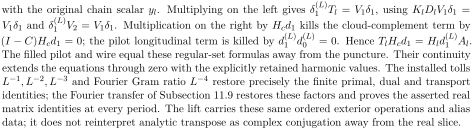
with the original chain scalar yl. Multiplying on the left gives δ(L)
1
Tl = V1δ1, using KlDlV1δ1 =
V1δ1 and δ(L)
1
V2 = V1δ1. Multiplication on the right by Hcd1 kills the cloud-complement term by
(I −C)Hcd1 = 0; the pilot longitudinal term is killed by d(L)
1 d(L)
0
= 0. Hence TlHcd1 = Hld(L)
1 Al.
The filled pilot and wire equal these regular-set formulas away from the puncture. Their continuity
extends the equations through zero with the explicitly retained harmonic values. The installed tolls
L−1, L−2, L−3 and Fourier Gram ratio L−4 restore precisely the finite primal, dual and transport
identities; the Fourier transfer of Subsection 11.9 restores these factors and proves the asserted real
matrix identities at every period. The lift carries these same ordered exterior operations and alias
data; it does not reinterpret analytic transpose as complex conjugation away from the real slice.
11.11 Positive extension and the complete tower Gram identity
Suppose the analytic Hermitian three-form symbol obeys
 on real momenta. This controls every vector at zero: for a complex three-form
 , the real-linear map
 from
 to the complex one-dimensional top space has a nonzero real kernel vector
 . Exterior contraction gives
 . Since
 , the vectors
 ) converge to
 . Apply the assumed image inequality to these vectors and pass to the limit; continuity yields

Increase its analytic coefficient bound 0 to a positive number if necessary. With
 and
 the fixed orientation constant, choose
 ). The departure estimate bounds each entry of
 , and hence gives
 2 when every
 . Else choose
 with
 and decompose

Searchable transcription
x = y + z,
y = d2(q−1
k ιkx),
z = q−1
k ιkd3x,
∥z∥2 ≤Nδ−2∥d3x∥2.
With , the quadratic form first obeys

Searchable transcription
⟨x, Qx⟩≥v∥y∥2 −2M∥y∥∥z∥−M∥z∥2.

Searchable transcription
The cross-term estimate then gives ⟨x, Qx⟩≥(v/2)∥y∥2 −(M +2M2/v)∥z∥2. Since ∥x∥2 ≤2∥y∥2 +
2∥z∥2, adding
rd∗
3d3,
r = (M + 2M2/v + v/2)Nδ−2
Source: Shadow Theory and the Wilson Yang–Mills Construction: A Source–Readout Reconstruction. Both papers belong to one Zenodo record. No external funding.