Integral, residual and limit transport

Searchable transcription
For each tagged finite lattice λ, let πλ and σλ be the maps above. The tag includes every source
parameter used by the operation. An insertion Fλ has lifted representative F Z
λ = Fλ ◦πλ. Coeffi-
cients, support labels, multiplicities and histories remain attached to this representative; equality
of functions alone is not permission to discard those records.
Theorem B.1 (Exact transport of tested limits). Suppose the supplied construction forms a scalar tested quantity

Searchable transcription
Iλ =
Z
Fλ dμλ

Searchable transcription
on its stated integrability domain. Then IZ
λ = Iλ at every tag. Every convergence assertion, Cauchy
estimate, uniform bound or iterated limit for these quantities therefore holds for their lifted repre-
sentatives with precisely the same index set, quantifier order and constants. The same statement
applies componentwise to finite-dimensional coefficient vectors and to distributional limits tested on
the original test class.
Searchable transcription
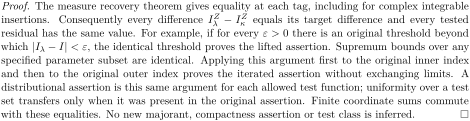
Proof. The measure recovery theorem gives equality at each tag, including for complex integrable
insertions.
Consequently every difference IZ
λ −IZ
κ equals its target difference and every tested
residual has the same value. For example, if for every ε > 0 there is an original threshold beyond
which |Iλ −I| < ε, the identical threshold proves the lifted assertion. Supremum bounds over any
specified parameter subset are identical. Applying this argument first to the original inner index
and then to the original outer index proves the iterated assertion without exchanging limits. A
distributional assertion is this same argument for each allowed test function; uniformity over a test
set transfers only when it was present in the original assertion. Finite coordinate sums commute
with these equalities. No new majorant, compactness assertion or test class is inferred.
A source operation with input space , output space
 and map
 has the canonical section representative
 More generally, relations are lifted by retaining all target branches and their original tags. A target residual
 is represented by
 , so its zero and nonzero values are both preserved. For a composable finite chain, insertion of
 proves the whole-chain readout identity. These identities provide recovery for operations already defined by the supplied construction; they do not replace its definitions or derivations, which must also be preserved in the complete correspondence.
In particular the original full mesh limit at a suitable fixed period is retained before its outer refined-period limit. Auxiliary compact extractions retain their actual refinement maps and common insertion tokens. This theorem does not turn a subsequential statement into a full limit, nor does it identify different phase choices. A common positive denominator is carried through numerator and denominator together; a normalized equality is not obtained by cancelling unrelated
partition functions. Hard masks and health indicators remain measurable insertion data on their original domains. No derivative of such an indicator is licensed by integral transport.
For parameter derivatives the equality is differentiated only on the source’s actual differentiability domain, with its given domination or finite-dimensional smoothness hypotheses. Moving-frame derivatives use the horizontal formula already proved. For infinite sums the original absolute majorant or other stated convergence mechanism is retained before passing the operation through the sum. Thus the map preserves quantitative estimates while leaving every analytic warrant at its original location in the dependency chain.
Source: Shadow Theory and the Wilson Yang–Mills Construction: A Source–Readout Reconstruction. Both papers belong to one Zenodo record. No external funding.