Feedback and Robust Local Readout of a Fixed Four-State Quantum Source
Robust readers: a convex-hull theorem and a global copy lower bound
Robust readers: a convex-hull theorem and a global copy lower bound
We remove the repeated-angle restriction at one and two copies. The larger-horizon robust optimum remains unresolved; no fixed-angle optimum is silently promoted to it.
A general antipodal composite-source theorem
Let be a nonempty compact subset of the equatorial Bloch disk. A hidden
 and sign
 are fixed throughout an experiment, and the source supplies independent copies of
 The reader cannot inspect the source label or nuisance register. On each copy it may choose any equatorial projective direction, followed by independent sign-blind erasure of fixed unknown efficiency
 1. It must decide
 at a fixed deadline, retaining all settings and nulls. Randomized policies and arbitrary terminal decision rules are admitted. The worst error takes a supremum over
 ), without imposing a nuisance prior. Let
 be the closest point to the origin in conv
 and
 . Compactness ensures existence. The supporting-plane property is

 (1)
Theorem 6.1 (Global robust equality through two copies). In this complete equatorial policy class, the adaptive and randomized nonadaptive minimax values at horizons one and two are exactly

Searchable transcription
e1 = 1 −η0m
2
,
e2 = 1 −η0(2 −η0)m
2
.
For , repeating the single direction
 and deciding by majority of nonnull signs with a fair tie attains both values. For
 , an uninformed fair decision attains
 and neither class improves it. The same statement for a general three-dimensional Bloch set requires full Bloch-sphere projective access, not merely the equatorial menu.
Proof. The minimum-distance projection inequality gives (1), so measuring has target-aligned bias at least
 on every admitted source. At one copy its worst error is at most (1
 2. At two copies majority with a fair tie has sign bias
 whenever at least one copy survives erasure, giving the stated upper bound. These bounds are valid for unknown fixed
 and unknown fixed
 , and use one controller policy for all their values. For the lower bound, choose a finitely supported distribution
 on
 with barycentre
 ; planar Carathéodory gives at most three support points. This distribution is a mathematical least-favourable comparison, not a new prior assumed by the robust protocol. Choose a fair source sign and efficiency
 . Each sampled
 remains fixed for all copies. Define the two conditional target mixtures

Searchable transcription
Ω(n)
s
=
∫︂
S
ρ⊗n
s,r dμ(r).

Searchable transcription
At one copy Ω(1)
+ −Ω(1)
−= z · σ, whose trace distance is m. At two copies, expanding each tensor
product gives
Ω(2)
+ −Ω(2)
−= 1
2{(z · σ) ⊗I + I ⊗(z · σ)}.
(2)
Searchable transcription
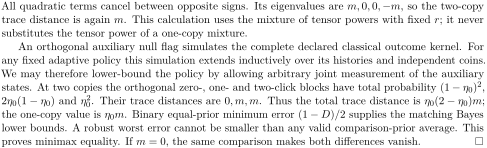
All quadratic terms cancel between opposite signs. Its eigenvalues are m, 0, 0, −m, so the two-copy
trace distance is again m. This calculation uses the mixture of tensor powers with fixed r; it never
substitutes the tensor power of a one-copy mixture.
An orthogonal auxiliary null flag simulates the complete declared classical outcome kernel. For
any fixed adaptive policy this simulation extends inductively over its histories and independent coins.
We may therefore lower-bound the policy by allowing arbitrary joint measurement of the auxiliary
states. At two copies the orthogonal zero-, one- and two-click blocks have total probability (1 −η0)2,
2η0(1 −η0) and η2
0. Their trace distances are 0, m, m. Thus the total trace distance is η0(2 −η0)m;
the one-copy value is η0m. Binary equal-prior minimum error (1 −D)/2 supplies the matching Bayes
lower bounds. A robust worst error cannot be smaller than any valid comparison-prior average. This
proves minimax equality. If m = 0, the same comparison makes both differences vanish.
This establishes a concrete interface where feedback and additional settings are unnecessary: through two copies, the closest point of the positive-target Bloch hull supplies a sufficient robust reader direction. It is a statistical decision result, not complete retained-instrument identification. Correlated accessible preparation records, a readable purifier, non-independent copies or a different erasure parent change the task. The trace-distance decision principle is established quantum theory; the composite-source cancellation and its application to the specified reader task are proved here.
Applying the theorem to asymmetric fixed calibration
The preceding detector kernels have the following equivalent statistical Bloch set for a positive sign:

Searchable transcription
S = {g(cos δ, −sin δ) : g ∈[a, 1], |δ| ≤∆} ∪{g(sin δ, cos δ) : g ∈[b, 1], |δ| ≤∆}.Indeed the X source gives cos
 ) and the Y source gives
 sin
 ) when paired with
 Absorbing fixed nuisance into this set is a representation of the admitted classical kernels and decision risks. It neither identifies complete residual channels nor makes the nuisance accessible to the controller. Define
 cos ∆
 sin ∆)

 sin ∆
 cos ∆)

They are admitted positive-target vectors: choose gain floors, with = +∆on X and
 For the lower-bound prior this nuisance is correlated with the fixed hidden axis, and remains fixed throughout that experiment. This is allowed in the supremum over source label and nuisance; it is not a per-node adversary or a claim that a physical random calibration law follows that prior. Put
 sin 2∆. The closest point on their segment is

Searchable transcription
z = pu + (1 −p)v,
p =
b2 −c
a2 + b2 −2c,
∥z∥= m∗=
ab cos 2∆
√
a2 + b2 + 2ab sin 2∆.
Here 0 1, and
 . The preceding optimized direction has signal at least
 on the whole uncertainty set, so the supporting-plane inequality also holds for all its other admissible vectors. Consequently
 is closest in the whole hull, not only this segment. The global robust optima are therefore


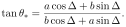
over every continuous equatorial adaptive or randomized nonadaptive reader. No common-positive restriction on competitors remains at these horizons. The attaining reader retains the robust angle
Searchable transcription
tan θ∗= a cos ∆+ b sin ∆
b cos ∆+ a sin ∆.

Searchable transcription
For η0 = 4/5, a = 9/10, b = 4/5, tan ∆= 1/100, one obtains p = 654464/1478945, m2
∗=
129574081296/369773223625 and errors approximately 0.26321655725 and 0.21585986870. These are
global small-horizon values, not a claim about the one-percent threshold or unrestricted collective
readers in a different physical parent.