Feedback and Robust Local Readout of a Fixed Four-State Quantum Source
Local-effect certificates for larger copy budgets
Local-effect certificates for larger copy budgets
Retaining local partial-transpose invariance gives exact all-angle comparison bounds without enumer-ating a continuum of policy trees. The relaxation is a lower-bound device, not a physically available collective reader.
Which effects every admitted reader produces
Rotate the original equatorial plane to the real X/Z Bloch plane. This is a mathematical common basis choice, not a new source preparation or accessible reference. A local outcome effect is then a real symmetric 2 2 matrix. For a fixed adaptive history, its joint probability on independent copies is computed by a tensor product of those effects. Although the direction on a later copy depends on earlier outcomes, each complete-history effect remains such a product. The effect
 for terminal decision plus is the sum over its histories and ready-coin branches, so

Searchable transcription
0 ⪯E ⪯I,
EΓA = E
for every subset A of copies.
Here Γ transposes the local tensor factors in
 The assertion requires classical feedback and destructively measured separate copies, as in the admitted model. It does not cover a coherent
returning controller, retained quantum memory that jointly interacts with later specimens, or an arbitrary collective measurement. Condition on an entire sign-blind erasure pattern. Its probability is independent of the fixed source label and measurement directions. Granting that pattern in advance is a permissible lower-bound relaxation. With nonnull copies, all resulting terminal effects still have the displayed properties. Null histories may guide the controller but do not reveal the source. No click postselection is performed in deployment: final bounds average over all patterns, including the all-null record. Let Ω
 be the two comparison target mixtures on these
 copies, and put ∆
 Ω
 . In both applications below they are real mixtures of fixed-source tensor powers and are permutation invariant. A formal permutation average of
 preserves positivity, partial-transpose invariance and Tr
 claim that every such averaged effect is locally attainable is needed. Global sign reversal is conjugation by
 , under which ∆
 changes sign. Replacing
 by

Searchable transcription
1
2{E + I −Y ⊗nEY ⊗n}
again preserves the relevant constraints and objective. Thus the actual reader’s correlation is bounded by a relaxation with the following exact parameterization.
Lemma 7.1 (Odd symmetric real Pauli representation). Let be the sum of all distinct tensor strings with
 copies of X,
 copies of Z and
 copies of I. Every permutation-and local-transpose- invariant terminal effect, after the sign symmetrization above, has form

Searchable transcription
E = 1
a+b odd
yabBab,
|yab| ≤1
2I +
∑︂
2.
Only pairs occur. Its positivity is equivalent to positivity of its ordinary qubit Schur blocks and their complements.
Proof. A Pauli string containing Y changes sign under transpose on that factor. Invariance under every local transpose therefore eliminates all such coefficients. Permutation invariance makes the remaining coefficient depend only on the X and Z counts. Sign symmetrization removes every even-degree nonidentity string and fixes the identity coefficient to 1 2. Orthogonality of individual Pauli strings gives
 Tr
 ) for any one string
 of those counts. Because
 is traceless with equally many +1 and
 1 eigenvalues and 0
 , its absolute trace pairing is at most 2
 . This proves the coefficient bound. The Schur transformation is unitary; positivity is therefore equivalent to positivity in all irreducible blocks.
Permutation and partial-transpose invariant discrimination relaxations are established methods[3]. The present contribution is their explicit grouped-target/fixed-nuisance application and the rational certificate interface below. The representation is a calculation of an operator relaxation, not a quantum memory resource construction.
Exact block generation without an exponential tensor matrix

Searchable transcription
Use the generating identity
(I + xX + zZ)⊗n =
∑︂
a,b
xazbBab.
In the Schur sector , put
 . The block is

Searchable transcription
(1 −x2 −z2)K Syms
(︄
1 + z
x
x
1 −z
)︄
.

Searchable transcription
This follows from the simultaneous determinant/symmetric-power qubit representation; the normalized
Dicke basis is essential. In row k, column l, the polynomial before multiplication by the determinant
factor is
√︄(︁s
k
)︁
(︄
k
q
)︄(︄
s −k
l−q
)︄

Searchable transcription
(︁s
l
)︁
∑︂
xk+l−2q(1 + z)s−k−l+q(1 −z)q,
q
Searchable transcription
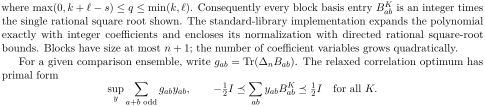
where max(0, k + l−s) ≤q ≤min(k, l). Consequently every block basis entry BK
ab is an integer times
the single rational square root shown. The standard-library implementation expands the polynomial
exactly with integer coefficients and encloses its normalization with directed rational square-root
bounds. Blocks have size at most n + 1; the number of coefficient variables grows quadratically.
For a given comparison ensemble, write gab = Tr(∆nBab). The relaxed correlation optimum has
primal form
sup
y
a+b odd
gabyab,
−1
2I ⪯
∑︂
ab
yabBK
ab ⪯1
2I
for all K.

Searchable transcription
∑︂
The objective equals Tr ) because Tr ∆
 = 0. Equal-prior average error is (1
 Tr
 2. The coefficient restriction from Lemma 7.1 is valid for all actual effects. It can safely be used to bound a certificate residual even when an SDP proposal omitted it. In fact the lower-bound comparison can grant arbitrary separate-copy POVMs with classical feedback on these real auxiliary states. Replacing every local effect
 2 preserves its conditional probability on every real source state, preserves positivity and preserves the POVM sum. The resulting real local effects again produce transpose-invariant terminal effects. Thus the relaxation is not exploiting the limitation to two projective outcomes. This is an auxiliary comparison only: it introduces no new physical detector law, and coherent memory passed between specimens remains excluded.
Residual-corrected dual certificate
Theorem 7.2 (An exactly checkable correlation upper bound). For every Schur block choose arbitrary positive semidefinite matrices . Put

Searchable transcription
rab = gab −
∑︂
K
Tr[(AK −CK)BK
ab].
Every admitted local terminal effect satisfies

Searchable transcription
Tr(∆nE) ≤Un,
Un = 1
2
∑︂
K
Tr(AK + CK) + 1
2
∑︂
ab
|rab|.
No exact dual feasibility, solver status or eigenvector accuracy is assumed.

Searchable transcription
Proof. Write FK = ∑︁yabBK
ab. Pairing FK ⪯I/2 with AK ⪰0 and −FK ⪯I/2 with CK ⪰0 gives
∑︁
K Tr[(AK −CK)FK] ≤1

Searchable transcription
2
∑︁
K Tr(AK + CK). The difference from the required objective is ∑︁rabyab.
The coefficient bound |yab| ≤1/2 proves the result.
The shipped certificate encodes each dual matrix as for an explicit rational factor
 . Its positivity is therefore exact. The dual cost is rational. The coefficient residuals use outward rational intervals for every square root and, in the robust application, for the exact objective coefficients. An upper bound on each absolute residual completes the proof. Floating SDP solutions only propose factors, whose entries are rounded to rationals; no numerical feasibility claim survives without this verification. Even poor or corrupted factors remain harmless: their residual is charged and may simply make the bound too weak to exclude a horizon.
Nominal one-percent interval: [13,14]
For the shared nominal parent, rotate the source axes to X and Z and use the uniform four-label prior. For odd , exact Pauli orthogonality gives
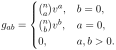
Searchable transcription
⎧
⎪
⎪
⎨
(︁n
a
)︁va,
b = 0,
(︁n
b
)︁vb,
a = 0,
0,
a, b > 0.
gab =
⎪
⎪
⎩

Searchable transcription
Define the auxiliary shortened states ρ(v)
a± = (I ± vσa)/2 for a = X, Z. Measuring them sharply
reproduces the nominal visibility-dependent classical kernel; this is a lower-bound representation
and does not identify the actual retained preparation or detector channel. The positive mixture is
Ω(n)
+ = 1


 ), and the hidden axis stays fixed. It is not a power of its one-copy average. For a horizon
 , the all-null error is 1
 2. All other erasure patterns are bounded by their
 -click certificates
 max(0
 2). Hence

Searchable transcription
B
∑︂
(︄
B
n
)︄
ηn(1 −η)B−n max(0, (1 −Un)/2).
eB ≥
n=0
The maximum with zero is harmless and permits arbitrary weak proposals. The delivered rational Gram certificates for 10 prove the exact lower bound reproduced by research11/bounds/ppt_certificate.py in the reader supplement and recorded in its generated research11/bounds/results.json; its decimal display is

Searchable transcription
e12 ≥L12 >
603
50000 = 0.01206 > 0.01,
L12 ≃0.012064933110195356.
Here denotes the full exact rational value in that JSON; its decimal is only a display. Thus twelve or fewer copies fail for both local protocol classes. The specified fourteen-copy bisector attainment remains valid, giving [13
 14] for each class. Neither exact threshold nor a one-percent adaptive/nonadaptive separation follows yet. The exploratory SDP value at thirteen does not itself exclude thirteen and is not an attaining physical protocol.
Original asymmetric robust interval: [16,17]
Retain the original uncertainty set and its fixed nuisance throughout each experiment. Use the convex-hull valid comparison prior with
 cos ∆
 sin ∆)

 sin ∆
 cos ∆)


 sin 2∆


 sin 2∆

It selects positive vector with probability
 and
 otherwise, then samples a fair source sign. The nuisance offset is correlated with the sampled axis in this mathematical prior but is not redrawn on later copies. Every prior point is admitted by the robust supremum. Therefore its average error lower-bounds that supremum for any one fixed policy. After a common real-plane rotation, write these vectors as

Searchable transcription
ru = (ac, −as),
rw = (bc, bs),
c =
1 −t
√︁
2(1 + t2),
s =
1 + t
√︁
2(1 + t2),
t = tan ∆.
Their inner product remains sin 2∆. The exact objective is

Searchable transcription
(︄
n
i
)︄(︄
n −i
j
)︄
{p(ru,x)i(ru,z)j + (1 −p)(rw,x)i(rw,z)j},
i + j odd.
gij = 2
Searchable transcription
For rational a, b, t, these coefficients are rational multiples of
√︁
 . The same exact dual verifier therefore applies with interval objective coefficients; no new physical noise law is introduced. At
 5, the fifteen-copy certificate proves

Searchable transcription
erobust
15
≥Lrobust
15
>
129
12500 = 0.01032 > 0.01,
Lrobust
15
≃0.010321278963318586.
Again the full exact rational is reproduced by research11/bounds/robust_ppt_certificate.py in its generated research11/bounds/robust_results.json; the decimal is only a display. The original seventeen-copy robust frozen reader supplies the upper endpoint. Thus both global robust thresholds lie in [16 17]. This does not determine whether sixteen is attainable, whether feedback helps there, or whether a stronger nonadaptive schedule already suffices. All source/controller, preparation, phase, erasure and archive conditions of the original robust task remain in force.
Verification and practical limits
The two delivered research11/bounds/ entry points verify the full nominal and robust certificates, respectively. An additional independent rational tensor-basis check verifies the normalized symmetric-power identity on 420 small-sector entries; its source and output accompany the supplement. These finite identity checks support implementation inspection, while the displayed representation and residual-corrected dual proofs supply the universal argument. Solver messages such as optimal_inaccurate are retained as proposal metadata; they are not proofs. The efficient exact core uses Python’s standard library. Optional proposal generation requires NumPy, CVXPY and an SDP solver. The computational improvement is material: a polynomial-size local-effect relaxation gives repro-ducible all-angle bounds without enumerating angular grid policies or exponential outcome trees. It does not establish that this relaxation is tight or that an SDP optimizer can be implemented as a reader. Its physical role is a comparison certificate. No Born-selection, consciousness, trine-resource or unique-source conclusion follows.