Feedback and Robust Local Readout of a Fixed Four-State Quantum Source
A robust frozen reader without X/Y symmetry
A robust frozen reader without X/Y symmetry
Admit unequal contrast transfer, a common unknown phase offset and a broader nominal equatorial direction. One frozen setting and one parameter-independent decoder suffice for a sharp restricted minimax theorem. The restriction is consequential: it optimizes the common-positive, repeated-single-angle class, not all equatorial adaptive policies or arbitrary collective measurements.
Physical parent and uncertainty contract
The source remains the four pure preparations and the nominated binary sign target. Conditional on its fixed inaccessible label, fresh copies and apparatus stock are independent. Before the phase reader apply a fixed, unknown Pauli channel with Bloch multipliers (
 ), where
 1. It has the explicit nonnegative Pauli probabilities

Searchable transcription
(pI, pX, pY , pZ) = 1
4
(︁(1 + gX)(1 + gY ), (1 + gX)(1 −gY ), (1 −gX)(1 + gY ), (1 −gX)(1 −gY )
)︁.
Their sum is one, so the channel is completely positive and trace preserving for every admitted gain pair. A coherent two-mode reader then measures the actual equatorial angle , followed by independent sign-blind erasure. Thus

Searchable transcription
E±|θ = η
2 [I ± (gX cos(θ + δ)X + gY sin(θ + δ)Y )] ,
E0|θ = (1 −η)I.
The channel precedes the phase measurement; changing this order can change the model. All effects are positive because their Bloch-vector length is at most one. The phase rotation uses the specified
 Ω
 2 coupling, calibrated beam splitter and terminal detector. Phase and offset are in radians, Ω
 is in radians per second and pulse durations are in seconds. The Pauli/environment ready stock and erasure port are physical resources, not free mathematical randomness. The unknown parameters are fixed throughout a deployment block and obey

Searchable transcription
η ∈[η0, 1],
gX ∈[a, 1],
gY ∈[b, 1],
|δ| ≤∆,
0 ≤∆< π/4,
0 < η0 ≤1,
0 < a, b ≤1.
No prior distribution over these nuisance parameters is assumed. The controller fixes one nominal angle before learning their values. The admitted common-positive class is ∆], so both axes have nonnegative target-aligned signal at every admitted offset. Every trial at the fixed deadline is counted; the decoder returns the majority of the nonnull signs, with an independent fair guess on a tie, including the all-null record. Nulls and all settings remain archived. No hidden label or calibration purifier is read. Under source label
 the nonnull sign has mean
 , where
 cos
 ); under
 it has mean
 , where
 sin
 ). The four labels need not have equal signal strengths. The proof below uses a hard binary pair for its lower bound rather than incorrectly reusing uniform-prior minimax equality from the symmetric experiment.
Exact minimax angle and full record risk
Define the majority error for successful signs of bias
 by

Searchable transcription
)︄n/2
,
)︃n−k
+ 12|n
(︄
n
k
)︄(︃1 + β
)︃k (︃1 −β
(︄
n
n/2
)︄(︄
1 −β2
qn(β) =
∑︂
2
2
2
4
k<n/2
and the deadline risk, including all erasures, by

Searchable transcription
B
∑︂
(︄
B
n
)︄
ηn(1 −η)B−nqn(β).
QB(η, β) =
n=0
The empty-sign case is 2. The integer
 counts correct signs under a positive-target preparation.
Theorem 5.1 (Sharp robust repeated-angle frontier). For a fixed nominal angle in the declared common-positive class, the minimum over every terminal decoder of the worst error over source labels and fixed nuisance parameters is exactly

Searchable transcription
QB
(︁η0, m(θ)
)︁,
m(θ) = min{a cos(θ + ∆), b sin(θ −∆)}.
The same fair-tie majority decoder attains this optimum for all parameters. The robust maximum signal is attained at
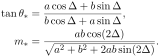
Searchable transcription
tan θ∗= a cos ∆+ b sin ∆
b cos ∆+ a sin ∆,
m∗=
ab cos(2∆)
√︁
a2 + b2 + 2ab sin(2∆).
Consequently is the exact robust optimum over all fixed angles and terminal decoders in this class. The setting and decoder do not depend on an inaccessible realized nuisance parameter.
Proof. For the symmetric binary pair of source signs with known bias , the likelihood ratio of a record
 ; null factors cancel. Thus fair-tie majority has equal error on the two signs and is minimax, with error
 ). The formula remains valid at the endpoints by continuity. Increasing
the bias cannot increase its optimal error: a larger-bias sign channel can simulate a smaller positive bias by an independent sign flip. Increasing the efficiency also cannot increase the error: success counts are coupled monotonically, and the optimal binary Bayes errors are nonincreasing in
 because an extra sign can be ignored. This is a direct experiment-degradation argument, not an assumed global four-label symmetry. For every admitted parameter and source axis, the bias is at least
 ), so the same majority policy has error no larger than the displayed bound. Conversely, if the minimum is supplied by the X term, choose
 = ∆and
 . The two admitted labels
 alone force every decoder’s worst error to be at least
 )). If the minimum comes from Y, use
 ∆and the Y sign pair. The adversary need not make both axes worst at the same offset; one hard pair suffices. On the admitted angle interval, the X floor is decreasing and the Y floor increasing. Their unique intersection maximizes their minimum. Solving their equality gives the stated tangent. Substitution gives
 , and ∆
 4 puts the intersection inside the admitted interval. No assertion is made that an outside-quadrant, multilevel decoder or an angle-varying protocol belongs to this restricted theorem.
The same bound extends to deterministic unknown efficiencies when their erasure events are independent of one another, source label, sign and control, while the gains and phase offset remain fixed. Condition on the erasure schedule; the retained signs still have one constant bias and success-count coupling applies. This does not license arbitrary history-dependent losses or varying per-trial biases. In particular, adding a weak sign to a majority of strong signs need not improve its error; the fixed-bias premise is essential to the efficiency argument.
Exact algebraic certificates and quantitative gain
For rational = tan ∆, the chosen nominal tangent is the rational (
 ), and

Searchable transcription
m2
∗=
a2b2(1 −t2)2
(1 + t2)[(a2 + b2)(1 + t2) + 4abt] ∈Q.

Searchable transcription
The nominal bisector instead has squared worst bias min(a, b)2(1−t)2/[2(1+t2)]. For rational efficiency
the risk is computed exactly in Q(
√︁
m2∗): every value is represented as A + C
√︁

Searchable transcription
m2∗with rational
coefficients. Comparisons with 1/100 use integer squaring after checking signs, not a floating-point
threshold. Integer-square-root enclosures provide independently checkable 96-bit rational lower/upper
bounds.
For η0 = 4/5, a = 9/10, b = 4/5, and tan ∆= 1/100, the robust setting is tan θ∗= 908/809, with
m2
∗= 129574081296/369773223625. The exact comparisons give
Reader in the same uncertainty class trials worst error Optimized frozen angle 16  Optimized frozen angle 17
 Nominal bisector 18
 Nominal bisector 19

Monotonicity in budget proves exact one-percent minimum budgets seventeen and nineteen within the respective repeated-angle classes. This is a two-trial improvement with one setting in each implementation, not a comparison against a restricted X/Y baseline. For the larger uncertainty example tan
 1, the corresponding minimum budgets are thirty and thirty-nine. Complete rational/algebraic certificates, including adjacent failing budgets, are supplied. The isotropic special case also clarifies the earlier access restriction. At
 and
 8, a repeated bisector reaches one-percent error at fourteen copies. Thus the axis-restricted
nineteen-versus-twenty-one X/Y threshold is not an unrestricted equatorial optimum. The continuous-reader results supply separate adaptive comparisons; this section does not claim that a repeated bisector is globally optimal.
Calibration and physical/resource limits
The theorem’s intervals are admitted premises until certified by a trusted calibration experiment or an independent device model. Four trusted source preparations at the actual frozen setting can directly bound the four sign/null kernels without inferring the entire channel or nuisance parameters uniquely. Such a calibration must pay for its probes, confidence coverage, source trust and stability into deployment. A control model claiming a lower gain or bounded phase over an interval of settings needs additional justified coverage; samples at one angle do not certify all angles for an arbitrary detector. The frozen majority controller needs a running signed count and deadline counter, plus a fair terminal tie bit; it has no setting-feedback branch. The angle itself must be prepared and maintained, with its phase reference and accuracy charged. Each physical realization must state whether the phase is applied separately to every fresh copy or configured once in a held passive reader. Their timing costs differ. The source copies are provided independently, not cloned from an unknown specimen, and the ordered archive is retained even when the decision uses only a count. Robust quantum discrimination is established literature [6]; its uncertain-state model is not the detector model optimized here. The ordinary degradation argument has classical antecedents[2], and its special case is proved above. Our additions are the explicit within-programme robust angle frontier, physical Pauli-channel realization and exact algebraic operating region. No worldwide priority, complete retained-output equivalence, empirical detector validation, Born-selection law or source ontology is asserted. The executable tests compare seventy-two independent ordered ternary-path sums, 1,500 rational geometry inequalities and 180 algebraic comparison/ enclosure cases. These supplement, rather than replace, the analytical minimax proof. The parameter-independent decoder, phase/gain uncertainty, retained nulls and access restrictions are part of every numerical result.