Feedback and Robust Local Readout of a Fixed Four-State Quantum Source
One reader across unknown erasure and calibration parameters
One reader across unknown erasure and calibration parameters
For already calibrated readers, a generic perturbation allowance is possible. Here an explicit feedback policy yields an exact minimax law under unknown erasure efficiency, followed by a stronger model-specific calibration certificate when visibility is imperfect. The two results have different strength: erasure-only minimax optimality is proved; the visibility-box result certifies one frozen policy without claiming robust-minimax optimality. Neither depends on an ETH theorem.
A policy independent of the nuisance parameter
Choose an initial axis with a fair independent coin. Query that axis until its nonnull signs include both + and
 . Then query the other axis. The first nonnull result on that other axis commits its sign; further records are retained but ignored by the terminal classifier. If the deadline arrives
before a switch, return the common sign; if there was no click, or a switch without a subsequent click, return an independent fair guess. Thus a flip at the last successful trial is explicitly an inconclusive internal state, resolved by a declared decision coin. There is always a terminal decision; nulls are not postselected away. Let be the ideal adaptive minimax error for the X/Y-restricted four-label sign task established in the preceding appendix, not the continuous-menu optimum:

Searchable transcription
e0 = 1
2,
e1 = 1
4,
en = 2−n
(n ≥2).
The same value is the optimal uniform-prior Bayes error. The policy just defined attains it simultaneously at every click horizon. To see attainment, condition on the initial axis. If it is the true axis there is no error. If it is the other axis, the observed signs are fair. For 2, errors are possible only when all
 signs agree, or the first opposing sign appears at position
 . Each event has probability 2
 , with conditional error 1
 2. The fair initial axis gives error 2
 for every source label. The
 1 cases give the displayed exceptional values.
Theorem B.1 (Exact unknown-erasure minimax frontier). Fix a deadline of trials. Visibility is one. Trial
 is independently erased with probability
 , regardless of source label, axis and ideal result, where the deterministic efficiencies satisfy
 . For known efficiencies, the minimum worst-case sign error among all adaptive X/Y policies and terminal decoders is

Searchable transcription
B
∑︂
EB(η1, . . . , ηB) = E[eN],
N =
t=1
Zt,
Zt ∼Bernoulli(ηt) independently.
One policy, specified above without any knowledge of the efficiencies, attains this value. In particular, for a common efficiency and

Searchable transcription
EB(η) = (1 −η/2)B −(1 −η)B
2
−Bη(1 −η)B−1
4
.
(3)
For the robust class of all deterministic vectors , unknown when the policy is fixed, the exact robust minimax error is
 . This includes a fixed unknown common efficiency.
Searchable transcription
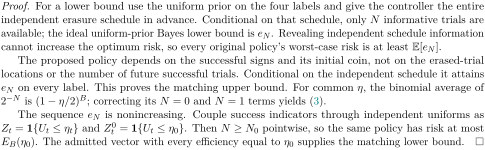
Proof. For a lower bound use the uniform prior on the four labels and give the controller the entire
independent erasure schedule in advance. Conditional on that schedule, only N informative trials are
available; the ideal uniform-prior Bayes lower bound is eN. Revealing independent schedule information
cannot increase the optimum risk, so every original policy’s worst-case risk is at least E[eN].
The proposed policy depends on the successful signs and its initial coin, not on the erased-trial
locations or the number of future successful trials. Conditional on the independent schedule it attains
eN on every label. This proves the matching upper bound. For common η, the binomial average of
2−N is (1 −η/2)B; correcting its N = 0 and N = 1 terms yields (3).
The sequence eN is nonincreasing. Couple success indicators through independent uniforms as
Zt = 1{Ut ≤ηt} and Z0
t = 1{Ut ≤η0}. Then N ≥N0 pointwise, so the same policy has risk at most
EB(η0). The admitted vector with every efficiency equal to η0 supplies the matching lower bound.
The independence and sign-blindness conditions are consequential. A nuisance depending on hidden source data, a measured sign before erasure, or the past record is not covered by this theorem merely because each unconditional click rate exceeds . Correlated detector baths and preparation copies are also outside its parent. The theorem does permit unknown nonstationary deterministic efficiencies under independent per-trial erasure stock.
For seven trials and every

Searchable transcription
E7(49/50) = 897410666811
1014
= 0.00897410666811 < 0.01.
This is a completed one-percent operating region requiring no estimate of the actual efficiency beyond the declared lower bound. Six ideal trials have optimal error 1 01, so seven is also the exact robust minimum trial budget in this class. The comparison with the fixed-schedule analysis is explicit: its fixed deterministic schedule required eight ideal trials; randomization of the setting and the declared feedback controller expand that access class. The present result does not attribute the whole gain to feedback alone.
A fixed-policy certificate for imperfect visibility
Keep the same policy unchanged when the actual, fixed unknown pair is ( ) in a rational rectangle. Each trial has the specified effects
 and fresh independent noise stock conditional on this pair. A history’s probability is a product of terms 1
 Consequently every source-specific error is a polynomial in
 of separate degree at most
 . Axis randomization and sign covariance make all four risks equal to their mean polynomial
 ). This avoids optimizing a different policy after learning an inaccessible nuisance parameter.

Searchable transcription
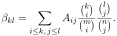
Proposition B.2 (Exact calibration-box certificate). Affinely map a rational rectangle [a, b] × [c, d] to
[0, 1]2 and write the fixed policy’s risk as ∑︁
ij Aijtisj. At degrees m, n no smaller than its respective
degrees, set
Searchable transcription
(︁l
j
)︁
(︁k
i
)︁
βkl =
∑︂
i≤k, j≤l
Aij
(︁n
j
)︁.
(︁m
i
)︁
Then max is a rigorous uniform error upper bound on that rectangle. Any evaluated point supplies a lower bound on the fixed policy’s worst error. Apply the same construction on a finite subdivision and take the maximum of its upper bounds; if an upper bound equals an attained point value, the fixed-policy worst error is certified exactly. Every coefficient and comparison is rational.

Searchable transcription
Proof. The identities ti = ∑︁m
k=i
(︁k
i
)︁(︁m
i
)︁−1(︁m
k
)︁tk(1 −t)m−k and their s counterparts give the stated
coefficients. The product Bernstein basis is nonnegative and sums to one on the unit square, so
the polynomial is a convex combination of its coefficients. Subdivision covers the original rectangle.
Attainment supplies the reverse inequality whenever the two bounds coincide.
This uses an established polynomial-enclosure technique, not a new theory of Bernstein polynomials[1]. Its addition here is a checked full-policy risk consumer, with the unknown parameters held fixed throughout the experiment. The implementation uses exact finite-state controller recurrences rather than accepting a grid scan as a proof. Its stored tuples may retain redundant history beyond a minimal logical-state quotient. The delivered certificates have zero enclosure gaps on the following boxes:
 admitted
 admitted
 worst fixed-policy error 7


 7


 8


 8



All entries are exact rational calculations, with full fractions in research8/robust/results.json. The worst point in each displayed box is its lower-left corner, established by a matching Bernstein
upper bound rather than assumed from monotonicity. The seven-copy visibility box proves a new robust one-percent guarantee. It is not a claim that this particular policy is minimax for every visibility box: at lower visibility an adaptive optimizer can choose a substantially different policy within the same X/Y menu. For the same seven-copy policy on [![.99, 1] × [.999,](/publications/source-readout/constructive/feedback-and-local-readout/math/p030-00629.svg) 1], applying a generic conditional total-variation allowance to its ideal error gives approximately 0
 0790373. The new model-specific upper bound is about 0
 00948265. This improvement is in a certified error allowance under a stronger specified noise parent, not a measured device gain. Complete retained quantum outputs or arbitrary purifiers are not certified by these classical terminal-record polynomials.