Feedback and Robust Local Readout of a Fixed Four-State Quantum Source
Continuous equatorial access: exact small-horizon optima and an improved fixed reader
Continuous equatorial access: exact small-horizon optima and an improved fixed reader
Permit every equatorial setting , with
 cos
 sin
 , and keep the same shared calibrated efficiency and visibility:

Searchable transcription
E±|θ = η
2(I ± vσθ),
E0|θ = (1 −η)I,
0 ≤η, v ≤1.
The source label is fixed, its controller is unread, and independently prepared copies are supplied conditional on
 . A policy selects one setting per fresh copy and always decides the sign target at the fixed deadline. All actual settings, signs, nulls and timing records remain retained. The expanded class includes randomized nonadaptive schedules and their terminal decoders,
Searchable transcription
as well as nonanticipating adaptive policies. No collective POVM, readable source register or returning
environment is added.
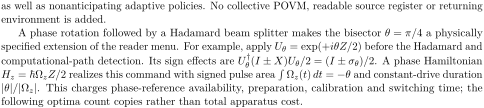
A phase rotation followed by a Hadamard beam splitter makes the bisector θ = π/4 a physically
specified extension of the reader menu. For example, apply Uθ = exp(+iθZ/2) before the Hadamard and
computational-path detection. Its sign effects are U†
θ(I ± X)Uθ/2 = (I ± σθ)/2. A phase Hamiltonian
Hz = ħΩzZ/2 realizes this command with signed pulse area
∫︁Ωz(t) dt = −θ and constant-drive duration
|θ|/|Ωz|. This charges phase-reference availability, preparation, calibration and switching time; the
following optima count copies rather than total apparatus cost.
A posterior formula and exact one/two-copy theorem
The full continuous menu is closed under X/Y exchange and global sign reversal. These operations permute source labels transitively, transform settings as or reverse outcomes, and transform the final sign consistently. The shared
 noise law is invariant. Consequently averaging a uniform-prior Bayes-optimal policy over this group makes all four source risks equal. Uniform-prior Bayes lower bounds and randomized minimax optima therefore agree in both the adaptive and the randomized-nonadaptive continuous classes. This argument does not transfer unchanged to unequal axis responses.
Lemma 2.1 (Exact one-step posterior risk). For unnormalized nonnegative hypothesis weights
 , put

Searchable transcription
W =
∑︂
h
wh,
d = wX+ −wX−+ wY + −wY −,
b = (wX+ + wX−, wY + + wY −).
The optimal unnormalized Bayes loss with one remaining equatorial measurement is

Searchable transcription
L1(w) = 1
2{W −(1 −η)|d| −η max(|d|, v∥b∥2)}.
A reader parallel to attains it; when
 any reader suffices.
Proof. The plus-minus target mass difference on a sign outcome 2, while on a null it is (1
 . For a two-target decision problem the Bayes error is half the total mass minus half the sum of absolute target-mass differences. The identity
 max
 ) reduces the optimization to maximizing
 , whose maximum is
 . This is an exact optimization over the entire circle, not a grid scan.
Theorem 2.2 (Exact continuous optima at one and two copies). For the shared-noise continuous equatorial class, the randomized adaptive and randomized nonadaptive minimax optima coincide at horizons one and two:

Searchable transcription
ead
1 = ena
1 = 1
2 −ηv
2,
ead
2 = ena
2 = 1
2 −η(2 −η)v
2
√
2
√
2
.
Repeated use of the fixed bisector , followed by majority of the nonnull signs and a fair tie decision, attains both optima.
Proof. At the uniform prior, = 0 and
 2), proving the one-copy statement through Lemma 2.1. For two copies, let the first angle be
 . After its sign
 , the unnormalized posterior is
 8. Its total mass is
 2, its target difference is
 cos
 sin
 4, and its vector
 4) is independent of that outcome and angle. Thus
 and the bisector is optimal
on either sign branch. The null branch retains the uniform prior scaled by 1 and also admits an optimal bisector. Adding all three optimal branch losses gives

Searchable transcription
2 −ηv
√
L2(θ) = 1
2
4
−η(1 −η)v
4
| cos θ + sin θ|.

Searchable transcription
Its minimum uses | cos θ + sin θ| =
√
2, giving the formula. At = 1 the first angle is immaterial to the uniform Bayes value; a repeated bisector still attains the minimax optimum. When
 = 0 all target information vanishes. Repeated bisector records have identical laws for
 + and
 +, and identical laws for
 and
 , so its four source risks already agree. The symmetry argument upgrades the Bayes lower bound to minimax equality. Since this attaining protocol is nonadaptive, the two admitted classes have equal optima.

Searchable transcription
The one-copy bisector is the familiar Breidbart direction for the unitarily equivalent BB84 subset/bit
task[4]; it is not claimed as a new measurement discovery. The addition relative to the declared
source–readout programme is the explicit noisy two-copy continuous-class theorem and its operational
comparison. At η = v = 1, both errors are (1 −1/
√

Searchable transcription
2)/2 ≃0.1464466, below the earlier X/Y value 1/4.
At η = 4/5, v = 9/10, the exact errors are 1/2 −(9/50)
√
2 and 1/2 −(27/125)
√
2.