Editorial amendments and conventions
The mathematical source is the expanded Full_pre_source_translation.md, included in the release’s sources/ directory. Its 15,788 lines are counted with universal newlines. The coverage record locates every source heading in this paper. The following records the mathematical amendments and interpreted typography.
A1: principal predictor (source line 1017). The extracted expression is the reconciled expression is
 ). The direct subtraction in Section 5.22 shows
 in the declared multiplier convention. The singular factor
 is cancelled before Fourier extraction, and the nonprincipal and dual branches retain their displayed definitions. The amended parenthesization implements the stated cancellation.

Searchable transcription
A2: Gaussian prefactor (source line 1317).
The extracted exponent −rh+dv is replaced by
−(rh + dv). The active, dormant and frozen-link counts, and the substitution mg = c(
√
2πg)r, are
calculated in Section 6.2. The dormant Gaussian integrates to one, and its normalization remains
present. The determinant factor is unchanged. This calculation fixes the normalization used by
the chart integral.

Searchable transcription
Interpreted typography (E2).
At source line 1575 use CK = (na+nb)AJ: the common row and
column count multiplies their common estimate. At line 3218 use 4 pcap(4)(
pdirecttop+pathstop)t;
the common factor t comes from both base-row estimates. At line 3428 use HC(QRprice)n, consis-
tent with the repeated bound at source line 4020. The source’s damaged comma in (CAL21) and
split rm free in (GL0) are restored from their displayed mathematical context.
Domains and interpretation. The combined startup allowances in Section 8.14 hold on
 . The forced estimate alone uses only the lower bound. The Gaussian comparison distinguishes
 and
 , with their determinant and inverse factors (Sections 8.23–8.25). The primitive relation retains ordered group multiplication (Section 7.22). Exact radius matching is geometric, while moment comparisons keep their error bounds (Section 16.2). The full idempotent-kernel proof is included in Section 11.5. These conventions also govern the corresponding recovery maps in the source–readout paper; the constructions used in this exposition are defined and derived locally.
Scope of the results. The group and representation are given; no connectedness hypothesis is added. One Wilson family precedes the requested volume sequence. Its inner fixed-period mesh limit is full, and its outer volume limit is subsequential. Field assertions use the common cyclic invariant domain. Every OPE/contact statement retains its finite horizon, geometry and chosen subtraction device. The full-distance trace argument retains the same table and phase; the moving-mass estimates retain their positive-mass choice order; the real fourth-order remainder is distinguished from a formal jet and from leading transfer to weaker frames. The two comparison exclusions retain their specified hypotheses. No positive mass gap or Millennium-problem solution is asserted by this presentation.

Searchable transcription
Transcription typography in the companion.
Short formulae written directly in source prose
are set in mathematical mode; subscripts, superscripts, inequalities and function names are joined
into coherent expressions. The Unicode aggregate signs Σ and indexed Π are printed as P and Q
where their context is a sum or product. The standalone heat-ground projection remains Π. These typography choices introduce no new operator or estimate. The following local interpretations make explicit the source’s intended application or grouping:
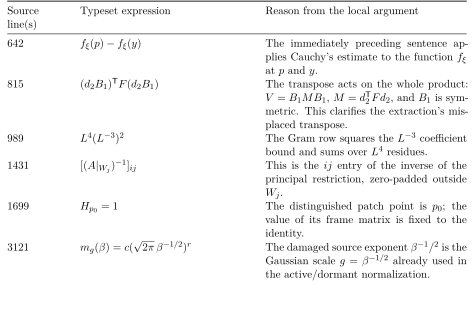
Accessible table transcription
| Source | Typeset expression | Reason from the local argument |
|---|---|---|
| line(s) | ||
| 642 | f(p) −f(y) | The immediately preceding sentence ap- |
| ξξ | ||
| plies Cauchy’s estimate to the function fξ | ||
| at p and y. | ||
| T | ||
| 815 | (d2B1)F(d2B1) | The transpose acts on the whole product: |
| T | ||
| V = BMB, M = dFd, and B | ||
| 112 21 is sym- | ||
| metric. This clarifies the extraction’s mis- | ||
| placed transpose. | ||
| 4−32 | −3 | |
| 989 | L(L) | The Gram row squares the Lcoefficient |
| 4 | ||
| bound and sums over Lresidues. | ||
| −1 | ||
| 1431 | [(A|)] | This is the ij entry of the inverse of the |
| Wjij | ||
| principal restriction, zero-padded outside | ||
| W. | ||
| j | ||
| 1699 | Hp0 = 1 | The distinguished patch point is p0; the |
| value of its frame matrix is fixed to the | ||
| identity. | ||
| √ | ||
| −1/2r | −12 | |
| 3121 | m(β) = c(2π β) | The damaged source exponent β/is the |
| g | ||
| −1/2 | ||
| Gaussian scale g = βalready used in | ||
| the active/dormant normalization. |
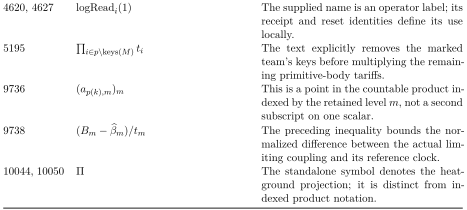
Accessible table transcription
| Source line | Reading | Explanation |
|---|---|---|
| 4620, 4627 | logRead(1) | The supplied name is an operator label; its |
| i | ||
| receipt and reset identities define its use | ||
| locally. | ||
| Q | ||
| 5195 | ti | The text explicitly removes the marked |
| i∈p\keys(M) | ||
| team’s keys before multiplying the remain- | ||
| ing primitive-body tariffs. | ||
| 9736 | (a) | This is a point in the countable product in- |
| p(k),mm | ||
| dexed by the retained level m, not a second | ||
| subscript on one scalar. | ||
| b | ||
| 9738 | (Bβ)/t | The preceding inequality bounds the nor- |
| m −mm | ||
| malized difference between the actual lim- | ||
| iting coupling and its reference clock. | ||
| 10044, 10050 | Π | The standalone symbol denotes the heat- |
| ground projection; it is distinct from in- | ||
| dexed product notation. |
In the reconstruction chapter, ASCII pairing brackets and postfix stars are set as Hilbert pairings  and adjoints on their declared domains. The zero-energy event is written
 and the low-energy function as
 ). These are the same pairings, spectral event and scalar function defined in the local proofs. Local internal source aliases identify provenance rather than supplying additional hypotheses or replacing a derivation.
Source: A Wilson Yang–Mills Construction: A Natural-Language Mathematical Exposition. Both papers belong to one Zenodo record. No external funding.