Phase decomposition and Wightman reconstruction
The reconstruction has three levels. Finite reflection-positive correlations first give Hilbert vectors and bounded slab operators. The commutative ground-compression algebra then produces characters and a full-support phase measure. Finally tube continuation and tempered boundary limits construct fields on a common cyclic domain in each selected phase. The proof below keeps these levels separate: it does not assume a one-dimensional ground space before the phase argument establishes vacuum uniqueness.
Bounded slab insertions and their norm derivatives

Searchable transcription
Fix an axis a, width d > 0, and word w = ((xi, vi))n
i=1 of distinct points inside 0 < xa
i < d. A
buffer 0 < r ≤1 requires pairwise maximum-coordinate distance at least r and r ≤xa
i ≤d −r. For
degrees at most D and coefficient norms at most R, we construct

Searchable transcription
∥Ud(w)∥≤Cn(n/r)An,
(BS1)
with depending only on
 . The empty word has bound one. On a future plant the prescribed action inserts
 before that plant translated by
 . Boundedness precedes extension to the Hilbert completion.
The centered one-cell estimate gives a threshold , exponent
 , and
 0, such that one insertion at level
 has price
 . Include all signed rotations and reflected conjugates by
 enlarging the coefficient ball by their finitely many operator norms on the finitely many raw degree spaces. These constants consequently work for every reflected copy.
The decreasing schedule satisfies
 At the first
 below
 32, we have
 ; decrease
 0 to include
 . Choose fixed sufficiently small
 0 and the first
 below
 . The same first-crossing argument gives

Searchable transcription
ak ≥c(r/n)4,
20nak < am,
k ≥m.
(BS2)
Indeed 20 , and strict decrease gives
 . Exterior insertions are paid at still finer scales, chosen after this main scale; their prices may depend on the exterior word.
First let be an integer multiple of
 . Alternating insertion of
 and its reflection produces, in the squared norm after
 repetitions, 4
 main copies and two exterior copies. The main positions repeat the original 2
 position patterns modulo
 . Thus cell packing needs only 20
 independently of
 . The buffer separates the main train from the translated exterior. The rooted product estimate and the fixed finite-word lattice limit give

Searchable transcription
∥plant of the repeated word∥2 ≤Bp[Ja−P
k
]4nq,
(BS3)
with independent of
 . This is the train estimate in Next/PHASE/Trains.travel_price and Seats.replicas. By (BS2), its main price is

Searchable transcription
Q = [Ja−P
k
]n ≤[Jc−P ]n(n/r)4Pn.
We may use the latter expression for
To remove the exterior prefactor, let send algebraic future words to the reflection Hilbert space,
 insert the main word, and
 insert its opposite reflected word. Reflection and translation invariance give
 . Put
 . Taking square roots in (BS3) and finite linear combinations gives
 . Therefore
 = sup
 is finite. Moving powers of
 across the pairing yields

Searchable transcription
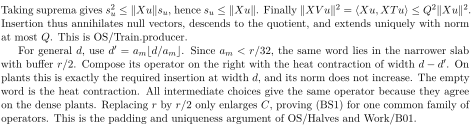
(Q−2q∥XT qu∥)2 ≤∥Xu∥su.
Searchable transcription
u ≤∥Xu∥su, hence su ≤∥Xu∥. Finally ∥XV u∥2 = ⟨Xu, XTu⟩≤Q2∥Xu∥2.
Taking suprema gives s2
Insertion thus annihilates null vectors, descends to the quotient, and extends uniquely with norm
at most Q. This is OS/Train.producer.
For general d, use d′ = am⌊d/am⌋. Since am < r/32, the same word lies in the narrower slab
with buffer r/2. Compose its operator on the right with the heat contraction of width d −d′. On
plants this is exactly the required insertion at width d, and its norm does not increase. The empty
word is the heat contraction. All intermediate choices give the same operator because they agree
on the dense plants. Replacing r by r/2 only enlarges C, proving (BS1) for one common family of
operators. This is the padding and uniqueness argument of OS/Halves and Work/B01.
We next prove operator-norm regularity. Fix labels and width, and write the open set of distinct slab configurations. For a slot-axis index
 ), replace its label by a representative of its physical
 -derivative and call the resulting placement
 ). Set

Searchable transcription
B(x)h =
X
b
hbFb(x).
(BS4)
Near a fixed configuration there is one positive buffer for the original word and these finitely many differentiated words. Equation (BS1) makes locally bounded in operator norm. Between two plants, the placement is a separated correlation with a fixed exterior word. The scalar slot-derivative law gives its derivative as the matrix element of
 ), also for finite linear combinations of plants. On a convex position ball suppose
 . The scalar mean-value estimate gives

Searchable transcription
|⟨u, [F(y) −F(x) −B0(y −x)]v⟩| ≤η∥u∥∥v∥∥y −x∥.
Density gives the same estimate in operator norm. First set = 0: local boundedness makes every placement locally Lipschitz. Apply this also to each differentiated label array; all
 , hence
 , are norm continuous. Then set
 ) and shrink the ball. Its oscillation tends to zero, proving
 ) in norm. Induction with differentiated labels gives smoothness of every order on the same position domain. This is the argument of Work/B02/Analysis.norm_remainder and Work/B02/Slab.smooth_place; it establishes the norm regularity used in the waves and compression-valued moments below.
Surjectivity of the reflection attachment
Surjectivity of attachment The reflection Hilbert space is formed from a positive pairing on future words. An attachment map can preserve that pairing and still have a proper closed range,
so its being an isometry is not the final step. Surjectivity below identifies a dense family of heated word vectors in that range and uses closedness to obtain the whole space. This identifies the reconstructed representation with the intended cyclic word space and is needed when the boundary fields are later placed on their common domain.
The attachment J is an isometry from the complete boundary Hilbert space, so its range is closed. First consider a regularized word vector integrated against the Fourier transform of a compact smooth test. The boundary tilt identity identifies it with J applied to the boundary word distribution tested against the correspondingly chilled test. Here is the Hilbert-space step in that identification. If A is the reflection-space regularized vector and B the proposed attached vector, the joint pairing formula gives . Pair A with the regularized approximants tending to B. Their partial-boundary correlations converge by the boundary distribution construction, giving
 . Therefore
 = 0 and
 . The strict-time wave and independently heated word constructions below establish the boundary tilt and joint pairing identities used here.
Compact cutoffs approximate any Schwartz test after Fourier transform. The regularized word map is continuous, by its bound , so closedness of the range extends membership to every integrated regularized word vector. For a pointwise regularized word vector, pair with a vector orthogonal to the range. All its smeared pairings vanish. The pointwise pairing is continuous, so equality as a distribution implies that it vanishes everywhere. The pointwise vector belongs to the double orthogonal complement of the range, hence to the range itself.
A future Euclidean word with strictly ordered positive times is exactly such a regularized word: choose the regularization below every initial time and consecutive time gap, then recursively insert the local regularized fields and intervening translation and heat operators. This recursion reproduces the reflection-space plant of the word with its specified insertion representatives. Quotientfield representatives give the same plant because their table expectations agree against all future words. Hence every strictly time-ordered future plant lies in J’s range.
For an arbitrary future word, permutation symmetry first sorts its times. Add to its
 - th sorted time. For
 0 the times are strictly increasing and remain positive. The original configuration is separated; the perturbed configurations remain separated and converge to it as
 0. Smoothness of the separated table makes the associated plant vectors continuous in norm, as seen by expanding the squared distance into three table pairings. Since the range is closed, the unperturbed plant also lies in it. Future plants have dense linear span by the GNS construction. Therefore the closed range is the whole reflection Hilbert space, proving surjectivity.
Explicit tested boundary formula
Fix a field word v and let Ψ( ) be its holomorphic wave smeared against a joint Schwartz test f at strictly increasing imaginary heights y. Let
 and define the continuous test operator
 . The tested Cauchy–Riemann identity is

Searchable transcription
d
dtΨ(y + ta, Dkf) = Ψ(y + ta, Dk+1f).
Assume the wave bound whenever the height gaps are at least k, 0
 For any nondecreasing y and
 0, y+ta has gaps at least t. Define

Searchable transcription
m
X
(−t)k
k!
Ψ(y + ta, Dkf).
Pm(y, f; t) =
k=0
Differentiating and cancelling adjacent terms yields The wave bound and integration in
 give

Searchable transcription
|∂tPm(y, f; t)| ≤C
m!∥Dm+1f∥L1,
0 < t ≤1.
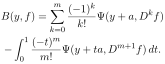
Thus the expression
Searchable transcription
m
X
(−1)k
k!
Ψ(y + a, Dkf)
B(y, f) =
k=0
−
Z 1
0
(−t)m
m!
Ψ(y + ta, Dm+1f) dt.
is defined for every nondecreasing y. For strictly increasing y, the fundamental theorem of calculus gives ). For y approaching any nondecreasing
 , the finite terms are evaluated at interior heights and are continuous. The remainder integrands are continuous for every
 0 and share the constant integrable bound just proved. Dominated convergence makes B continuous at
 . Therefore Ψ(
 ) tends to
 ) along every strict-height approach, with no restriction on the ratios of the gaps.
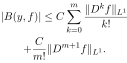
Furthermore
Searchable transcription
m
X
∥Dkf∥L1
|B(y, f)| ≤C
k!
k=0
+ C
m!∥Dm+1f∥L1.
This is a continuous Schwartz seminorm. Linearity in and multilinearity in the labels pass through the interior limits and yield a tempered multilinear boundary distribution. Different choices of the admissible exponent
 give the same distribution by uniqueness of these limits. The common character-independent
 prove both boundary continuity in the character and passage of the character barycenter to the boundary. The construction of the waves and the tested Cauchy– Riemann and polynomial gap estimates used here is given in (SW1)–(SW7) and (CR1)–(CR2) below.
Character integration at strict imaginary times
For a fixed field word v of arity n, the heat-regularized field factors have bounds . Choosing the regularization
 8 for imaginary-time gaps at least k, with 0
 1, gives a product bound

Searchable transcription
|Wχ(v; x + iy)| ≤[
Y
a
Qa(8)da]k−P
a da,
uniformly in and the real positions x. The comparison of the phase regularized factor norm with the unselected factor norm supplies the same constants in every phase. The factors are constructed in (SW1)–(SW3); the phase norm comparison is (ST1)–(ST4), using the bounded slab construction (BS1)–(BS4).

Searchable transcription
At a strict imaginary-time configuration the phase values are continuous in χ and have the
unselected value as their integral. For a joint Schwartz test f and fixed strict heights y, the preced-
ing bound gives the integrable dominator Ck−m|f(x)|. Dominated convergence therefore proves
R Wχ(v; x + iy)f(x)dx. The same bound, combined with the probability normal-
continuity of χ 7→
ization of the phase measure, makes the double integral absolutely integrable. Fubini transfers the
character integral inside the x-integral and yields the unselected strict smeared wave.
The source passes this identity to the Wightman boundary using a common finite-order Taylor representation along an interior height ray. Its polynomial part uses finitely many strict evaluations; its remainder has a common integrable bound on the ray parameter after enough test derivatives. Thus continuity in passes separately through that finite sum and the dominated remainder integral. The same representation bounds the smeared strict waves uniformly in
 as the heights approach the boundary. Dominated convergence in
 then gives the boundary barycenter identity. The tested boundary formula and strict-time wave estimates below provide this Taylor representation and its common polynomial-order bound.
Identification of the heat ground projection
Let be the positive reflection-space contraction semigroup, and let Π be its strong
 limit, the projection onto its fixed vectors. Its lifted joint momentum measure gives for every vector x

Searchable transcription
⟨x, Esx⟩=
Z
exp(−sE(p))dνx(p).
Since 0 almost everywhere, the integrands are bounded by one and converge to the indicator of
 = 0. Dominated convergence gives the limit
 . The strong semigroup limit gives the same limit
 Π
 . Polarization of these quadratic pairings proves Π =
 ), without an assumption that this projection has rank one.
For the isometric attachment J from the boundary Hilbert space to this reflection space, set
 . The attachment identifies the diagonal spectral measures, so
 is the Boltzmann integral for the boundary momentum measure. It also intertwines the zero-energy projections. Applying
 to the reflection-space strong limit and using
 gives

 for every x. The vacuum rank is established later by the locality and character argument, not used in this identification. Surjectivity of J, supplied separately by the attachment construction, then realizes the whole reflection heat evolution on the boundary Hilbert space.
Weak irreducibility from heat evolution
With the reconstructed Hilbert space and heat evolution, let Φ be the reconstructed fields on their common word domain, Ωthe cyclic unit vacuum, ) the time translations, and B a bounded operator satisfying the weak commutation identity

Searchable transcription
⟨Φ(a, f)∗u, Bv⟩= ⟨u, BΦ(a, f)v⟩
for word-domain u,v, with the adjoint interpreted by its actual Hilbert-space adjoint restricted to that domain. No preservation of the domain by B is assumed. Repeated application moves a whole word across the pairing:
Fix a word vector Ωand let
 Ω. The heat-space attachment supplies bounded continuous scalar functions on the closed upper half-plane, holomorphic in its interior, with real boundary values

Searchable transcription
F(t) = ⟨u, U(t)BΩ⟩, G(t) = ⟨B∗Ω, U(t)v⟩.
Translation covariance, invariance of Ωand the weak word identity give ) for real t. Glue F above the axis to
 ) below it. The boundary equality makes the glued function continuous. Cauchy’s theorem on rectangles cut along the real axis, with cancellation of the common boundary integrals, shows that the glued function is entire. It is bounded, so Liouville’s theorem makes it constant. In particular

Searchable transcription
⟨u, BΩ⟩= ⟨u, exp(−sH)BΩ⟩, s ≥0.
The constructed heat evolution converges strongly to the vacuum projection as s tends to infinity. Hence Ω
 Ω
 Ω
 Ω
 for every word vector u. Density gives
 Ω
 Ω
 Move each word across B once more to obtain
 Ω
 Ω
 for all word vectors u,wΩ. Density and boundedness imply
 . Conversely every scalar multiple of I satisfies the weak identity by the field adjoint relation. Thus the weak commutant is precisely the scalars. The heat-contraction, holomorphic-edge and vacuum-projection arguments of this chapter establish the properties used in this weak-commutant argument.
From low-energy measure bounds to uniform heat decay
Low-energy spectral bounds control heat decay without supplying a positive mass gap. The heat-ground projection and its compression algebra are the actual objects used in phase decomposition. Full support of the character measure subsequently upgrades certain continuous almost-everywhere identities to every character, after the required continuity and common bounds have been established.

Searchable transcription
The shell estimate uses positivity of a time average. Let μ, ν be the scalar spectral measures of a
compact word combination and its adjoint word combination, both supported in the forward cone,
with total mass sum at most M. Their characteristic-function difference A(x, t) = bμ(x, t)−bν(−x, −t)
is the vacuum commutator pairing. Locality gives A(x, t) = 0 whenever |x| > R and |t| ≤1, with
R uniform in the character: the words have fixed compact test supports and the label action is
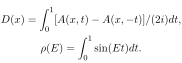
common across phases. Define
Searchable transcription
D(x) =
Z 1
0
[A(x, t) −A(x, −t)]/(2i)dt,
ρ(E) =
Z 1
0
sin(Et)dt.
Searchable transcription
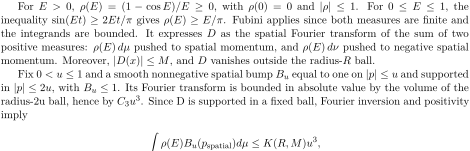
For E > 0, ρ(E) = (1 −cos E)/E ≥0, with ρ(0) = 0 and |ρ| ≤1. For 0 ≤E ≤1, the
inequality sin(Et) ≥2Et/π gives ρ(E) ≥E/π. Fubini applies since both measures are finite and
the integrands are bounded. It expresses D as the spatial Fourier transform of the sum of two
positive measures: ρ(E) dμ pushed to spatial momentum, and ρ(E) dν pushed to negative spatial
momentum. Moreover, |D(x)| ≤M, and D vanishes outside the radius-R ball.
Fix 0 < u ≤1 and a smooth nonnegative spatial bump Bu equal to one on |p| ≤u and supported
in |p| ≤2u, with Bu ≤1. Its Fourier transform is bounded in absolute value by the volume of the
radius-2u ball, hence by C3u3. Since D is supported in a fixed ball, Fourier inversion and positivity
imply
Z
ρ(E)Bu(pspatial)dμ ≤K(R, M)u3,
where the fixed positive Fourier normalization is absorbed into K. On the shell the cone support gives
 , and
 ). Thus

Searchable transcription
μ({u/2 < E ≤u}) ≤2πK(R, M)u2.
Searchable transcription
Decompose 0 < E ≤u into the countable dyadic shells with upper endpoints u2−n.
The
corresponding masses sum to at most K’ u2 P
n4−n ≤2K′u2. This proves the low-energy bound
used below. The uniform total masses follow from continuity of the word norms on the compact

Searchable transcription
character space; those norms are table expectations of adjoint words concatenated with words. The
word-moment continuity, locality and spectral reconstruction in this chapter give these properties.
Let ν be a finite positive spectral measure supported in the forward cone, and let E(p) be its time
coordinate. Suppose ν({0 < E ≤u}) ≤Cu2 for u > 0. For s > 0 the identity e−sE =
R ∞
E se−st dt
on E > 0 and Tonelli’s theorem give
Z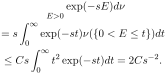
Searchable transcription
E>0
exp(−sE)dν
= s
Z ∞
0
exp(−st)ν({0 < E ≤t})dt
≤Cs
Z ∞
0
t2 exp(−st)dt = 2Cs−2.
The final equality follows by substituting and integrating
 exp(
 ) twice by parts. A bound initially supplied only for 0
 1 extends to all u by increasing C to at least
 (total), since
 1 for
 1. Applied to the scalar spectral measure of a word vector, this is the estimate for
 (exp(
 . It leaves the zero-energy atom separate throughout.
Searchable transcription
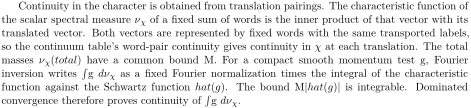
Continuity in the character is obtained from translation pairings. The characteristic function of
the scalar spectral measure νχ of a fixed sum of words is the inner product of that vector with its
translated vector. Both vectors are represented by fixed words with the same transported labels,
so the continuum table’s word-pair continuity gives continuity in χ at each translation. The total
masses νχ(total) have a common bound M. For a compact smooth momentum test g, Fourier
R g dνχ as a fixed Fourier normalization times the integral of the characteristic
inversion writes
function against the Schwartz function hat(g). The bound M|hat(g)| is integrable. Dominated
R g dνχ.
convergence therefore proves continuity of
For the heat multiplier exp( ), use a smooth bump equal to one on the Euclidean ball of radius 2N and supported in the ball of radius 3N. On the forward cone, outside the smaller ball
 . Thus the error in every phase is at most M exp(
 ), tending to zero uniformly in
 The heat pairings are consequently uniform limits of the continuous compact-test pairings, and are continuous. These arguments supply the heat continuity and shell-to-heat steps used in the removal of exceptional characters. The preceding time-average argument supplies the shell bound; the compression-valued word construction below supplies continuity of the word pairings.
Removal of exceptional characters in vacuum uniqueness
From almost every phase to every phase The measure-theoretic argument first gives the relevant property outside a null set of characters. To obtain it at every character, one also needs continuity of the fixed probe readings and full support of the phase measure. A nonzero continuous violation would persist on a nonempty open set, which full support gives positive measure. The common countable probe family makes the exceptional set compatible before this continuity argument is applied. Almost-everywhere statements alone would not establish the asserted all-phase conclusion.
The phase measure has full support: every nonempty open subset of the compact character space has positive measure. Consequently a closed set containing almost every character is the whole space; otherwise its nonempty open complement would have both positive measure and measure zero.
For a finite sum of compactly supported words w let be its vector in phase
 and Ω
 its vacuum. The construction supplies a common
 0 and, for almost every
 , a unique heat ground state together with the inverse-square estimate for the zero-energy-subtracted heat pairing. In those
phases the zero-energy projection is the vacuum projection. Indeed the heat attachment sends its range into the one-dimensional heat ground space; normalization and self-adjointness determine its scalar coefficient as
 Ω
 . Thus for each
 1 almost every
 obeys

Searchable transcription
0 ≤⟨xχ, exp(−sHχ)xχ⟩−|⟨Ωχ, xχ⟩|2 ≤Ms−2.(4)
For fixed s this pairing is continuous in , as is the vacuum overlap. The set where (4) holds is therefore closed. Full support extends (4) to every
 , with the same M. This step uses continuity of heat pairings, without first assuming continuity of the ground projections themselves. Fix
 and let s tend to infinity. The spectral theorem gives strong convergence exp(
 for nonnegative
 Equation (4) yields
 Ω
 Since
 is an orthogonal projection fixing Ω
 , expansion of the norm gives
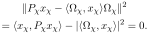
Searchable transcription
∥Pχxχ −⟨Ωχ, xχ⟩Ωχ∥2
= ⟨xχ, Pχxχ⟩−|⟨Ωχ, xχ⟩|2 = 0.
Thus acts as the vacuum projection on these compact word vectors. Approximate each Schwartz test in a word by compact cutoffs. Continuity of the joint smeared word map gives convergence of the word vectors, and boundedness of the two projections transfers their equality to every Schwartz word vector. Cyclicity and boundedness then extend it to the whole Hilbert space. This proves rank-one zero energy in every character, supplying the vacuum-projection heat limit used in the weak-commutant argument. The low-energy estimate, character probability construction, heat-pairing continuity and attachment arguments in this chapter provide the ingredients used here.
Propagation of analytic limits on a complex slice
Here is the analytic limit argument needed when continuing strict Euclidean values to real-time slices. Let be open and connected, let
 be eventually holomorphic on
 , and suppose that at each
 some ball
 ) has a common bound
 on a tail of the indexing filter. The tail may depend on the ball. If a holomorphic
 is the pointwise limit on a subset accumulating at an interior point of
 , then
 ) at every

First derive the requisite local equicontinuity. Choose 0 with
 , put
 min(
 2, and
 = max(1
 ). For
 ), the closed disc of radius
 about
 lies in

 . The Cauchy derivative estimate gives

 on the common tail. Integration along the segment from
 to
 ) yields

Searchable transcription
|Fa(y) −Fa(x)| ≤D|y −x|.
If has pointwise limit
 throughout
 , passing to the limit gives the identical local Lipschitz estimate for
 . Given
 0, restrict further to
 ) and use
 4. The triangle inequality proves local uniform convergence to
 ; hence
 is holomorphic.
To remove the assumption of an everywhere pointwise limit, pass to an arbitrary ultrafilter finer than the original filter. Each scalar family ) is eventually in a compact closed disc, so this ultrafilter has a limit
 ) for every
 . The preceding argument makes
 holomorphic. At every point of the prescribed accumulation set its value equals
 , by uniqueness of scalar limits. The identity theorem gives
 throughout
 . Thus every finer ultrafilter converges to
 ), proving convergence along the original filter. This argument applies equally to the boundary-height filter and to limits of phase characters, and uses only local bounds on tails.
Source: A Wilson Yang–Mills Construction: A Natural-Language Mathematical Exposition. Both papers belong to one Zenodo record. No external funding.