Quantum Source Completions and Memory–Environment Tradeoffs
Universal qutrit lower bounds
Universal qutrit lower bounds
Process, observability and the complete-channel task

Searchable transcription
Let 0 < λ < 1, r = 1 −λ, and

Searchable transcription
Taa = λ/3,
Tab = (3 −λ)/6 (a ̸= b).
The stationary delayed-trine law is

Searchable transcription
n−2
∏︂
P(w1 · · · wn) = 1
t=1
Twt,wt+2,
n ≥2.
9

Searchable transcription
All words are positive. Let CP maps Ψj : M3 →M3, with ∑︁
j Ψj trace preserving, and stationary
τ realize this entire law. Write σab = 9ΨbΨa(τ) for the normalized pair state, Ej = Ψ∗
j(I), and
Fab = Ψ∗
aΨ∗
b(I).
The eigenvalues of T are 1, −r/2, −r/2. Consequently the two-past/two-future matrix

Searchable transcription
Hab,cd = 1
9TacTbd = 1
9 Tr(σabFcd)
has ordinary rank nine. The nine pair states and nine pair effects are therefore separately bases of the Hermitian qutrit operator space. The same cut rules out internal dimension below three, so every admitted qutrit realization in this parameter range is automatically memory-minimal; this is not an extra restriction on the source class. In particular

Searchable transcription
9
∑︁
ab σab is faithful.
The next-two probabilities after any longer history ending in b, j agree with those after b, j. Since the
future-pair effects span the entire operator space, these predictive equalities force actual memory-state
equalities. Thus
Ψj(σab) = Tajσbj,
ΨkΨj(X) = Tr(FjkX)σjk.
(30)
Every single branch has linear rank three: its image is precisely the three-dimensional span of  . This observable-state argument does not permit an extra inaccessible history variable to be added to a nominal three-dimensional source. For a finite horizon define the complete classical-record channel

Searchable transcription
Cn(X) =
∑︂
w
|w⟩⟨w|A ⊗Ψw(X),
Ψw = Ψwn · · · Ψw1.
Its output retains final memory and the classical word archive, as well as an arbitrary inert reference to the input. Put rank
 ). This is the minimum initially pure Stinespring bath dimension for this specified final channel. It is not a peak-hardware count or a product of independently minimized time cuts. The one-step analysis’s universal one-step bound remains applicable: a CP qutrit map of linear rank three needs at least three Kraus operators, so
 9. The full elementary proof is reproduced in Appendix A; the general apparatus sum-of-Kraus-ranks rule is established measurement-model theory. The present improvement uses additional dynamics and support geometry, beyond that one-step lemma.
A rank-three CP map cannot make a rank-two input pure
Lemma 7.1 (No plane-to-ray output at linear rank three). Let be CP with complex-linear rank three. If
 rank
 , and
 , then rank Φ(

Proof. If is faithful and its output is pure, positivity places the image of every Kraus operator on the same output line; the entire map then has rank one. It remains to treat a rank-two input supported on a plane
 . Suppose its output lies on the ray
 . Each Kraus operator maps all of
 into that ray. Choose
 orthogonal to
 and a basis
 of
 . The responses on
 are multiples of
 and the remaining responses are

Searchable transcription
W = Φ(|u⟩⟨u|) ≥0,
Ci = Φ(|pi⟩⟨u|) = |v⟩⟨zi|,
C†
i .

Searchable transcription
The nonzero pure response implies V belongs to the image. If the whole output support is the line v,
the map has rank one. Otherwise W has a nonzero positive block on v⊥, since it is the only response
capable of supplying such a block. If some zi has a component on v⊥, the two cross directions Ci, C†
i ,
modulo V , are independent; their opposite off-diagonal blocks distinguish them. Together with V and
W they give at least four independent image directions. If no zi has such a component, the image is
contained in span{V, W} and has rank at most two. Neither alternative has rank three.
The missing rank is substantive: CP maps of linear ranks two and four can both collapse a positive plane input to a ray. The code gives explicit examples. A rank-three map with two-dimensional input and output supports also exists, so one cannot simply declare all branch supports faithful.
Corollary: every pair state and effect has rank at least two. The first-symbol state has the same support as Ψ
 ) because
 is faithful. That support cannot be a line, as the branch has linear rank three. Hence rank
 2, and the lemma applied to Ψ
 ) proves

Searchable transcription
rank σab ≥2
for every a, b.
(31)
For the effects, use the stationary adjoint reverse instrument

Searchable transcription
 ̃︁Ψj(X) = τ 1/2Ψ∗
j(τ −1/2Xτ −1/2)τ 1/2.
It is CP, its summed map is trace preserving and stationary at , and its word probabilities are the reversed original word probabilities. Since
 is symmetric, it realizes the same delayed-trine law. Its
pair state for . Congruence preserves rank, so applying (31) to this qutrit source gives rank
 for every
 (32)
This reverse is a constructed CP realization; microscopic time-reversal symmetry is not assumed. After two steps each word map in (30) is measure-and-prepare. For longer words its input effect is a positive scalar times , and its output state is
 . Its Choi rank is their rank product, at least four. Therefore


This conclusion applies word by word and already holds at horizon two.
Support incidence and preliminary horizon estimates
Let ran Ψ
 ) and
 ran
 . Their dimensions are two or three; an input or output support of dimension one would give branch rank at most one. Let

Searchable transcription
A = {j : dim Qj = 3},
B = {j : dim Pj = 3},
a = |A|, b = |B|.
Pair states in column are supported on
 , and pair effects in row
 are supported on
 . No two two-dimensional output supports are the same plane, because six independent pair states cannot all lie in its four-dimensional Hermitian operator space. The analogous input-plane statement follows from independence of the pair effects. Suppose
 and
 are both planes. If their overlap projection
 has rank two, compression by this invertible 2-by-2 matrix induces an invertible map on the four-dimensional plane-operator space. The composition Ψ
 Ψ
 then factors through two maps of rank three and an invertible map on that four-dimensional space. Sylvester’s rank inequality gives composition rank at least 3 + 3
 contradicting (30). Thus the projection has rank one, or equivalently

Searchable transcription
ker Ek ⊆Qj
whenever dim Pk = dim Qj = 2.
(33)
Two distinct output planes intersect in a line. They cannot contain two distinct input-kernel lines. Therefore there cannot be at least two planes on both sides: 1 and
 1 are impossible. There is a further extreme-case obstruction. If all three input supports are planes (
 = 0) and any output plane exists, all three input-kernel lines lie in that output plane. Their orthogonal input planes share a common line
 . Hermitian operators supported on three planes sharing
 span at most eight dimensions: one for the projector onto
 , four for cross terms between
 and
 , and at most three for the remaining plane directions. This contradicts the nine independent effects. Hence
 = 0 forces
 = 3. The dual argument gives
 = 3. These obstructions imply the necessary condition

Searchable transcription
a + b ≥3.
(34)

Searchable transcription
No sufficiency or CP attainability is claimed for a support pattern satisfying this inequality. At least
three of the six branch input/output support matrices are faithful. The argument is independent of
any cyclic covariance.
Put Sσ = ∑︁
ij rank σij and SF = ∑︁
ij rank Fij. If i ∈A, the first-symbol state ρi is faithful; its
output under Ψj has support exactly Qj. Thus σij has rank three whenever i, j ∈A. Similarly Fij has
rank three whenever i, j ∈B, since a faithful Ej satisfies Ψ∗
i (Ej) ≥cEi. Therefore

Searchable transcription
Sσ ≥18 + a2,
SF ≥18 + b2.
(35)
For 4 the initial and final pairs can be freely combined, giving the exact identity

Searchable transcription
Rn = 3n−4SF Sσ.
The minimum allowed product in (35) under 22 = 418. Thus

Searchable transcription
Rn ≥418 3n−4
(n ≥4).
(36)
The use of branch support geometry strengthens a bound based only on individual pair ranks. The pure-output argument below gives the sharper coefficient 437. At the shorter horizons let . Counting the same forced rank three pairs in a word gives
Searchable transcription
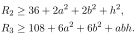
R2 ≥36 + 2a2 + 2b2 + h2,
R3 ≥108 + 6a2 + 6b2 + abh.
Minimizing with 3 and
 max
 yields

Searchable transcription
R2 ≥46,
R3 ≥138.
(37)
For example the boundary profiles give the following relaxed minima:

 lower bound
 lower bound
 lower bound
 54 162 486
 46 138 418
The finite enumeration is reproduced exactly with integer counts in the code; the constraints are necessary, not constructions of the mixed profiles. Equality in (36) would require mixed profiles ( 1) with rank sums (19
 22) or its reverse. The construction in the main text realizes (19
 24) and improves the attainable coefficient to
 99; the new main-text obstruction raises the lower coefficient to 437; attainment of that value remains unresolved.