Quantum Source Completions and Memory–Environment Tradeoffs
A universal one-step qutrit dilation bound
A universal one-step qutrit dilation bound
The branch-image dimension forces a lower bound on Choi rank. The following elementary proof treats every complex qutrit CP map with the stated linear rank, without a covariance or source-encoding assumption.
A CP map of qutrit linear rank three needs at least three Kraus operators
Lemma A.1 (Kraus rank from three image directions). If a nonzero CP map has complex-linear rank three, its Choi rank is at least three.
Searchable transcription
Proof. A one-Kraus map X ↦→AXA† has linear rank (rank A)2, which cannot equal three. Suppose
two Kraus matrices A, B suffice.
First consider input support of dimension at most two. Dimension one gives rank at most one.
On a two-dimensional support, an invertible input congruence normalizes A†A + B†B to identity
without changing linear rank. If the resulting trace-preserving map had rank three, its Hermitian
kernel would contain a nonzero traceless X. Diagonalizing X gives orthonormal u, v with equal outputs
Φ(|u⟩⟨u|) = Φ(|v⟩⟨v|) = ρ. This common output has rank at most two. Positivity places all four Kraus
vectors Au, Bu, Av, Bv in its support, reducing the output to dimension two. If ρ has rank one the image
is one-dimensional. Otherwise write the two output-vector matrices as M0 = √ρU0 and M1 = √ρU1,
where U0, U1 are 2-by-2 unitaries. The off-diagonal response is C = √ρU√ρ, U = U0U†
1, and trace
preservation gives Tr(ρU) = 0. A positive weighted average of the two unit-modulus eigenvalues of
U can vanish only if they are antipodal. Hence U is Hermitian up to a common phase, and C† is
proportional to C. The entire image then lies in span{ρ, C}, contradicting rank three. The same
argument applied to the adjoint handles output support of dimension at most two.
It remains to treat full input and output support. If the pencil A + tB contains an invertible
matrix, a unitary change of Kraus basis makes the first Kraus matrix invertible. An invertible output
congruence then reduces the map to X ↦→X + CXC†. Its superoperator is I + C ⊗C. Among three
eigenvalues c1, c2, c3 of C, no diagonal product |ci|2 equals −1, and at most two unordered pairs can
satisfy cicj = −1: all three pairs would force one product to be positive. The algebraic multiplicity of
−1 is therefore at most four, also for defective C. The superoperator has rank at least five.
Finally suppose every pencil matrix is singular. Some linear combination has rank two; otherwise
two rank-one matrices either have common image or common kernel, contradicting full supports.
For invertible L, R, replacing both Kraus matrices by LAR, LBR composes the map with invertible
input/output congruences. This preserves CP and complex-linear rank, although it need not preserve
trace normalization. Such transformations put
Searchable transcription
(︄
D
c
q
b
)︄
A = diag(1, 1, 0),
B =
.

Searchable transcription
The coefficients of t, t2 in det(A + tB) ≡0 give b = 0 and qc = 0. Full supports give q, c ̸= 0. A
matched invertible two-dimensional change of basis preserving A puts c = e1, q = eT
2 , so

Searchable transcription
⎛
⎜
⎝
a
b′
1
s
d
0
0
1
0
⎞
B =
⎟
⎠.
The cubic coefficient gives det
 = 0. Subtracting
 times row three from row two, then
 and

times column three from columns one and two, preserves and gives
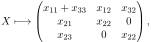
 . Its CP map is
Searchable transcription
⎛
⎞
⎜
⎝
x11 + x33
x12
x32
x21
x22
0
x23
0
x22
X ↦−→
⎟
⎠,
of linear rank six. Every case contradicts rank three.
The qubit-support reduction also follows from the standard two-Kraus qubit canonical form of Wolf and Perez-Garcia [16], Eq.(5); the proof above supplies the elementary argument actually
used. The displayed singular-pencil map has six independent image directions by direct inspection. The supplement also supplies an independent rational row-reduction check of this normal form in supplement/check_structural_lemmas.py.
Universal one-step bath consequence. By (30), every branch of any minimal qutrit realization needs at least three Kraus operators. Its classical-record channel has Choi rank at least 3 + 3 + 3 = 9. This is a universal lower bound for the declared qutrit realization class. The exact normal measurement-model apparatus rule is an established antecedent: Pellonpää and Tukiainen, Rep. Math. Phys. 79, 261–278 (2017), Eq.(22), Corollary 1 and the finite-dimensional apparatus bound, DOI 10.1016/S0034- 4877(17)30040-X, https://arxiv.org/abs/1509.08886. Pure initial apparatus and a sharp pointer are retained hypotheses.