Quantum Source Completions and Memory–Environment Tradeoffs
A mixed-support qutrit source with lower complete-history cost
A mixed-support qutrit source with lower complete-history cost
Mixed input/output support profiles are compatible with a completely positive, stationary, full-law source. At 100 the construction below has one faithful output branch and two faithful input branches, and generates the entire delayed-trine law. Its complete retained-memory/classical-history channel has


The coordinate-plane Weyl sources attain 54 instead. This reduces the long-horizon coefficient by 30
 81, about 6
 173%. A separate universal obstruction below raises the lower coefficient from 418 to 437, leaving the interval [437
 456]. The specified source uses fifteen one-step Kraus operators, compared with the separate optimum nine: the improvement is in the complete final channel task, not in every resource simultaneously.
Task and baseline identities

Searchable transcription
Write Φj : M3(C) →M3(C) for autonomous CP symbol maps, with ∑︁
j Φj trace preserving and
stationary preparation τ. The target transition matrix and stationary word law are

Searchable transcription
n−2
∏︂
Taa = λ/3,
Tab = (3 −λ)/6 (a ̸= b),
P(w1 · · · wn) = 1
t=1
Twt,wt+2.
9
All symbols range over . At the parameter considered here,
 100 and
 200 for
 . The complete channel is

Searchable transcription
Cn(X) =
∑︂
w
|w⟩⟨w|A ⊗Φw(X),
Rn = rank J(Cn).
It retains final memory and the classical archive, including any inert input reference. is the minimum pure Stinespring remainder dimension for this specified final channel, rather than peak causal hardware or the number of append-only records. The comparisons below use this same task and the same three-dimensional internal input/output type. For a full-law minimal qutrit source the basis-complete reset proof establishes that the nine normalized pair states
 are an operator basis and

Searchable transcription
Φj(σab) = Tajσbj,
ΦkΦj(X) = Tr(FjkX)σjk,
Fjk = Φ∗
jΦ∗
k(I).
(38)
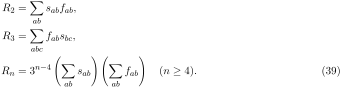
Consequently, with = rank
 and
 = rank

Searchable transcription
R2 =
∑︂
ab
sabfab,
R3 =
∑︂
abc
fabsbc,
Rn = 3n−4
(︄∑︂
)︄(︄∑︂
)︄
ab
sab
ab
fab
(n ≥4).
(39)
The final identity counts freely chosen first/last pairs; the intervening strictly positive weights do not change Choi ranks. We explicitly verify (38) for the source below, rather than assuming that a PSD factorization alone yields a recurrent source.
Explicit algebraic source

Searchable transcription
Let (e0, e1, e2) be an orthonormal qutrit basis and ω = (−1 + i
√
3)/2. Set

Searchable transcription
p = 32
35,
c = 7
20,
u1 = e1 −e2
√
2
,
u2 = e1 −ωe2
√
2
.
The two output planes are = span
 2. Define the unit vectors and their projectors

Searchable transcription
√︃3
√︃32
√︃3
√︃32
w1 =
35e0 +
35e1,
w2 =
35e0 −
35e1,
w3 = e2,
Wl = |wl⟩⟨wl|.
The pair states in column zero are

Searchable transcription
σ00 = W1 + W2 + W3
3
,
σ10 = W2 + W3
2
,
σ20 = W1 + W3
2
.
(40)
Put 35 and
 70. The remaining states are

Searchable transcription
σab = (1 −qa)|e0⟩⟨e0| + qa|ub⟩⟨ub| + zab|e0⟩⟨ub| + zab|ub⟩⟨e0|,
b = 1, 2.
(41)

Searchable transcription
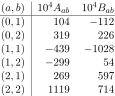
2(Aab + Babω), and all coefficients are exact:
Here zab =
√
Searchable transcription
(a, b)
104Aab
104Bab
(0, 1)
104
−112
(0, 2)
319
226
(1, 1)
−439
−1028
(1, 2)
−299
54
(2, 1)
269
597
(2, 2)
1119
714

Searchable transcription
All source matrices have entries in the algebraic field K = Q(
√
6, ω): the
√

Searchable transcription
2 in z cancels the denominator
of ub, and w1, w2 projector cross terms are ±4
√
 Let vec stack matrix rows consistently, and form the nine-by-nine matrices

Searchable transcription
S:(a,b) = vec σab,
(Bj):(a,b) = Taj vec σbj,
with columns indexed lexicographically by ( . Define the entire arbitrary-input maps by

Searchable transcription
vec Φj(X) = BjS−1 vec X.
(42)
The inverse exists by the exact certificate. Equation (42), together with the small rational table, specifies each map exactly and independently of horizon.

Searchable transcription
The first branch has a direct measure–prepare realization.
Let vl = (e1 +ωle2)/
√
2, l = 0, 1, 2.
Then

Searchable transcription
2
∑︂
Φ0(X) = 2c
l=0
⟨vl|X|vl⟩Wl+1,
E0 = Φ∗
0(I) = c
(︁|e1⟩⟨e1| + |e2⟩⟨e2|
)︁.
(43)
3

Searchable transcription
The three Kraus operators are
√︁
 . Their vectorizations are independent because the
 are independent. Thus this branch has Choi rank exactly three, plane input support and full output support. The antipodal relations
 = 0 and
 = 0 explain the two rank-two states
 while the common entrance line
 is killed. This gives a concrete mixed-support branch mechanism.
Exact certificate and full-law proof
Lemma 8.1 (Exact algebraic admissibility). For the explicit data above, S is nonsingular; all nine  are positive semidefinite of trace one. The maps in (42) are CP. Branch zero is precisely (43); branches one and two have Choi matrices positive definite on
 and
 , respectively, and zero on the orthogonal output complements. Their Choi ranks are six each.

Searchable transcription
Certificate verification. The supplied exact verifier certifies this lemma with arithmetic in Q(
√
 not floating-point eigenvalue signs. It checks nonsingularity, symbolic equality with (43), exact Hermiticity/support and positive leading principal minors of the two six-dimensional Choi compressions. State positivity follows from
 0 for the six plane states, and from independence of the explicit
 in (40). All certificate values and verification instructions accompany the source. Floating-point reconstruction, useful only as a diagnostic, gives a smallest supported Choi eigenvalue approximately 3
 . This diagnostic is not used to establish positivity.
Theorem 8.2 (Stationary full-word attainment at The maps in (42), initialized at


Searchable transcription
9
∑︁
ab σab, generate every finite word of the stationary delayed-trine process at λ = 99/100.
Proof. CP is supplied by the certificate lemma. On each basis state,

Searchable transcription
Tr
∑︂
j
Φj(σab) =
∑︂
j
Taj = 1 = Tr σab.

Searchable transcription
Since the states are an operator basis, the summed map is trace preserving on all inputs. The initial
state is faithful because it includes a positive multiple of the faithful σ00. Double stochasticity of T
gives
∑︂
j
Φj(τ) = 1
∑︂
abj
Tajσbj = 1
∑︂
bj
σbj = τ.

Searchable transcription
9
9

Searchable transcription
Moreover
Φj(τ) = 1
b
σbj,
ΦkΦj(τ) = 1
b
Tbkσjk = 1
∑︂
∑︂
9σjk.
9
9
Every adjacent pair therefore has probability 1 9 and the designated posterior state. Repeatedly applying the exact basis relation Φ
 yields the stated product for all longer words. It also proves (38) on each basis operator and hence on arbitrary operators. No fitted finite word list is used to infer the full law.
Exact ranks and improved horizon boundary
Theorem 8.3 (Attainable mixed-support resources). This fixed source has

Searchable transcription
⎛
⎞
⎛
⎞
⎜
⎝
3
2
2
2
2
2
2
2
2
⎜
⎝
2
2
2
3
3
3
3
3
3
[sab] =
⎟
⎠,
[fab] =
⎟
⎠.
In particular , branch support counts
 , and one-step recorded-channel Choi rank

Proof. The state ranks follow from the certificate lemma and (40). Branches one and two have full input support because their supported Choi matrices are strictly positive; their output supports are exactly . Thus
 are faithful, whereas
 has plane support
 span
 . For every
 ) gives

Searchable transcription
F0k = 2c
∑︂
l
⟨wl+1|Ek|wl+1⟩|vl⟩⟨vl|.
3

Searchable transcription
All three coefficients are positive: for k = 0 their weights are cp, cp, c, and for k = 1, 2 positivity follows
from faithfulness. Therefore every F0k has rank two on P. For j = 1, 2 and each nonzero input vector
x, strict Choi positivity on C3 ⊗Qj implies ⟨x|Φ∗
j(Ek)|x⟩> 0 whenever the compression of Ek to Qj
is nonzero and positive semidefinite. That compression is faithful for k = 1, 2, and nonzero rank one
for k = 0. Hence all six Fjk are faithful. Finally the Choi supports of the three classically recorded
branches are orthogonal, so their ranks sum to 3 + 6 + 6 = 15.
Substituting these ranks into (39) gives the claimed exact 50 . Together with the universal bounds, the improved attainable intervals at this parameter are

Searchable transcription
48 ≤Rmin
2
≤50,
145 ≤Rmin
3
≤152,
437 3n−4 ≤Rmin
n
≤456 3n−4 (n ≥4).
The old relaxed profile ( 22) is excluded by the universal theorem below. Attainment of the improved relaxed profile (19
 23), or its reverse, remains open. Our source has one further faithful effect beyond that new bound. At
 = 4 the final certified upper-minus-lower gap is nineteen.
Local persistence, with no claimed certified endpoints. For near 99
 100, replace

Searchable transcription
p ↦−→4λ −3
6 −5λ,
c ↦−→
λ
2p + 1,
q0 ↦−→2p + 1
3
,
q1 = q2 ↦−→p + 1
2
,
keep the rational table fixed, and use the same definitions. Branch zero remains exactly (43), as direct substitution into the trine probabilities verifies. The basis determinant, six state determinants and two supported Choi matrices vary continuously, and all have strict nonzero/positive values at
 100. Thus there is an open nonempty parameter neighborhood on which this same rank profile and 456 coefficient are attained. This existence statement supplies no explicit certified endpoints and does not move the known qutrit memory threshold. The finite-parameter theorem above is the fully specified certificate.
A universal pure-output obstruction: the lower coefficient is 437
The construction above establishes that mixed support profiles exist. A separate positivity argument shows that the former relaxed lower value 418 cannot occur for any admitted qutrit source at any  1. No numerical search or symmetry ansatz enters this obstruction.

Searchable transcription
Lemma 8.4 (A singular composite effect forces a pure output). Let Uj = im Φj. For any full-law
minimal qutrit source, U0 ⊕U1 ⊕U2 = M3(C) as vector spaces: the three states in each column form a
basis of Uj, and all nine states are independent. Suppose Ek has rank two, with kernel line L. Among
indices j with faithful Ej, at most one effect Fjk = Φ∗
j(Ek) can be singular.
Proof. If is singular, choose 0
 ker
 . The positive operator
 ) is nonzero because Tr
 0. Moreover Tr
 = 0. Positivity therefore places ran
 in ker
 is a positive multiple of the rank-one projector
 . Thus
 . Two such distinct indices would put the same nonzero projector in two disjoint branch images, a contradiction.
The faithful hypothesis matters. If
 has a kernel, the chosen input might instead be annihilated; no pure-output conclusion follows. Likewise, this lemma does not assert that all singular composite effects are impossible: one faithful-input branch may supply the ray.
Theorem 8.5 (Universal complete-history lower bounds). For every stationary autonomous qutrit realization of the entire delayed trine process at any feasible

Searchable transcription
R2 ≥48,
R3 ≥145,
Rn ≥437 3n−4
(n ≥4).
(44)
Proof. Retain the preliminary notation rank Φ
 rank
 , and

 . The baseline support-incidence proof gives
 3, and every pair state/effect has rank at least two. There are forced rank-three states in
 and forced rank-three effects in
 let
 be the sole index outside
 . The lemma implies that at least one of the two additional effects
 , has rank three. Consequently
 18 + 4 + 1 = 23, improving the old 22. Stationary adjoint reversal preserves the full passive law and exchanges state/effect ranks with transposed indices. Thus
 = 2 similarly implies
 23. The complete rank-sum bounds are therefore

Searchable transcription
Sσ ≥g(a),
SF ≥g(b),
(g(0), g(1), g(2), g(3)) = (18, 19, 23, 27).

Searchable transcription
Minimization under a + b ≥3 gives min g(a)g(b) = 19 · 23 = 437, at profiles (1, 2) or (2, 1). The
alternatives (0, 3), (3, 0) cost at least 486; (2, 2) costs at least 529; all other allowed profiles are higher.
Equation (39) proves the long-horizon bound.
For completeness the short-horizon counting retains the labels, not just rank sums. Consider
(a, b) = (1, 2), put h = |A ∩B| ∈{0, 1}, and let k /∈B. The old forced pairs yield R2 ≥46 + h2 and
R3 ≥138 + 2h. The new faithful Fjk adds at least sjk ≥2 at horizon two. At horizon three it adds
∑︁
l skl, which is at least seven when k ∈A (h = 0), and at least six when k /∈A (h = 1). Thus
Searchable transcription
R2 ≥48 + h2 ≥48,
R3 ≥145 + h ≥145.
Stationary reversal gives the same bounds for (2 1): its word Choi matrices are invertible congruences of adjoints of reversed word maps, so total word Choi ranks are unchanged. The extreme profiles give
 162, while the remaining profiles already exceed 48
 145 from the old forced counts alone. This proves all three inequalities.
The exact integer verifier supplement/memory/six/resources/verify_support_bound.py enumerates all 93 minimal labelled patterns after these forced additions and reproduces 48
It is a check of the finite counting argument, not a test of CP attainability. The analytical lemma supplies that necessary dynamical constraint; no claim that 437 is attained follows. A necessary condition for attaining 437 is now more concrete. In the (1 2) case, exactly one faithful-input branch must map some pure input to the kernel ray of the sole plane-supported effect, while the other branch must avoid that ray in its image. The dual statement applies to (2
 1). Our strictly supported-positive two-plane branches avoid both pure-output degeneracies, explaining their stable 456 coefficient.
Resources and limits
The source’s minimum internal memory dimension is three: the nine-by-nine past/future predictive ma-trix has ordinary rank nine, so any -dimensional quantum realization needs
 9. An implementation of the specified one-step instrument can use a fresh pure fifteen-dimensional port and a three-symbol classical record per clock tick. The independently initialized ports do not carry preinstalled history, and the stationary initial memory and any retained purifier are declared stock. No returning environment, feedback archive or history-dependent external preparation is used. A time-homogeneous Stinespring isometry exists for the CP instrument; the construction here is an operational quantum-source model, not a specified laboratory Hamiltonian, energy budget or clock design.
 minimizes the pure remainder of the complete final channel, allowing a global dila-tion/compression for that channel. It is not the product of one-step minima and does not prove a causal apparatus can store its entire working bath in dimension
 at every intermediate time. The simple fresh-port implementation uses raw port dimension 15
 before any compression. The prior
 = 9 source therefore remains better on the separate one-step objective, while this source is better on the declared complete history objective. Both retain final memory and a sharp classical archive; neither comparison gives a hardware, speed, work or thermodynamic advantage. The rational coherence table, algebraic CP maps and resource theorem extend the operator-support analysis to the mixed-support source defined here. Standard quantum probabilities, admitted preparation/intervention class, fresh stock, stationary clock, reference and archive conditions remain assumptions. The result supplies neither a new Born-selection principle nor an ontology or consciousness mechanism.
Two typed horizon tasks do have exact qutrit optima
Stationary memory–archive state, initial purifier omitted. For the fixed stationary input and no retained original purifier, the state is

Searchable transcription
Ωn =
∑︂
w
P(w)|w⟩⟨w|A ⊗σwn−1wn.

Searchable transcription
Orthogonal archive blocks give

Searchable transcription
rank Ωn = 3n−2Sσ ≥2 3n
(n ≥2).
(45)
The known orbit source has all nine conditional states of rank two, and attains equality throughout its certified feasible range. This is a complete fixed-input state-rank optimum among the declared qutrit sources. It is a minimum dimension of a global purifier for that state, not a proof of the smallest causal apparatus implementing every intermediate operation.

Searchable transcription
Archive-only channel, original input reference retained.
If final memory is deliberately omitted,
the channel is
Dn(X) =
∑︂
w
Tr(Ψw(X))|w⟩⟨w|A.
Its word Choi blocks are transposed effects, so

Searchable transcription
rank J(Dn) = 3n−2SF ≥2 3n
(n ≥2).
(46)
The stationary adjoint reverse of the orbit source attains this lower bound: its pair effects are congruent to the forward pair states and therefore all have rank two. The reverse is an explicit stationary source with the same complete passive word law. At the known one-step optimum its Kraus ranks are unchanged by adjunction, so its reusable memory is three and its one-step pure apparatus cost is nine as before. The pure Stinespring remainder in (46) includes the omitted final memory. It must not be called an additional external bath independently of that memory. In contrast retains final memory and counts an external purifying remainder. If the original stationary purifier is retained in (45), faithful
 makes the resulting joint-state rank equal to
 , by an invertible input congruence of the Choi matrix; the smaller marginal-state rank cannot be substituted for it.