Quantum Source Completions and Memory–Environment Tradeoffs
Access-dependent distinctions at a common resource optimum
Access-dependent distinctions at a common resource optimum

Searchable transcription
Two parameters h1 ̸= h2 on opposite sides of h∗= (1 +
√
17 4 can have identical
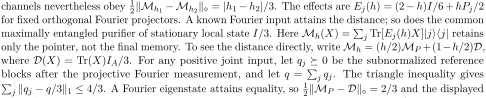
 ) and thus identical full passive laws, dimension three and one-step rank nine. Their common-input pointer channels nevertheless obey

Searchable transcription
2∥Mh1 −Mh2∥⋄= |h1 −h2|/3. The effects are Ej(h) = (2 −h)I/6 + hPj/2
for fixed orthogonal Fourier projectors. A known Fourier input attains the distance; so does the common
maximally entangled purifier of stationary local state I/3. Here Mh(X) = ∑︁
j Tr[Ej(h)X]|j⟩⟨j| retains
only the pointer, not the final memory. To see the distance directly, write Mh = (h/2)MP +(1−h/2)D,
where D(X) = Tr(X)IA/3. For any positive joint input, let qj ⪰0 be the subnormalized reference
blocks after the projective Fourier measurement, and let q = ∑︁
j qj. The triangle inequality gives
∑︁
j ∥qj −q/3∥1 ≤4/3. A Fourier eigenstate attains equality, so 1
 3 and the displayed result follows by scaling. On the common maximally entangled input the pointer/reference blocks are
 3; their difference has the same trace norm, proving the second attainment claim. The technical companion gives an exact algebraic parameter pair and the operational decoder. Physical readability of the purifier is additional access, and passive dimension optimality does not identify a unique generator.