Quantum Source Completions and Memory–Environment Tradeoffs
A quantitative positive-noise interval requiring four quantum dimensions
A quantitative positive-noise interval requiring four quantum dimensions
The diagonal-zero argument proves exact dimension four at zero noise. Its zeros disappear under strictly positive trine noise, so that proof cannot simply be reused. The following quantitative bound establishes a nonempty positive-noise interval with the same minimum dimension. It is an explicit mathematical robustness result; the small numerical constant is not a practical apparatus noise tolerance. For 0 1, put
 and

Searchable transcription
T λ
ii = λ/3,
T λ
ij = 1/2 −λ/6
(i ̸= j),
Cλ = T λ ⊗T λ.
All entries and parameters are dimensionless. Multiplication by the stationary factor 1 9 does not change PSD rank. Every three-dimensional quantum instrument reproducing the full delayed law would give a complex Hermitian PSD factorization of
 of size three through its two-past/two-future cut. The known two-qubit shift construction provides size four and reproduces the entire process, not only this cut.
Proposition 3.1 (A positive-noise dimension-four interval). For

Searchable transcription
0 ≤λ ≤λ0 := 3 × 10⁻⁸,
the complex PSD rank of is four. Consequently the delayed trine process has exact minimum internal quantum memory dimension four throughout this interval, among autonomous CP instruments with an emitted classical symbol and no orthogonal current-symbol storage requirement.

Searchable transcription
Proof. The eigenvalues of T λ are 1, −r/2, −r/2. Hence Cλ has ordinary rank nine, and its second
and fifth singular values are both r/2. A PSD factorization of size d has ordinary rank at most d2,
excluding d ≤2.
Suppose a size-three factorization exists. Normalizing the sum of its row factors by congruence
gives effects Aab ≥0, ∑︁
a,b Aab = I3, and density matrices bcd ≥0, Tr bcd = 1, such that

Searchable transcription
Tr(Aabbcd) = T λ
acT λ
bd.
The normalization is legitimate: a singular sum would restrict all row factors to dimension at most two, already contradicting ordinary rank nine. Column sums of are one, giving the density normalization. Define positive row and column sums of the preparation states,

Searchable transcription
Ra =
∑︂
d
bad,
Qb =
∑︂
c
bcb.

Searchable transcription
Each has trace three and operator norm at most three. Row sums of Cλ give 1 = Tr(Aab
∑︁
cd bcd) ≤
9 Tr Aab, so the largest eigenvalue of Aab is at least 1/27. Moreover

Searchable transcription
Tr[Aab(Ra + Qb)] = 2λ/3.
Evaluating on a largest-eigenvalue eigenvector of therefore yields

Searchable transcription
λmin(Ra + Qb) ≤ε := 18λ
for every a, b.
(13)

Searchable transcription
Set s = 1/2000 and split into two cases.
Case 1: some Ra or Qb has second eigenvalue at least s. By symmetry take Ra. Let P project
onto its two largest eigenvectors, and let z be a unit vector in the complementary line. For each b,
choose a unit nb attaining the minimum in (13). Positivity gives ∥Pnb∥2 ≤ε/s and ⟨nb, Qbnb⟩≤ε.
After choosing the phase of nb, ∥nb −z∥≤
√︁
2ε/s. Thus

Searchable transcription
⟨z, Qbz⟩≤
(︃√ε +
√
2ε/s
)︃2
=: L = ε(1 +
√︂
3
√︂
6/s)2.

Searchable transcription
Since bcd ≤Qd, every preparation has complementary mass Tr[(I −P)bcd] ≤L. The projection/gentle
bound gives ∥bcd −PbcdP∥1 ≤2
√

Searchable transcription
L. Replacing every preparation by its two-dimensional compression
creates a real matrix C′ of ordinary rank at most four. The complete POVM {Aab} contracts the trace
norm of each Hermitian preparation difference, so every column error has l1, hence l2, norm at most
2
√ . There are nine columns; therefore

Searchable transcription
∥Cλ −C′∥op ≤∥Cλ −C′∥F ≤6
√
L.

Searchable transcription
But the best rank-four approximation has error at least the fifth singular value r/2. This contradicts
the numerical bounds below.
Case 2: every Ra, Qb has second eigenvalue below s. Their top-eigenvector projections, denoted Pa
and Q′
b, leave residual trace below 2s. Since bab ≤Ra, Qb,

Searchable transcription
D(bab, Pa) ≤
√
2s,
D(bab, Q′
b) ≤
√
2s,

Searchable transcription
where D is half trace distance. For completeness, the pure-state upper bound D(ρ, |v⟩⟨v|) ≤
√︁

Searchable transcription
1 −⟨v, ρv⟩
follows by convexity and Jensen. Fix P0. Comparing through b0b gives D(P0, Q′
b) ≤2
√
2s, hence
D(bab, P0) ≤3
√

Searchable transcription
2s for every pair. Replacing all preparations by P0 produces a rank-one matrix C′′.
Each error column is a difference of normalized probability vectors and has TV at most 3
√

Searchable transcription
2s. For
a zero-sum real vector v, ∥v∥2
2 ≤2(∥v∥1/2)2, by separately bounding its positive and negative parts.
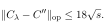
Thus each column has l2 norm at most 6√s, so
Searchable transcription
∥Cλ −C′′∥op ≤18√s.

Searchable transcription
This contradicts the necessary rank-one approximation error r/2.
Here are explicit conservative constants for both contradictions. Since
√
 110, the Case-1 squared error is at most 6



and the Case-2 squared error is 18 . Meanwhile
 49. Also
 1 throughout the interval, justifying the eigenvector estimate. Both cases are impossible. Thus PSD rank is at least four; the supplied two-qubit construction supplies the matching upper bound.
Scope and benefit. This turns the isolated zero-noise dimension obstruction into an explicit positive-noise interval. The constants are deliberately loose; no optimal transition noise or exact middle interval is asserted. CP instruments permit fresh environment ports and retained classical output archives. Internal memory dimension does not count those resources or prove equality of complete microscopic environment laws. Sources with equal complete declared symbol laws remain operationally equivalent for that experiment family.