Quantum Source Completions and Memory–Environment Tradeoffs
Question, contributions and operational scope
Question, contributions and operational scope
Searchable transcription
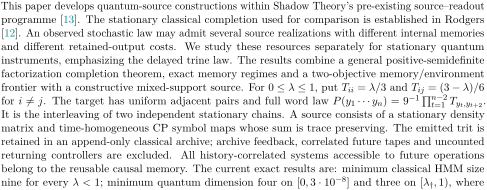
This paper develops quantum-source constructions within Shadow Theory’s pre-existing source–readout
programme [13]. The stationary classical completion used for comparison is established in Rodgers
[12]. An observed stochastic law may admit several source realizations with different internal memories
and different retained-output costs. We study these resources separately for stationary quantum
instruments, emphasizing the delayed trine law. The results combine a general positive-semidefinite
factorization completion theorem, exact memory regimes and a two-objective memory/environment
frontier with a constructive mixed-support source. For 0 ≤λ ≤1, put Tii = λ/3 and Tij = (3 −λ)/6
for i ̸= j. The target has uniform adjacent pairs and full word law P(y1 · · · yn) = 9−1 ∏︁n−2
t=1 Tyt,yt+2.
It is the interleaving of two independent stationary chains. A source consists of a stationary density
matrix and time-homogeneous CP symbol maps whose sum is trace preserving. The emitted trit is
retained in an append-only classical archive; archive feedback, correlated future tapes and uncounted
returning controllers are excluded. All history-correlated systems accessible to future operations
belong to the reusable causal memory. The current exact results are: minimum classical HMM size
nine for every λ < 1; minimum quantum dimension four on [0, 3 · 10−8] and three on [λ†, 1), where

Searchable transcription
17/4. The intermediate dimension is three or four; the iid endpoint needs dimension
one. In the admitted high-noise interval the exact one-step Pareto points are (d, k) = (3, 9) and (4, 3).
Here k is the Choi rank of the channel retaining the classical symbol and final memory, equivalently
its minimum initially pure Stinespring remainder dimension. At λ = .99 a different qutrit source
has one-step cost fifteen but lower complete-history cost, with certified bounds 48 ≤Rmin
2
≤50,
λ† = 1−
√︂
71 −17
√

Searchable transcription
145 ≤Rmin
3
≤152 and 437 3n−4 ≤Rmin
n
≤456 3n−4 for n ≥4. These costs concern distinct tasks:
reusable memory, complete arbitrary-input channels retaining final memory, fixed-input marginal
states, and archive-only channels. They are not interchangeable and are not hardware, energy or
thermodynamic minima. The complete-channel statements retain arbitrary inert input references.
Initial mixed preparation and any purifier, clocks, controls and independent fresh ports remain declared
resources. Equality of passive output laws is not equality under arbitrary interventions.
Searchable transcription
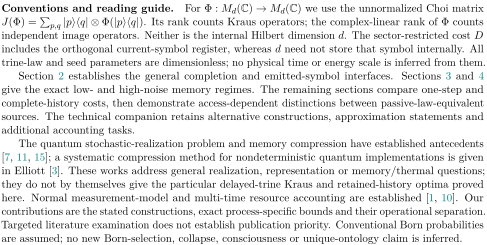
Conventions and reading guide.
For Φ : Md(C) →Md(C) we use the unnormalized Choi matrix
J(Φ) = ∑︁
p,q |p⟩⟨q| ⊗Φ(|p⟩⟨q|). Its rank counts Kraus operators; the complex-linear rank of Φ counts
independent image operators. Neither is the internal Hilbert dimension d. The sector-restricted cost D
includes the orthogonal current-symbol register, whereas d need not store that symbol internally. All
trine-law and seed parameters are dimensionless; no physical time or energy scale is inferred from them.
Section 2 establishes the general completion and emitted-symbol interfaces. Sections 3 and 4
give the exact low- and high-noise memory regimes. The remaining sections compare one-step and
complete-history costs, then demonstrate access-dependent distinctions between passive-law-equivalent
sources. The technical companion retains alternative constructions, approximation statements and
additional accounting tasks.
The quantum stochastic-realization problem and memory compression have established antecedents
[7, 11, 15]; a systematic compression method for nondeterministic quantum implementations is given
in Elliott [3]. These works address general realization, representation or memory/thermal questions;
they do not by themselves give the particular delayed-trine Kraus and retained-history optima proved
here. Normal measurement-model and multi-time resource accounting are established [1, 10]. Our
contributions are the stated constructions, exact process-specific bounds and their operational separation.
Targeted literature examination does not establish publication priority. Conventional Born probabilities
are assumed; no new Born-selection, collapse, consciousness or unique-ontology claim is inferred.