Technical Companion: Detector Interfaces and Retained Outputs
Operational contracts and scope
Operational contracts and scope
This companion develops detector, reference and calibration interfaces within Shadow Theory’s pre-existing source–readout programme [9]. A complete record law, a quantum output channel and a conditional pointer statistic are different interfaces. Every section states which it covers. The optical mode models use introduced interactions, and finite-reference costs apply to a separately declared nondegenerate charge encoding. Established antecedents include Davies–Lewis instruments, mode-selective conversion, Stinespring continuity, WAY/asymmetry constraints, symmetric-state discrimination, polynomial multi-copy estimation and martingale calibration. They are credited in the source text and bibliography [1, 3–6]. The source’s scalar event labels do not supply perspective-admission or conscious-incorporation conditions.
Complete absorbing readers

Searchable transcription
M3: one reader, null output and retained reference.
The normalized matched-template
prescription in [7, pp. 18–21] and [8, Section 32, pp. 42–43] informs the template choice; the absorbing
dynamics and complete instrument are specified here. Let |r⟩be a normalized template in a finite
source space and Π = |r⟩⟨r|.
Fix a duration T ≥0 in seconds and a rate κ ≥0 in s−1, and
set the dimensionless α = κT, η = 1 −e−α. Adjoin an orthogonal absorbing flag f, choose zero
interaction-picture Hamiltonian, and a fixed jump J = √κ|f⟩⟨r|. The source-input instrument has

Searchable transcription
K0 = (I −Π) + e−α/2Π,
K1 = √η|f⟩⟨r|,
K†
0K0 + K†
1K1 = I.
(1)

Searchable transcription
Thus
Eclick = ηΠ,
pclick = (1 −e−α) tr(Πρ),
(2)
which differs from 1 . For arbitrary inert reference
 and joint input


Searchable transcription
I1(ρSR) = η|f⟩⟨f| ⊗⟨r|ρSR|r⟩,
(3)
I0(ρSR) = (K0 ⊗IR)ρSR(K†
0 ⊗IR).
(4)
The inert reference is not traced out: its correct conditional assemblage is retained. The measurement back-action can nevertheless change or destroy original source–reference correlations; retention is not preservation of the input joint state.

Searchable transcription
Proof and time record.
The no-jump propagator solves  ̇K0(t) = −(κ/2)ΠK0(t). A jump at t
has operator density Lt = √κe−κt/2|f⟩⟨r|. Integrating LtρL†
t dt over [0, T] yields the click branch; an
absorbing flag prevents a second click. Completeness follows by integration or Eq. (1). Tensoring
Kraus operators with IR proves the reference formula. Retaining exact click time keeps LtρL†
t dt as a
separate classical record. Time bins integrate over each declared bin and retain its label. Coarsening
that record is an explicit forgetting operation.
□

Searchable transcription
M4: finite bank and tight simplification.
For normalized templates rj, fixed rates κj ≥0,
orthogonal absorbing flags fj and S = P
j κj|rj⟩⟨rj|, choose Jj = √κj|fj⟩⟨rj|. Then

Searchable transcription
K0(T) = e−ST/2,
Lj,t = √κj|fj⟩⟨rj|e−St/2,
(5)
E0(T) = e−ST ,
Ej(T) =
Z T
0
e−St/2κj|rj⟩⟨rj|e−St/2 dt.
(6)

Searchable transcription
Each coarse click map integrates Lj,tρL†
j,t and is CP even without commutation. Differentiating e−St

Searchable transcription
proves E0 + P
j Ej = I. In general the effects are not independent saturated projectors.
For P
j wj|rj⟩⟨rj| = I and κj = κwj, the exact instrument is

Searchable transcription
K0 = e−α/2I,
Kj = √ηwj|fj⟩⟨rj|,
Ej = ηwj|rj⟩⟨rj|,
E0 = e−αI.
(7)
The null probability is state independent and recorded. There is no separate irreversible loss sink in this bank model. Tensoring the operators with retains any inert reference. Conditional click time has density
 , independent of source in this tight case; this need not hold for a non-tight bank.
Searchable transcription
Physical contract and experimental antecedents.
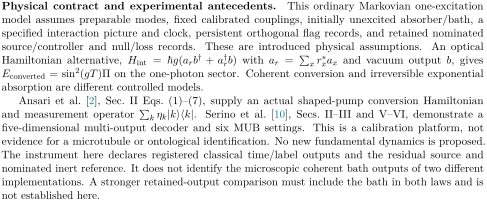
This ordinary Markovian one-excitation
model assumes preparable modes, fixed calibrated couplings, initially unexcited absorber/bath, a
specified interaction picture and clock, persistent orthogonal flag records, and retained nominated
source/controller and null/loss records.
These are introduced physical assumptions.
An optical
Hamiltonian alternative, Hint = ħg(arb† + a†
rb) with ar = P
x r∗
xax and vacuum output b, gives
Econverted = sin2(gT)Π on the one-photon sector. Coherent conversion and irreversible exponential
absorption are different controlled models.
Ansari et al. [2], Sec. II Eqs. (1)–(7), supply an actual shaped-pump conversion Hamiltonian
and measurement operator P
k ηk|k⟩⟨k|. Serino et al. [10], Secs. II–III and V–VI, demonstrate a
five-dimensional multi-output decoder and six MUB settings. This is a calibration platform, not
evidence for a microtubule or ontological identification. No new fundamental dynamics is proposed.
The instrument here declares registered classical time/label outputs and the residual source and
nominated inert reference. It does not identify the microscopic coherent bath outputs of two different
implementations. A stronger retained-output comparison must include the bath in both laws and is
not established here.