Certified Target-Sufficient Readout Design and Exact Finite-Model Reduction
Target-sensitive summary preprocessing and a completed restricted improvement
Target-sensitive summary preprocessing and a completed restricted improvement
The supplied OpenAI preprint’s summary routine (Lemma 3.2, pp. 22–23) scans integer tuples in a box of size (2 . Its Definition 3.1 requires rational-linear replacement forms to be invariant under kernels of the specified integer measurement matrices. The following construction does not replace those conditions by an unproved nonlinear invariant. It preprocesses a declared finite boundary response before invoking a general contraction method, and optimizes the retained information for a specified output task. A concrete rational source example then reduces an exact weighted calculation’s arithmetic work from quadratic to linear in its horizon. This is a restricted reciprocal benefit, not an improved ETH worst-case exponent. The algebra uses established Boolean Fourier analysis [6] and finite-state dynamic programming. The contribution relative to the source–readout completion baseline is an executable synthesis of minimal parity summaries, explicit source/readout and retained-record conditions, and the complete task-specific cost comparison. It is not a new general Fourier theorem, the first use of dynamic programming or a publication-priority claim. It specializes the canonical target-relative completion principle rather than adding a new ontological premise. Rodgers’s target-family completion proposition and relation-versus-target completion theorem already give the abstract coarsening and its universal property[11]. The parity synthesis below is a restricted executable realization and cost analysis, not a stronger abstract minimal-completion theorem. For the boundary example the initial readout can be constant; when a nonconstant original readout must be retained, its coordinates must remain in the sufficient response rather than silently being dropped.
The finite pushforward identity and its cost

Searchable transcription
Let X be a finite boundary domain, μ : X →Q a supplied weight function, F : X →Qq a response,
and h : X →Y a summary such that F = F ◦h. Then
∑︂
x∈X
μ(x)F(x) =
∑︂
F(y)M(y),
M(y) =
∑︂
x:h(x)=y
μ(x).
(1)

Searchable transcription
y∈h(X)
This follows by partitioning the finite sum into disjoint fibres. Signed rational weights are allowed; when weights are probabilities, the right side is the ordinary pushforward probability calculation. Its cost is the cost of constructing or evaluating and computing
 , plus the final sum. A small summary alone does not make an arbitrary weight function easy to push forward. The group-product version clarifies the link to Lemma 3.2. Partition finite assignments into
 and choose summaries
 ). Suppose factor product
 depends only on
 and the other summaries. For an attainable tuple
 ) define

Searchable transcription
Bg(y) =
∑︂
xg:hg(xg)=yg
Ag(xg, y−g).

Searchable transcription
Distributivity gives
∑︂
∏︂
g
Ag(xg, h−g(x−g)) =
∑︂
∏︂
g
Bg(y).
x1,...,xr
y∈∏︁
g hg(Xg)
This is a finite-fibre identity, not a new analytic assumption. Nonlinear Boolean summaries are admitted only after proving this factorization for the actual response. Computing the image, fibre sums and representatives is charged. In particular, one may not use the identity to assert that an arbitrary parity summary supplies the rational-kernel condition for the ETH paper’s Taylor-shifted forms at every interpolation node.
An exact minimum within the parity-summary class

Searchable transcription
Write χa(y) = (−1)a·y for a, y ∈Fb
2. Every vector-valued rational response has the unique Walsh
expansion
F(y) =
∑︂
ˆ︁F(a)χa(y),
ˆ︁F(a) = 2−b ∑︂
y
F(y)χa(y).

Searchable transcription
a∈Fb
2

Searchable transcription
Let KF be the binary linear span of the nonzero-frequency masks with ˆ︁F(a) ̸= 0; the zero mask has no
effect on its rank.
Theorem B.1 (Minimal sufficient parity summary). On the full Boolean boundary cube, factors through
 over
 if and only if
 row

Thus the minimum parity-summary rank is dim . A basis of
 and the coordinates of each supported frequency in that basis supply an exact constructive certificate. For any declared rational linear output projection
 ; strict inclusion can remove summary coordinates required by the full response.

Searchable transcription
Proof. If F factors through H, it is unchanged by translation by every u ∈ker H. Fourier uniqueness
gives ˆ︁F(a) = χa(u) ˆ︁F(a), so each supported a is orthogonal to ker H and belongs to row H. Conversely,
if every supported a lies in that row space, each character χa is a function of Hy, hence so is their sum.
A basis gives attainment, and any sufficient row space has dimension at least dim KF . Applying L
to the expansion can annihilate coefficients but cannot introduce a new frequency, proving the final
statement. All arithmetic for constructing a basis is exact binary Gaussian elimination; no numerical
rank threshold is involved.
If masks are supplied sparsely, basis synthesis takes polynomial work in
 and coefficient bit length, without a full cube scan. Obtaining the sparse expansion can nevertheless require exponential work. The minimum is only among parity summaries, not all nonlinear readouts: Hamming weight on
 bits has Walsh-support rank
 but only
 + 1 output values. Restrictions to an admissible proper subset of the cube can also change the minimum, so the full-domain hypothesis must not be dropped.
A positive stochastic response and its requested marginal
For a boundary word ), let
 be a noisy record of its global parity and let
 be noisy records of the individual first
 1 bits. Specify the response law

Searchable transcription
P(g, z | y) = 1 + α(−1)g+∑︁
b−1
∏︂
i yi
1 + β(−1)zi+yi
2
,
α = 1
2,
β = 1
3.
(2)
2
i=1
Every factor is strictly positive, and independent private noise makes the normalized joint record law. The source and fresh noise stock are independent. This is an ordinary classical stochastic model with explicit rational probabilities. It is not a quantum measurement construction or a selection of a probability law from geometry. Generating at the deadline requires a parity accumulator and a clock; any history-correlated controller available to later production belongs in the physical causal-memory account. The workspace comparison below concerns the mathematical calculation of a probability, not a reduction of that physical apparatus or of its retained archive. The nominated full response can be the
 individual zero-record probabilities, rather than its exponentially large joint table:

Searchable transcription
(︄
1 + αχ1(y)
2
, . . . , 1 + βχeb−1(y)
)︄
2
, 1 + βχe1(y)
F(y) =
.
2

Searchable transcription
Its supported masks 1, e1, . . . , eb−1 span all b dimensions, so every parity summary sufficient for this
full response has rank b. The requested target is only P(g = 0 | y), obtained by the first-coordinate
projection. Its minimum parity-summary rank is one, with the two possible summaries ∑︁
i yi mod 2.
Neither the nuisance outcomes nor their physical records are erased by this mathematical calculation;
they are unread by the nominated target. Computing their complete law remains a different task.
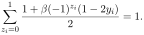
There is an exact compositional elimination before any ETH deformation:
Searchable transcription
1
∑︂
1 + β(−1)zi(1 −2yi)
2
= 1.
zi=0
The equality holds as a rational polynomial identity in , not just on Boolean inputs. Thus tracing these independent noise records locally costs
 ) and yields the target response without constructing
 -entry output table. Conditional or adaptive access to the
 would change the task and invalidate this omission.
An end-to-end exact cost comparison
Use a stationary binary Markov source, with one clock tick per bit,

Searchable transcription
(︄
9
3
4
8
)︄
τ = (4/7, 3/7),
T = 1
.
12
The initial stock has the displayed distribution and is independent of future transition noise. All transition weights are positive, hence the full Boolean boundary is admissible. The task is one exact

Searchable transcription
predicted record probability at horizon b:

Searchable transcription
pb = P(g = 0) = 1 + α E[(−1)
∑︁
i Yi]
2
.

Searchable transcription
A fair integer-summary comparator keeps Hamming weight W = ∑︁
i Yi, not the needlessly large
identity summary. W is a single integer-linear row with b + 1 attainable values (the paper’s symmetric
box would contain 2b + 1). It is sufficient for this target. A standard exact count-histogram dynamic
program stores last bit and current weight. At length t it has 2t nonzero integer cells. Summing all
outgoing transitions over t = 1, . . . , b −1 requires exactly

Searchable transcription
UW (b) = 2b(b −1)
multiply-by-constant/add updates. The target quotient instead retains last bit and parity. It has four nonzero cells from length two onwards, and requires exactly 

Both programs start from integer weights 4 3, use transition numerators 9
 8, and share final denominator
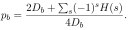
 . If their histogram is
 , they return the same exact rational
Searchable transcription
pb = 2Db + ∑︁
s(−1)sH(s)
4Db
.
For the weight program is an integer count; for the target program it is its parity. Equivalence follows either by summing count states modulo two at each update or directly from Eq. (1). Each integer has
 ) bits and updates use only multiplication by a fixed small integer and addition. Thus the displayed implementations have bit-work upper bounds
 ) versus
 ) and integer-workspace bounds
 ) versus
 ), respectively. These are explicit algorithm bounds, not lower bounds against all possible algorithms. A specialized signed transfer-matrix method can also exploit the same target and need not form a full weight histogram.

 updates parity updates
 live cells parity live cells

Searchable transcription
8
112
52
16
4
32
1984
244
64
4
128
32512
1012
256
4
256
130560
2036
512
4
At = 256 the exact update ratio is 32640
 13. The gain includes the inexpensive local output projection and the pushforward calculation; it is not merely a comparison of summary cardinalities with their construction cost omitted. Wall-clock timings are diagnostic and platform dependent. Both methods compute the same one target probability under the same fixed rational source law. The factored input has length
 compile_target_record checks the local nuisance cancellation with
 1) coefficient additions and constructs the two target Walsh coefficients directly. It does not first build the dense full response or perform an exponential Fourier transform. The table counts DP updates separately from this common linear preprocessing. General sparse Fourier synthesis can cost more. This finite-domain integer-summary comparator is not asserted to satisfy Definition 3.1 for the ETH paper’s rationally deformed polynomials either; the shared object here is its summary-enumeration stage, with a fully proved finite response factorization.
Verification, reciprocal status and limits
The supplied code compiles sparse vector Walsh data to a basis and an exact frequency-coordinate certificate. Verification checks 254 response instances, 6060 complete small parity-map tests against independent fibre equality, direct source-word enumeration for lengths one through seven, and exact agreement of the two integer DPs through length 256. It also checks the Hamming-weight counterexam-ple to unrestricted nonlinear minimality. The code is a conventional exact preprocessor and reference algorithm; it is not the paper’s external ETH counter or contraction routine. This supplies an explicit answer to the reciprocal question at a restricted level: target-relative completion can remove unnecessary summary detail and improve a declared weighted calculation without recovering its full response distribution. It does not prove a new general ETH exponent, improve the best known algorithm for this simple Markov family, or show that the ETH paper overlooked a universally smaller sufficient summary. To use the parity quotient inside that paper’s own recursive Taylor/mode computation, one would additionally need a factorization and coefficient certificate at every transformed node. No such universal claim is made. The result changes computational organization, not physical access. No individual hidden source bit becomes readable through faster marginal calculation. The source, Markov law, independent noise, target projection, clock and unread-record permissions remain assumptions. No quantum resource minimum, Born-selection law or consciousness condition changes.