Certified Target-Sufficient Readout Design and Exact Finite-Model Reduction
Scalable completion design with checkable interrupted bounds
Scalable completion design with checkable interrupted bounds
The circuit interface permits exact source-collision separation with exhaustive menu reoptimization. Here a conventional exact branch-and-bound optimizer replaces exhaustive subset enumeration without changing the source semantics. Its output includes a covering tree, rational dual bounds, genuine source-pair witnesses and a separately validated sufficient incumbent. The improvement is an effective and audited implementation of established integer-optimization ideas, not an implementation of either external ETH algorithm or a new general optimization principle.
Problem, admissibility and lower certificates
Let the menu be [ ], with nonnegative rational prices
 . Each accumulated source collision supplies a set
 ] that every sufficient selection must intersect. A declared feasible family may impose pair incompatibilities, prerequisites
 , a cardinality cap and an additional arbitrary pure decidable predicate. In particular, feasibility need not be upward closed. The implementation accepts that predicate without making unsound assumptions about its values on supersets or partial assignments.

Searchable transcription
A search node assigns some ports S present and some F absent. Propagation closes prerequisites
and their contrapositives, propagates incompatibilities, enforces the cardinality cap, and forces the
unique available element of a still-uncovered cut. An inconsistent node is infeasible. Write DS for the
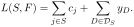
cuts not yet hit and U = [m] \ (S ∪F). For nonnegative numbers yD with
∑︂

Searchable transcription
D∈DS: j∈D
yD ≤cj
(j ∈U),
the following lower bound is valid:
Searchable transcription
L(S, F) =
∑︂
j∈S
cj +
∑︂
D∈DS
yD.
Excluded items are removed from the residual cuts. A cheap greedy dual packing constructs the displayed exactly: process residual cuts and increase the current dual variable by the least remaining price capacity on that cut. This is a valid packing bound, not necessarily the optimal LP value.
Theorem 3.1 (Certified bounded completion optimization). For the finite declared menu and feasibility family, best-first binary branch-and-bound with the displayed lower bound returns an exact optimum or a sound infeasibility conclusion when exhausted. At any interruption, an existing feasible optimizer incumbent of cost and the minimum of the open node bounds and
 certify the restricted optimum interval. The bound is valid for arbitrary non-upward-closed leaf feasibility predicates. A finite covering-tree certificate can verify the interval without enumerating every menu subset or rerunning the optimizer.

Searchable transcription
Proof. An extension A ⊇S disjoint from F must select at least one element of every residual cut.
Therefore
∑︂
j∈A\S
cj ≥
∑︂
∑︂
D∋j
yD ≥
∑︂
D
yD.

Searchable transcription
j∈A\S
All additional admissibility constraints only remove extensions, so ignoring them in this dual calculation is safe. Every propagation rule is a necessary consequence of the declared constraints or a residual one-element cut. Branching on a free item partitions all remaining extensions into those including it and those excluding it. No extension is silently lost. Once the current is itself feasible and hits every cut, it is cheapest within that node: further ports have nonnegative cost. If
 fails an opaque predicate, its supersets are still explored unless every variable is assigned. Thus non-upward feasibility is preserved. Nodes whose lower bound is no smaller than the incumbent are safely pruned. The remaining nodes, incumbent and already closed branches cover the finite family, establishing both the interrupted interval and exact termination statement. A checker replays the covering tree, propagation, each rational capacity inequality, each solution leaf and every pruning inequality. It need not solve another optimization.
Outer source synthesis and safe stopping
The outer counterexample loop uses the unchanged criterion

Searchable transcription
C(x) ∧C(x′) ∧[eA(x) = eA(x′)] ∧[R(x) ̸= R(x′)].
An optimizer incumbent is not automatically a source-sufficient incumbent: it may hit all known cuts and miss a new source collision. Only a completed exact no-collision check promotes a feasible selection to an upper certificate for source completion. A user may provide such a selection initially, but it is verified rather than trusted. Its cost remains a real upper bound even if the run stops before finding another candidate.
Corollary 3.2 (Anytime source-completion interval). Every optimizer lower certificate on genuine collision cuts is a lower bound on the minimum cost of a sufficient feasible selection. A feasible selection with a completed no-collision certificate supplies an upper bound. Matching bounds certify global minimum cost under the declared menu. Interruption, failure to find a collision with an incomplete oracle, and failure to find an optimizer incumbent do not establish source sufficiency or menu insufficiency.
Proof. Every sufficient selection separates each genuine target-disagreeing pair and therefore obeys every stored cut. The restricted optimizer’s feasible family contains all sufficient feasible selections. The previous lower bound thus applies to the true optimum, while the validated incumbent attains its stated upper cost. Equality sandwiches the optimum. If a genuine pair has an empty distinguishing set, no menu subset can separate it. If the necessary cuts are infeasible, no sufficient feasible selection exists. These last two conclusions require the corresponding positive evidence, not an unfinished search.
The supplement exports the final covering tree and one source witness per necessary cut. The checker independently recomputes each witness’s admissibility, original-readout equality, target disagreement and exact distinguishing menu. It validates the tree and replays the declared exact no-collision oracle for the claimed upper selection. This is an oracle-relative certificate interface, not a new proof-logging SAT/UNSAT format. Opaque feasibility is a declared pure predicate supplied unchanged to both optimizer and checker. Certificate bounds and dual weights are exact integers or rational numbers, not in-memory floating-point values; masks and indices have integer types. The public JSON interface parses decimal tokens directly as rational numbers and rejects nonfinite constants before certificate validation. These input contracts prevent rounded arithmetic from being accepted as an exact lower-bound proof. An explicit incomplete example has zero expanded nodes, a certified lower bound zero and a previously validated all-port upper bound 227 3. Its status remains incomplete; that wide interval is reported rather than converted into an apparent optimal result. The tests also cover zero prices, contradictory cuts, cyclic prerequisites, cardinality limits, unknown separation status and non-upward parity feasibility. A less trivial interrupted example has 60 explicit source rows and 24 ports. Twenty-four charged source-oracle queries construct a greedy sufficient starting design of cost 26
 3. A subsequent run limited to sixteen expanded nodes per restricted optimization uses twenty further source-oracle calls (including incumbent revalidation) and certifies

Searchable transcription
6 ≤OPT ≤26/3.
Its status remains bounded, not optimal. Both the lower proof tree and the source-sufficient upper design survive interruption; the input and certificate are supplied. The forty-four source queries include preparation of the incumbent rather than hiding that work outside the comparison.
Scaling the nonlinear predictive-source application

Searchable transcription
For the nonlinear register,

Searchable transcription
2b−1
⨁︂
F0 = x0 ∧
i=0
xi,
Fi = xi (i > 0),
π = x0,

Searchable transcription
we preserve the same raw and disjoint-pair parity menu. An exact structural separator avoids repeatedly
solving its generic CNF when the recognized model promise holds. On x0 = 0 the target is constant.
On x0 = 1, two sources with hidden-bit difference h ∈F2b−1
2
collide exactly when

Searchable transcription
lj(h) = 0
(j ∈A),
⨁︂
i
hi = 1,
where is the selected raw or pair parity functional. Gaussian elimination either supplies
 and a concrete source-pair witness or proves the linear system inconsistent. Conversely, any original collision supplies such a difference, so the separator is complete for this actual nonlinear source family. It is not a generic shortcut for nonlinear circuits. All 292 menu subsets of the one-, two-and three-block models are checked against the inherited circuit/CNF separator. At
 = 20, the method certifies the unchanged optimum 20 using a 59-port menu and 40 source bits, with 40 separation calls and 630 expanded optimization nodes in the recorded run. This extends practical problem size, not the already proved
 versus 2
 1 cost theorem. The extra gain from GF(2) recognition is identified separately from the optimizer gain.
Controlled comparison and non-closed-form examples
The old and new optimizers use the same exact separator within each controlled comparison. Two finite-table families have independently declared initial readouts, random binary target values, rational port prices, incompatibilities and prerequisites. These are explicit finite classical reader menus, not simultaneous assignments to incompatible quantum observables. There is no free target port. No closed-form optimum is assumed for the random constrained instances.
Model Optimum Old subset visits New expanded nodes Oracle calls old/new
Predictive 4 16,384 30 8/8 32 rows, 12 ports
 57,344 128 14/16 40 rows, 14 ports
 327,680 142 20/19
Subset visits and expanded nodes are different units; both are reported rather than presented as a hardware speedup. In the recorded controlled execution with Python allocation tracing enabled, elapsed times were about 0 096 and 6
 136 seconds for old/new respectively. These are reproducible synthetic prototype observations, not a universal runtime theorem or a statistical performance study. The old and new source oracle counts can differ because tied optimum candidates differ. The new method also certifies exact costs 28
 3 for a 60-row, 24-port constrained source and 23
 for an 80-row, 32-port constrained source. Their proof trees and full input tables are included. The latter execution used 77 separation calls, 10,445 expanded nodes and about 39 seconds with allocation tracing. Larger certificates consume additional storage; retaining them is not free. Worst-case runtime, oracle calls and tree size can remain exponential. No general subexponential synthesis bound follows from either ETH paper. The independent reference suite checks 160 exact optimization instances and 640 interrupted bounds against all subsets, 20 full source-table optima and their interrupted runs against direct source-pair enumeration, the 292 GF(2)/CNF comparisons, and rejection of forged dual/global-bound certificates. The implementation uses exact Fraction arithmetic. The distinction between empty admitted sources, impossible readouts and zero prior mass remains with the inherited model interface; this optimizer does not change its prior or probability semantics. The practical contribution to Rodgers’s finite target-descent interface is a checked design procedure that can now stop with an honest cost interval and solve larger constrained menus. Its antecedents are conventional weighted hitting-set branch-and-bound, LP-dual packing and implicit hitting-set synthesis, including Chandrasekaran et al., SODA 2011, DOI 10.1137/1.9781611973082.48, and Moreno-Centeno– Karp, 2013, DOI 10.1287/opre.1120.1139. No worldwide priority is asserted for those methods.