Certification Resources and the Value of Retained Quantum-Reader Records
What richer records can and cannot certify
What richer records can and cannot certify
A full trajectory is a richer observation than its terminal error, but the number of recorded fields alone does not imply a cheaper certificate. This section supplies the missing interface-dependent lower-bound comparison. It also gives an exact trusted-seed repair. These are specializations of classical change-of-measure and safe-testing methods, not new general statistical principles; the programme contribution is a checked account of which source–readout promises permit a resource reduction.
An unrestricted full-record no-free-lunch result
Let be the entire classical record of one completed frozen
 -copy experiment, including any available commands, seed and outcomes, and let
 indicate a wrong terminal sign. At label
 its good law is
 , with
 ). Suppose the admitted model of record laws is closed under changing the error mass while keeping both conditional record laws
 ) fixed. This is an explicit unrestricted observation model, not a claim about the Pauli apparatus.
Theorem 4.1 (Error-mass tilt preserves the terminal information floor). For define

Searchable transcription
{︄
q/ph,
f(z) = 1,
(1 −q)/(1 −ph),
f(z) = 0.
dQh,q
dPh
(z) =
Then is a probability law with error
 and

Searchable transcription
D(Ph∥Qh,q) = kl(ph∥q).
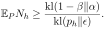
Consequently every sequential validator with access to the full , global false-acceptance probability at most
 whenever some label error is above
 , and good-world acceptance probability at least
 obeys
Searchable transcription
EP Nh ≥kl(1 −β∥α)
kl(ph∥ε)
.
Here completed experiments are fresh and independent conditional on their selected labels; label allocation and stopping may be adaptive. The bound allows an infinite stopping time in a bad world.
Proof. The two density values normalize because the two event masses under are
 and 1
 Integrating their logarithms gives the binary relative entropy exactly. Change only label
 to this alternative, with
 . At a finite global query cap the transcript KL chain rule gives
 kl
 allocation coins have the same conditional law in both worlds. Data processing through acceptance by that cap, followed by monotone convergence as the cap increases and then
 , proves the result. This is the same finite-prefix argument used in the earlier terminal-only analysis and the established sequential change-of-measure literature.
Thus merely reading an unconstrained archive does not defeat the previous information limit. A useful improvement must exploit a restriction on the alternative record laws, not their representation length. Conversely, closure under this tilt must not be silently assumed for a physically specified detector. The tilt can violate a trusted seed marginal, a known erasure law or a declared response family. Such restrictions are genuine additional information and can yield a different frontier.
A trusted-seed information projection and attaining gate
Searchable transcription
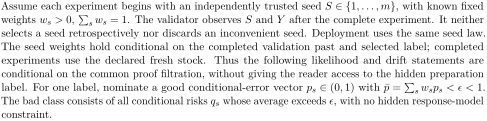
Assume each experiment begins with an independently trusted seed S ∈{1, . . . , m}, with known fixed
weights ws > 0, ∑︁
s ws = 1. The validator observes S and Y after the complete experiment. It neither
selects a seed retrospectively nor discards an inconvenient seed. Deployment uses the same seed law.
The seed weights hold conditional on the completed validation past and selected label; completed
experiments use the declared fresh stock. Thus the following likelihood and drift statements are
conditional on the common proof filtration, without giving the reader access to the hidden preparation
label. For one label, nominate a good conditional-error vector ps ∈(0, 1) with  ̄p = ∑︁
s wsps < ε < 1.
The bad class consists of all conditional risks qs whose average exceeds ε, with no hidden response-model
constraint.
Theorem 4.2 (Seed-informed lower boundary and safe likelihood gate). There is a unique

Searchable transcription
minimizing
Iw(p, ε) =
min
∑︁
∑︂
s
ws kl(ps∥qs).
s wsqs≥ε

Searchable transcription
It satisfies ∑︁
s wsq∗
s = ε and, for one λ > 0,

Searchable transcription
(1 −λ)2 + 4λps
q∗
s −ps = λq∗
s(1 −q∗
s),
q∗
s = λ −1 +
√︁
2λ
.
For the weights trusted above, define

Searchable transcription
fs(1) = ps/q∗
s,
fs(0) = (1 −ps)/(1 −q∗
s).
The product of these observed multipliers is a nonnegative supermartingale under every bad conditional- risk vector. Stop and certify the label when it first reaches . Under the exact good vector
 , or under a coordinatewise smaller conditional-risk vector, it crosses almost surely with expected experiment count bounded by

Searchable transcription
ENh ≤log(1/α) + bw
Iw(p, ε)
,
bw = max
s
log fs(0).
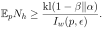
Every seed-informed validator with false-certificate probability at most and good acceptance at least
 instead satisfies
Searchable transcription
EpNh ≥kl(1 −β∥α)
Iw(p, ε)
.
For multiple labels, an intersection–union gate may certify only when every label passes; no confidence split over labels is required.
Proof. The objective is strictly convex in for interior
 . Its unconstrained minimum is
 , which is infeasible, and moving any
 upward toward
 improves the objective and the constraint. The optimum is therefore at the average-risk boundary with
 . Differentiation gives the common positive multiplier equation. The displayed positive quadratic root increases continuously from
 as
 increases, so there is one multiplier giving the nominated boundary.

Searchable transcription
The same equation implies

Searchable transcription
fs(1) −fs(0) = −λ,
∑︂
s
wsfs(0) = 1 + λε.

Searchable transcription
Hence at any alternative vector q,

Searchable transcription
(︄
)︄
EqfS(Y ) = 1 + λ
ε −
∑︂
s
wsqs
≤1.
This proves composite-null validity, including predictable label allocation. Ville’s inequality gives the crossing-size bound. At , expected log increment is
 , and reducing any
 increases that drift since
 (0). Before crossing the log product is below
 log
 ); an upward step adds at most
 Applying the finite stopped increment sum yields
 , and monotone convergence proves finite expectation and almost-sure crossing. For the lower bound, preserve the seed weights, choose errors just above
 , and preserve all other record shapes conditional on (
 ). Per-experiment divergence decreases to
 as that alternative approaches the boundary. The finite-prefix acceptance change-of-measure proof above then applies. An all-label certificate with a bad label requires that particular bad label’s crossing; this proves the intersection–union claim.
This construction specializes established reverse-information-projection safe testing[2] and sequential change-of-measure bounds[4] to the declared reader-seed interface. The contribution is the explicit specialization and verification, rather than a new general information projection or likelihood-testing principle. Log-sum/data processing gives 

Searchable transcription
For interior, heterogeneous ps the inequality is strict. Equality would require both ps/q∗
s and (1 −
ps)/(1−q∗
s) to be constant across seeds. Two distinct ps then force both constants to one, contradicting
 ̄p < ε. Known seed marginal information can therefore improve the terminal-only information floor. It
does not ensure a large improvement for a particular reader.
Actual fourteen-copy check: seed heterogeneity is too small
The verified unsymmetrized fourteen-copy base risks, in label order , are approxi-mately

Searchable transcription
(.008642797684269258, .009021802859698374, .008473934585934470, .008858815447399504).
For each fixed physical label the four trusted root symmetries permute this vector. Thus every label has the same mean . The code constructs a nearby exact rational good-design vector dominating the independently verified outward bounds, and a rational boundary vector with mean exactly
 01. It chooses one rational
 so the quadratic relation is exact. This avoids presenting numerical root finding as a proof. The resulting certified information ratio is

Searchable transcription
Iw
kl( ̄p∥.01) = 1.00000546458 . . . .
It implies only about 0 000546% improvement in the matched information floor. The upper expected source-stock account is below 9
 413292 million for four labels and fourteen copies per complete experiment. This is not the earlier
 00875 rounded planning case: comparisons must use the same
good-risk promise. Root-seed stratification alone is therefore not a meaningful practical advance for this frozen reader. An exact two-seed illustration uses weights (1 019) and
 has mean good error
 00875 and an information ratio 1
 . This checks the strict-gain construction but is not claimed as a new quantum-reader protocol. Reading an even richer archive can help under a justified detector-response model, as in the separate structured protocol. It is that restricted model, not a universal claim that more fields always lower certification cost, that must support any substantive savings. All tests here certify terminal risk only; neither the unread bath nor the complete retained quantum instrument is identified. Expected stopping costs have no finite worst-case completion bound. A selected policy must be frozen before fresh validation, or selection multiplicity must be controlled separately.