Technical Companion: Approximation and Accounting for Quantum Sources
Sharp bath approximation costs with and without retained purification
Sharp bath approximation costs with and without retained purification
Exact Choi rank counts even arbitrarily weak Kraus directions. It does not by itself say what apparatus savings become possible at a prescribed error. For the three-charge qutrit instruments there is a constructive, sharp answer at three useful budgets. The answer differs depending on whether the purifying bath is unread or is part of the compared retained output. This is an application of established spectral approximation and Stinespring methods, not a new general theory of approximate quantum channels. The standard maximum-trace eigenvalue principle and minimum-pure-Stinespring dimension are antecedents [2, 12]; the proofs needed here are supplied below. The added result is exact saturation for the declared charge-orbit channels, with separate retained and unread-bath tasks.
The typed channel and its three trace-scaled components
Let be the reusable memory,
 the registered pointer, and
 an initially pure, fresh purifying bath. The reduced output channel is
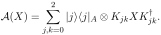
Searchable transcription
2
X
j,k=0
|j⟩⟨j|A ⊗KjkXK†
jk.
A(X) =
Only and the final memory belong to this reduced output; an arbitrary inert reference is retained throughout. In the retained-purification task we instead compare the full isometries into
 The two metrics must not be substituted for one another. Write
 diag
 ) and
 . The rank-one charge blocks give Kraus matrices of the form

Searchable transcription
Kjk = XjK0kZ−j,
|K0k⟩⟩= αk|fk⟩|1⟩+ βk|fk+1⟩|2⟩,
(31)

Searchable transcription
where |fk⟩= 3−1/2 P
p ωpk|p⟩and the vectorization orders input before output. Put νk = |αk|2 +|βk|2 >
0, and assume P
k νk = 1. The three vectors at fixed j are orthogonal. Moreover
X

Searchable transcription
j
K†
jkKjk = νkI3.
(32)

Searchable transcription
Indeed K†
0kK0k is a weighted sum of two conjugate Fourier projectors, so each computational diagonal
entry is νk/3. Twirling it by Z kills the off-diagonal entries and gives (32). Consequently

Searchable transcription
Qk(X) = ν−1
k
X
j
|j⟩⟨j| ⊗KjkXK†
jk

Searchable transcription
is CPTP with Choi rank three, and A = P
k νkQk. The three component Choi supports are mutually
orthogonal, including the pointer factor. The normalized Choi state ρA = J(A)/3 therefore has
eigenvalues νk/3, each with multiplicity three.
Exact approximation theorem

Searchable transcription
Relabel the weights ν(1) ≥ν(2) ≥ν(3) and put pm = Pm
i=1 ν(i), m = 1, 2, 3. A pure bath of dimension b
means the minimum pure Stinespring environment of the specified reduced channel; all fresh apparatus
factors purifying that channel are included.
Theorem. Among all CPTP channels with the same input and reduced output spaces and pure bath dimension at most 3

Searchable transcription
inf 1
2∥e
A −A∥⋄= 1 −pm.
(33)
The infimum is attained by the actual channel

Searchable transcription
m
X
Am = p−1
m
i=1
ν(i)Q(i).
(34)
It retains the same pointer alphabet and needs no added null branch. The normalization defines a new fixed trace-preserving instrument; it is not postselection on original trials. For the full retained pure Stinespring output, allow any bath-only isometric identification of the competitor’s at-most-3 dimensional bath with the target bath. Then the corresponding optimum is

Searchable transcription
inf 1
2∥W −V∥⋄=
p
1 −pm,
(35)
where and similarly for
 . The dimension counts are intrinsic bath dimensions; the isometric embedding only defines a common comparison space. Proof of the reduced statement. For a channel of bath dimension at most
 , its Choi state has rank at most
 projects onto its support, the variational characterization of trace distance gives

Searchable transcription
b
X
1
2∥ρA −ρ e
A∥1 ≥Tr[(I −P)ρA] ≥1 −
i=1
λi(ρA).
The last step follows by diagonalizing : for any rank-
 projector its diagonal weights lie in [0
 1] and sum to
 , so the maximum weighted eigenvalue sum selects the largest
 eigenvalues. Evaluating the diamond norm on a maximally entangled input gives the same lower bound for half diamond distance. For
 this is 1
 For
 = 3 attainment is exact and immediate. Otherwise both
 and the normalized omitted component
 are CPTP, and
 . The half diamond distance of any two channels is at most one, hence

 . The preceding lower bound is equal, proving (33). Orthogonal Choi supports explain why no slack remains. Proof of the retained statement. Use a bath basis
 and define

Searchable transcription
V =
X
j,k
|j⟩A ⊗Kjk ⊗|j, k⟩B,
Wm = p−1/2
m
X
j, k retained
|j⟩A ⊗Kjk ⊗|j, k⟩B.

Searchable transcription
Both are isometries by (32), and
V †Wm = √pmI3.
(36)
Searchable transcription
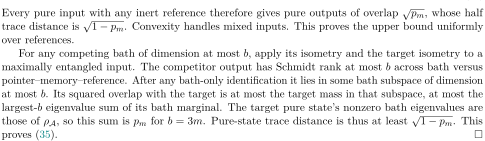
Every pure input with any inert reference therefore gives pure outputs of overlap √pm, whose half
trace distance is √1 −pm. Convexity handles mixed inputs. This proves the upper bound uniformly
over references.
For any competing bath of dimension at most b, apply its isometry and the target isometry to a
maximally entangled input. The competitor output has Schmidt rank at most b across bath versus
pointer–memory–reference. After any bath-only identification it lies in some bath subspace of dimension
at most b. Its squared overlap with the target is at most the target mass in that subspace, at most the
largest-b eigenvalue sum of its bath marginal. The target pure state’s nonzero bath eigenvalues are
those of ρA, so this sum is pm for b = 3m. Pure-state trace distance is thus at least √1 −pm. This
proves (35).
□
An exact, independently checked qutrit example

Searchable transcription
At the fixed-seed construction’s critical parameter t =
√
14/21, r = 4
√
 63, the three positive charge blocks have traces

For example their first diagonal entries are (2 27) and off-diagonal entries are

 9. Their determinants vanish; each is nonzero and has rank one. Thus the following are sharp resource points for this specified channel:
pure bath budget optimal reduced half diamond error optimal retained half diamond error 3 
 6

 9 0 0
No exact answer is claimed at the intervening budgets four, five, seven or eight. The same theorem applies to any other certified member with the charge form (31), using its actual block weights; it does not require the particular numerical example.

Searchable transcription
Repeated use.
For the displayed streaming implementations, fresh independent pure bath ports and
the same internal dynamics give V †
nWm,n = pn/2
m I: contract the last pair of isometries using (36) and
induct. Their full retained distance is therefore exactly √1 −pnm for every input and reference. This
is the error of these explicitly declared implementations, not the optimum over globally compressed
horizon baths or a grant of fresh preparation independence in an unrelated physical source.
Practical meaning and limits. The earlier count nine was an exact one-step apparatus cost. It now has a precision-sensitive interpretation: for this channel a bath of size six cannot achieve reduced error below 1 9, and cannot achieve retained-pure error below 1
 3; both boundaries are constructively attained. The comparison keeps the same source space, original preparation, pointer, clock tick and arbitrary inert reference. It compares alternative admitted interactions. Access to a returning bath or controller changes the reusable-memory ledger. An initially mixed apparatus requires its purification resource to be declared; the pure-bath budget here cannot silently be replaced by its unpurified marginal dimension. This does not optimize over all qutrit sources with the same passive word law, compare a three-dimensional source with a four-dimensional one under arbitrary interventions, or certify a laboratory realization. It does not turn an unread-bath bound into equality of complete retained instruments. The two separate, explicit statements above provide the appropriate interfaces. The construction supplies no Born selection, mass-noise admission, actual-event mechanism or conscious perspective. supplement/memory/five/audit/check_bath_approximation.py independently reconstructs all nine Kraus matrices, proves their orbit trace identities and Choi orthogonality with exact symbolic arithmetic, and checks the scalar isometry overlaps. Its arbitrary-reference samples are numerical diagnostics, not the universal proof. All parameters and outputs are in supplement/memory/expect ed_outputs/five/audit/bath_approximation_results.json.