Technical Companion: Approximation and Accounting for Quantum Sources
Retained reference access separates two optimal passive generators
Retained reference access separates two optimal passive generators
The source–readout programme already distinguishes a passive output law from an intervention or an accessible retained reference. Here this distinction has a sharp, quantitative example even after jointly minimizing memory and one-step pure-environment dimension. It is an explicit application of established channel discrimination, not a new general identifiability ceiling. Use the minimum-Kraus family, writing its parameter as

Searchable transcription
s r(h)2 = h3(2 −h) 2(h + 1)(3h + 2), a(h) = 1 2 −h 3h + 2 , t(h)2 = h(2 −h) 2(h + 1)(3h + 2). 1 + 2

Searchable transcription
Its nine pair states and CP reset maps, defined in the main resource manuscript, generate the entire
stationary delayed-trine law with r = 1−λ. Each realization has reusable dimension three and recorded
one-step Choi rank nine, both minimal at the indicated parameter. Its stationary memory is I3/3. The
maximum of r(h) occurs at h∗= (1 +
√
17 4; every interior 0
 has two distinct parameters on opposite sides of that maximum.
Theorem 7.1 (An exact access-dependent operational separation). Let have
 The two admitted source instruments generate identical passive classical word laws, attain the same one-step Pareto point
 , and have full-history cost
 for
 (the one-step rank is nine). Nevertheless their single-use pointer channels on the common qutrit input obey

Searchable transcription
1
2∥Mh1 −Mh2∥⋄= |h1 −h2|
3
.
The distance is attained either by one fixed known Fourier-basis input, or by retaining and reading a common maximally entangled purifier of the stationary local input It is invisible to the passive pointer archive alone at every finite horizon. No claim equates the two full retained quantum instruments.
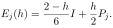
Proof. Let be the three fixed orthogonal Fourier projectors, indexed once consistently with the source covariance. The effects computed from the Choi blocks are
Searchable transcription
Ej(h) = 2 −h
6
I + h
2Pj.
This follows from the fixed phase , eigenvalues (2
 3 and covariance under
 . Thus


Searchable transcription
where MP is the projective Fourier measurement with classical pointer and D(ρ) = Tr(ρ)IA/3. For
any positive joint input ρSR of trace one put σj = TrS[(Pj ⊗I)ρSR]; σj ≥0 and P
j σj = ρR. Then

Searchable transcription
2 3 Tr σj + 1 = 4 X j ∥σj −ρR/3∥1 ≤ X k̸=j Tr σk X 3. 3 j
Searchable transcription
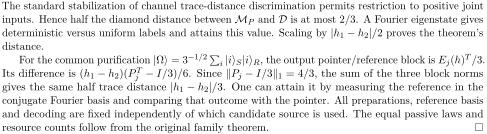
The standard stabilization of channel trace-distance discrimination permits restriction to positive joint
inputs. Hence half the diamond distance between MP and D is at most 2/3. A Fourier eigenstate gives
deterministic versus uniform labels and attains this value. Scaling by |h1 −h2|/2 proves the theorem’s
distance.
For the common purification |Ω⟩= 3−1/2 P
i |i⟩S|i⟩R, the output pointer/reference block is Ej(h)T /3.
Its difference is (h1 −h2)(P T
j −I/3)/6. Since ∥Pj −I/3∥1 = 4/3, the sum of the three block norms
gives the same half trace distance |h1 −h2|/3. One can attain it by measuring the reference in the
conjugate Fourier basis and comparing that outcome with the pointer. All preparations, reference basis
and decoding are fixed independently of which candidate source is used. The equal passive laws and
resource counts follow from the original family theorem.

Searchable transcription
For equal prior probabilities of the two candidate generators, one use therefore achieves optimal
success probability
psucc = 1
2 + |h1 −h2|/6.
This is discrimination between two conventional quantum implementations, not a test of Shadow Theory against standard quantum mechanics. The purifier must be physically available and measurable; retaining an inaccessible reference does not make this decision possible. Supplying a joint purifier is an original preparation contract shared by both models; its marginal agrees with the stationary state but its operational access differs from a pointer-only experiment.
An algebraic pair and a reproducible certificate

Searchable transcription
Take h1 = 1, r2 = 1/20, so λ = 1 −1/
√
20. The unique root h2 ∈(3/2, 8/5) of

Searchable transcription
10h3
2 −10h2
2 −7h2 −2 = 0

Searchable transcription
is the second parameter. Indeed

Searchable transcription
20 = −(h −1)(10h3 −10h2 −7h −2)
r(h)2 −1
20(h + 1)(3h + 2)
.
The cubic changes sign across that interval and its derivative is positive there, proving the root’s existence and uniqueness. Rational bisection certifies it without a floating-point feasibility claim. The code also rebuilds the effects and checks the passive full-word update from the state-basis inverse, with explicit entangled-reference and ordinary-input distance calculations. The universal conclusion follows from the proof. This example strengthens the concrete operational interface: equality of all passive histories and joint dimension optimality still do not identify the generator’s reference correlations. It establishes an access-dependent distinction between the specified generators, not an additional ontological source.