3. An enacted experience of succession
3.1 Four relations that must not collapse
A succession of physical states puts different states at ordered physical locations. A record of succession preserves order information but can remain dormant or inaccessible. Successive experiences occur at different stages without their mere succession guaranteeing that an ordered transition is experienced. An experience of succession is a qualifying enactment whose content relates distinguishable contributions as a transition.
The last case need not be assembled from isolated experiential packets. Different notes can belong within one continuing melody experience. What requires explanation is their differentiation and relation within that activity.
Consolidation alone does not supply the answer. In auditory experiments, sequential nonoverlapping formant tones can be reported as a synthetic vowel rather than as an ordered sequence (Saija et al., 2014). Response controls constrain the finding without eliminating every alternative explanation. A model making two traces jointly available still leaves open whether their content is succession, fusion or uncertainty.
3.2 Source events and current uptake
Consider an already qualifying listener with operative pitch discrimination, auditory grouping and implicit temporal relations. Let illustrative source events occur at 0, 100 and 200 milliseconds. A 10 ms reception delay and 5 ms integration delay make a -to- construction available at 115 ms, before arrives at 210 ms. These chosen numbers demonstrate a schedule, not a universal human integration window.
At 115 ms, the retained contribution from and the live estimate associated with enter one auditory stream. Their directed relation is taken up as a rising continuation. The listener need neither name the note nor explicitly formulate “before.” Actual recognition and relating can shape anticipation, comparison or orientation.
The first expression orders interpreted source references. The availability predicates locate a retained contribution and live estimate within present use. Their joint availability does not assign their sources a common represented time. A current reference can preserve an earlier role.
At 215 ms, the continuing construction incorporates , preserves the phrase and changes the live role from to . The earlier stage already experienced a directed transition. It did not wait for a completed melody to be displayed to another observer.
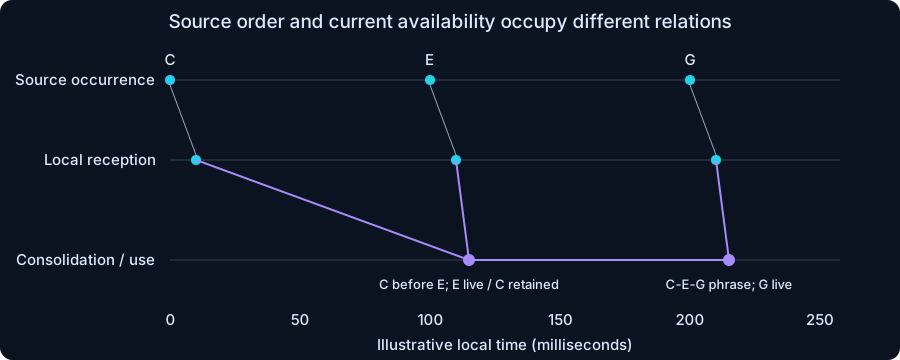
Figure 1. Source occurrence, reception and integration in the constructed example. Common availability at the integration stage preserves different source-time roles. The 115 ms transition precedes reception of the third note.
3.3 What the temporal projection must retain
The structural projection of complete enactment is
Its fields carry different jobs:
- supplies source references and the discriminated features, such as pitch.
- gives represented order; binds contributions into a continuing auditory stream.
- distinguishes live input, operative retention, retrieved construction and anticipated possibility.
- carries learned reception-to-source calibration; organizes possible continuations and expected endpoints.
- supplies actual use in ongoing uptake. A dormant code or an analyst's chronological list does not supply this field.
These distinctions obtain their meaning from learned discrimination, source coupling and actual use in the listener. A label reading “before” does not instantiate the relation if it changes none of that organization. The model specifies temporal interpretation within an already grounded person rather than deriving temporal meaning from uninterpreted data.
Complete also includes relevant bodily, evaluative and affective organization, implementation, formative embedding and associations where present. Write for experienced character under the adopted identity. Equality of alone does not ensure equality of . Two people can take up the same ordered notes with different bodily responses or associations. This projection fixes temporal structure, not every quality numerically.
Represented order can also be mistaken. Delivery delay and calibration can change the relation between source and interpreted order without abolishing the experience. Accuracy concerns what the construction represents; occurrence concerns whether it is enacted.
3.4 Immediate understanding and later recollection
At the stage, the retained contribution participates in interpreting as a continuation. That is immediate reflection in the relevant sense. It exceeds a residue merely changing a threshold and requires no deliberate recollection of a completed performance.
An optional query can select a predecessor, compare ordered pitches or identify a retained construction's mode. Successfully using that route supplies evidence of access and current uptake. An unexecuted capacity, or a correct answer obtained by an independent later lookup, does not establish earlier uptake. Blocking later retrieval after completed uptake does not erase the earlier experience. Blocking uptake of the joint relation prevents this particular construction, while leaving other experience open.
Later recollection is a new activity that treats the earlier notes as past sources. It is current when recalled. Both the initial hearing and subsequent remembering belong to the person's interpretive operations, with no additional witness and no infinite sequence of acknowledgments.
Published source: Experienced Temporal Passage. Read the original PDF alongside the web treatment.