Availability needs a schedule, binding and actual use
The accuracy theorem concerns a code and a task. An actual temporal interpretation additionally needs executable timing, grounded source references and use. A correct stored pair does not supply those facts automatically.
A finite joint-use opportunity
Let be arrivals on one local clock. The earlier trace survives to age ; consolidation requires latency after the later arrival. A possible uptake occasion satisfies
Therefore
is necessary. With guaranteed access through and an executable update of latency , it is sufficient for this schedule: choose its lower endpoint. It does not certify human experience. If both traces decay, both age constraints apply. For probabilistic memory the survival replaces the hard-window guarantee.
An illustrative RC trace has , with detectable lifetime [36]. For , , , , the lifetime is . Voltage survival differs from quantum probability . A capacitor or order detector does not automatically meet a coherent-completion theorem. Electronic components have precedents [39]; an embodied interpreter requires its own realization.
Source order is calibrated, not freely supplied
For timelike source gap and channel delays ,
The interpreter has arrivals and learned delay estimates, not true timestamps as an oracle. If ,
On a full rectangular bounded-error set, sign is guaranteed exactly when . Inside that band zero or contrary signs remain possible. A finite coincidence band should return unresolved order rather than assign it by arbitrary IDs. The directed-feature theorem assumes fixed earlier/live provenance. Establishing it is a separate apparatus requirement.
For example C emitted at with delay and E emitted at with delay arrive E then C. Correct calibration restores C-before-E. Learned order recalibration has empirical precedents [45]. It changes no physical cause or proper time, and establishes no absolute order for spacelike events.
A transition before the sequence finishes
Use C,E,G at source times , reception delay and integration delay . The C–E transition is usable at , before G arrives at . The activity can incorporate G at . These values demonstrate a schedule, not a universal measured human window.
The operative state distinguishes source reference, features, stream binding, represented order, live/retained/retrieved/anticipated mode, calibration and use. Joint availability retains ordered source roles. An illustrative C–E prefix supports probabilities for G and for D in different later environments, with subsequent surprises and nats. An omission changes expectation without becoming a received note. These probabilities and deadlines are stipulated.
A truth table or flag called does not establish human uptake. The transducer's use gate means the relation actually drives its declared continuation/action update; closing it leaves an archive without that effect. Experiential application requires entry into the qualifying person's grounded recognition, relating or response with other constitutive conditions intact. A separate later lookup cannot establish earlier use. This is an application condition, not another final conversion into experience.
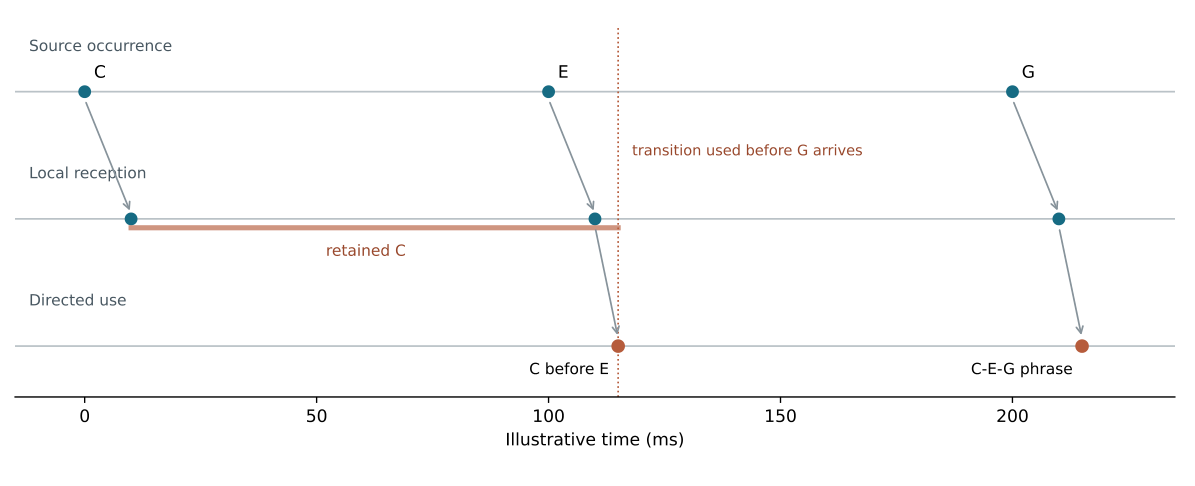
Figure 4. Source occurrence, reception and directed use are separate. The marked local occasion is not a universal present. Available retained C and live E preserve distinct represented temporal roles.
What the empirical comparisons constrain
Auditory fusion shows that successive nonoverlapping tones can be reported as one synthetic vowel; identities and overlap do not uniquely fix succession [40]. Pitch, signed pitch change and contextual expectation have differentiable neural encoding [41]. Omission responses expose prediction beyond the received prefix [52]. Narrative-sensitive activity in a severely amnesic patient separates online integration from durable recall [54]. Each constrains a component; none alone establishes grounded uptake, universal formation requirements or complete experiential identity.
These sources are not a collection of independent repetitions. Stetson's behavioral and imaging samples overlap, including repeated participants across hand conditions. Zuo's controls reuse an earlier dataset. Sankaran's main recordings involve eight patients, not one independent participant per electrode; preprint and publication are one work. Mechanism evidence and constitutive interpretation retain separate warrants.
Physical intervals, duration reports and felt pace
Proper time, record asymmetry, duration response and felt pace have different targets. The partial pace model [36] is
is internal elapsed estimate, interpreted boundaries, expected endpoint and a learned reference rate. At fixed , the Jacobian with respect to has determinant . For selected nonzero parameters it has rank two; human response rank has not thereby been measured. Density and endpoint studies motivate separate contrasts but do not fit this equation [15,46]. Shared participants and reused comparison conditions limit replication claims.
A local timer and watch both scaling with proper time keep their ratio fixed. Proper-time scaling alone cannot explain a changed local timing/watch ratio. A timing task's measured target must be specified before its response is interpreted as passage. These models provide constructed relations, not participant-data fits.
Published source: Block Universe and Shadow Theory. Read the original PDF alongside the web treatment.