# Block Universe and Shadow Theory
Source, history, and enacted temporal reality
Jeremy Rodgers · 2026-10-23
DOI: https://doi.org/10.5281/zenodo.23604713
## A world lived from within a complete history
## The world does not need an outside projector
**A complete history and a lived temporal world answer different questions.** The history contains a note's emission, propagation, reception, retention and interpretation. The listener never receives that entire description. Placing two notes on a spacetime diagram does not explain hearing one as following the other. The task is to follow the relevant physical relation into the organization that actually uses it.
Shadow Theory gives this task a definite architecture. Source and readout name complementary structural and presentation roles within one reality. Readout includes instruments, bodies and records; it is not an image delivered to a witness outside the world. The source–readout mathematics asks which relations descend to a representation, what distinctions a sufficient completion must preserve, and when projected dynamics close. The philosophical account distinguishes the unknown Ground and unsplit unity from every working source model. The enacted-experience account identifies complete qualifying organization with the experience, without adding a recipient beyond it. The [references](./14-references#references) identify the canonical mathematics [24–26,28,29] and experiential sources [21,36,37].
A block interpretation supplies a temporal setting for this architecture. Events occupy causal and temporal locations without a universal present advancing through the world. An organization within that history still changes, learns and acts. Its stages genuinely differ in what they receive, retain and can do. Those differences belong to the history. Relativity supplies causal restrictions and no invariant inertial simultaneity convention; the further interpretation of all actual events as equally real requires an ontological argument [17,43,44].
The integration works in both directions. Relativistic history makes physical realization demanding: a local readout needs communication routes, clocks, preparation, storage and a deadline. Shadow Theory identifies the precise distinction that must reach a participant, the completion needed to support a task, and the constitutive account under which its actual use is experienced. Its target-relative completion theory also gives explanatory economy an exact meaning: an extra actuality selector supplies no needed distinction when it preserves the declared predictions, records and complete qualifying enactments.
A retained predecessor, live contribution and anticipated continuation can participate together without representing their sources as simultaneous. Interpretation can begin before a sequence ends. This is explanatory integration and a physical realization programme. Neither the block interpretation nor the unknown Ground receives experimental confirmation merely because the two descriptions fit together.
The physical argument goes beyond saying that memory is limited. Two independently prepared source features pass through a solved delivery and memory programme. Exact optimization identifies the attainable accuracy for a directed relation. Binding interventions preserve stored information while changing the relation actually executed. A separate coherent-completion benchmark asks a stronger quantum question under different preparations. These supply quantitative constraints on how a source becomes usable organization.
Two distinctions remain decisive. **Global co-reality is different from causal access or temporal interpretation.** A reciprocal-pair theorem has strong geometric consequences, but an actuality interpretation requires its own witness. **Local information loss is different from loss in the source-to-entire-history map.** A complete physical history may itself be a sufficient working source. The following chapters preserve those distinctions while developing the positive construction.
The full argument connects [whole-field constitution](/consciousness/whole-field), [experienced temporal passage](/consciousness/temporal-passage) and [constituted agency](/consciousness/constituted-agency). Each connection concerns a specified explanatory role rather than an exchange of names.
## Ground, source, history and readout
## Four roles in one reality
### The unknown Ground and a nominated source
**The Ground is not the first variable in a physical equation.** It names the proposed unconditioned basis of reality. A differentiated source model is not claimed to exhaust it. The unsplit $U$ expresses unity prior to the source–readout distinction. This priority is explanatory, not an earlier event before physical time.
A nominated source is a specified mathematical object with states, symmetries and realization rules. The claim that concepts formed within differentiation do not exhaust the Ground is philosophical, not a formal incompleteness theorem. Ground, unsplit and source model therefore remain distinct [37,38].
The same discipline governs consciousness. Fundamental awareness provisionally names a quality attributed to the Ground, not a cosmic subject observing physical events. A successful decoder does not create that quality. Physical organization is proposed to determine localized experiential form and boundaries. The motivation is one basis for physical reality and experiential presence, with differentiation supplied by actual organization. A common basis does not entail a universal subject.
The scientific burden belongs to the nominated realization. Its source might be an ordinary system–environment quantum state, a gravitational bulk or a pregeometric formation package. States first have to be reduced by the declared gauge and redescription equivalences. Two coordinate descriptions are not two physical source states. Naming a space "source" proves no need for a bearer beyond spacetime [24,27,29].
### Where physical history enters
The formation architecture uses a partial, potentially set-valued realization relation
$$
\mathrm{Read}_{\Omega}:\mathcal S_0\rightrightarrows\mathrm{Comp}_{T1}.
$$
Here $\Omega$ belongs to the formation model; it is not an exact name for the Ground. The target comprises coupled compatible quantum sectors, records, geometric and matter structure, and consistency conditions. Admission or compatibility can fail. An admitted source need not select one readout without further boundary or selection data [33,37].
Fix an admitted branch and sufficient realization conditions $L$. Its physical-history representation is
$$
F:S\longrightarrow\mathcal H_L,\qquad\text{or a probability kernel }F(s,dh).\tag{1}
$$
This is a history component of one realization. It does not say that every source generates one classical block. Quantum alternatives may require process or event/branch-relative accounts; writing $h\in\mathcal H_L$ settles no measurement interpretation. Where an actual complete history is admitted, eternalism concerns its actual events, not an identity of that history with the Ground.
Shadow's broader physical proposal is that one source realizes the coupled physical order without necessarily exhausting its distinctions. This is a hypothesis about $F$, distinct from local ignorance. Its motivation is unification: independently fixed structure should constrain quantum sectors, objective records, geometry and compatible dynamics together. A model earns an advantage by deriving compatibility or discriminating responses, rather than appending a separate hidden coordinate for each observation [27,28,30,37]. A block can be the physical realization of those constraints without being fundamental Ground.
An observer $O$ is an organization inside $h$. Its collection and retention programme $\pi$, at local occasion $\tau$, induces another map or instrument:
$$
q_{O,\tau,\pi}:\mathcal H_L\longrightarrow Z_{O,\tau,\pi}.\tag{2}
$$
This code is a physical record. Its interpretation requires native source bindings and learned organization. A complete qualifying enactment is proposed to be the experience itself:
$$
S\xrightarrow{F}\mathcal H_L\xrightarrow{q_{O,\tau,\pi}}Z_{O,\tau,\pi},
\qquad
\text{qualifying actual enactment}\equiv_{\mathrm{constitution}}\text{experience}.
$$
Observer, record and use all occur inside the physical realization. The same history may be readout relative to $F$ and source relative to $q$, without either role revealing the unknown Ground.
The wider schema $L=\Omega_{T1}\Delta\partial[L]$ records the programme's typed completion/readout discipline. $\Omega_{T1}$ is neither Ground nor universal solver, nor automatically the branch map $F$. The operators have their own types and hypotheses. Here the schema has content only after a target, admitted realization and physically attainable completion are specified [31–33,37,38].
Notation likewise has local types. Scalar channel parameters below are not the access map $q_{O,\tau,\pi}$. Spin frequency $\Omega$ is different from the formation-model parameter. Unsplit $U$, actual uptake $U_A$ and unitary $U$ are different objects.
### What readout loss actually requires
Let $q:H\to Z$ with $Z=\operatorname{im}q$, and nominate a target $f:H\to A$. The descent criterion is exact:
$$
\exists\bar f:Z\to A\text{ with }f=\bar f\circ q
\quad\Longleftrightarrow\quad
q(h)=q(h')\Rightarrow f(h)=f(h').\tag{3}
$$
**Proof.** A factorization gives equal targets on equal readouts. Conversely define $\bar f$ by the common target value on each nonempty fibre. Fibre constancy makes that definition well defined.
A coarsest sufficient extension is
$$
E_f=\operatorname{im}\bigl(h\mapsto(q(h),f(h))\bigr).
$$
If an extension is restricted to its realized image, $e:H\twoheadrightarrow E$ with $\pi e=q$ and $ge=f$, its unique comparison map is $v(y)=(\pi(y),g(y))$. Then $ve=(q,f)$. This is the canonical target-relative completion result [25,26]. Physical completion adds the question whether the distinction can be transmitted, retained and used by the occasion.
Autonomous evolution of a dynamical readout $W$ additionally requires its equivalence classes to be preserved by source evolution. In a linear split, unresolved initial conditions and coupling yield exact projected memory and forcing terms. This fact requires neither stochastic noise nor a Markov approximation [28]. A display may be insufficient for a later continuation because a distinction survives elsewhere, even though a larger physical state closes.
### Selector economy, stated as a factorization
Let admitted pairs $x=(h,a)\in\widetilde H$ include an extra actuality selector, and let $b(x)=h$ forget it. Compare precisely $H=b(\widetilde H)$. Declare targets $\Theta=(T_i)_{i\in I}$ covering prediction laws for specified preparations and interventions, records and relevant complete qualifying enactments. Assume
$$
\widetilde q=q\circ b,\qquad T_i=t_i\circ b\quad(i\in I).
$$
Then
$$
\operatorname{im}(\widetilde q,\Theta)
=
\operatorname{im}\bigl(h\mapsto(q(h),(t_i(h))_{i\in I})\bigr).\tag{4}
$$
**Proof.** A point on the left comes from an admitted pair and therefore its history image. Every history in the compared domain has such an antecedent, giving the reverse inclusion. Thus the selector supplies no distinction needed by this minimal completion.
These factorization premises must be established for the actual comparison. They do not describe every rival ontology automatically. A selector that changes admissible histories, laws, actual records, qualification or complete enactment requires another assessment. Experiential equivalence additionally uses the complete-enactment identity and equal independently justified qualification. Equal reports or stored bits do not suffice. Removing an unnecessary selector from an explanation proves neither its nonexistence nor the absence of indexed actuality relations definable from geometry. An exhaustive ontology requires a further principle of ontological economy.
## Relativity and reciprocal reality
## A block interpretation with explicit geometric commitments
### Change remains inside the history
For a timelike worldline in inertial coordinates,
$$
d\tau^2=dt^2-\|d\mathbf x\|^2/c^2.
$$
Proper time measures physical processes along the worldline; it selects no simultaneous universe-wide state. An extended organization occupies a worldtube, transporting signals and using local clock conventions. Relativity fixes causal relations and proper durations, while spacelike simultaneity varies by inertial frame.
Eternalism takes actual events at their temporal locations to belong to reality without an additional activation process. Its economy is concrete: one organization explains change, clocks and records without another present selecting which region exists. Equation (4) supplies a target-relative version of this economy when its equivalences hold. It neither proves the selector nonexistent nor deletes relations definable from geometry.
A manifold represents events; tenseless existence is an interpretation of that representation. Relational becoming can use invariant past-definiteness without a preferred simultaneity surface. Myrvold extends such relations to regions and hypersurface-indexed state/chance descriptions while retaining quantum nonseparability [17,43,44]. This is a serious alternative. The block branch is defended for its economy and fit with one actual physical history.
Geometry, determinism, time-reversal symmetry and eternalism answer different questions. Determinism asks about uniqueness from adequate data. A complete actual history does not establish uniqueness. Time reversal transforms solutions. Change is difference along a history: propagation, memory writing and deliberation occur at ordered events without an outside clock. An indeterministic history law can still have one actual complete outcome history.
### One reciprocal pair has a decisive consequence
Let $R(p,q)$ be one fixed event relation, conditionally interpreted as "q is co-real relative to p". It is not local access or an observer-indexed family. In real 1+1 Minkowski space, set $c=1$ and write the proper orthochronous boosts as
$$
B_\ell(t,x)=\left(\frac{\ell+\ell^{-1}}2t+\frac{\ell-\ell^{-1}}2x,
\frac{\ell-\ell^{-1}}2t+\frac{\ell+\ell^{-1}}2x\right),\qquad\ell\gt0.
$$
Spatial reflection is $P(t,x)=(t,-x)$.
**Theorem 3.1: reciprocal pair under relativistic symmetries.** Assume transitivity and invariance under every translation. In real 1+1 dimensions assume invariance under every $B_\ell$ and reflection. In real 3+1 dimensions assume instead all proper spatial rotations and proper orthochronous boosts. If distinct $p_0,q_0$ obey both $R(p_0,q_0)$ and $R(q_0,p_0)$, then $R(p,q)$ for every pair. Reflexivity follows; dilation, global symmetry, continuity and measurability are unnecessary.
**Proof mechanism.** The mutual core $H=\{v:R(0,v)\land R(v,0)\}$ is an additive subgroup containing a nonzero displacement. In 1+1, reflection extracts a nonzero pure-axis vector. Differences of opposite boosts generate the whole other axis because $\ell-\ell^{-1}$ ranges over all reals. One fixed nonzero boost generates the first axis. Thus $H=\mathbb R^2$. In 3+1 the subgroup proof uses proper spatial half-turns and coordinate-axis boosts to generate the time axis and then all spatial axes. Translation yields universality. The [full proof](./11-reciprocal-proofs#section-a) supplies every step.
This is a direct Stein-type consequence. Stein's fixed-length spacelike argument already removes the no-unit/dilation stipulation [44,p.150]; no general historical priority is claimed. The direct 1+1 and 3+1 statements have formal modules independent of the dilation-based classification. The 3+1 proof needs the coordinate-axis boosts and three proper half-turns in Appendix A. Full proper-orthochronous Lorentz invariance is a stronger sufficient package, not a new full 3+1 classification.
The separate six-way 1+1 classification has stronger hypotheses: reflexivity, transitivity, translation/boost/dilation/reflection invariance and an ordered field with positive square roots. Its outcomes are identity, chronological past or future with identity included, causal past or future, and universality. A fixed positive proper-interval threshold supplies an invariant transitive past relation outside that list when dilation is omitted. It has no distinct mutual pair, so does not refute the direct theorem.
### The bridge to actuality is substantive
The theorem proves universality under its mathematical premises. Applying it to actuality needs independent reasons for the meaning of $R$, the invariances, transitivity and one distinct reciprocal witness. A process's duration, dependence on an earlier state, or two contributions constituting one transition do not themselves establish reciprocal actuality.
One may propose that actuality means a homogeneous mutual belonging, and motivate a reciprocal witness through one actual relation spanning events. The theorem makes the consequence exact. Yet taking a process as that witness already adopts the disputed reading of belonging. Its occurrence does not independently establish it. Reciprocal actuality is therefore not added as a universal Shadow Theory axiom.
A fixed relation's invariance also exceeds covariance of a family. For future-directed unit velocity $u$, define
$$
R_u(p,q)\Longleftrightarrow u\cdot(q-p)=0.
$$
Each fixed $R_u$ is a nonuniversal equivalence relation with reciprocal spacelike pairs. Transforming $u,p,q$ together gives covariance; holding $u$ fixed does not give boost invariance. The distinction applies to apparatus, observer and process-window relations. Generic covariance cannot license the theorem for access.
Countermodels isolate the premises. Without boosts, equal coordinate time is nonuniversal and reciprocal. Without transitivity, equality-or-spacelike separation is another. Without translations, equality of Minkowski norm relative to a chosen origin survives Lorentz symmetry. Without reflection in 1+1, a null-line equivalence survives every boost. Their details appear in Appendix A. Global co-reality never implies global observation.
## Experience without an external owner
## The organization doing the interpreting is where the experience belongs
### Constitution and realization do different work
A complete history locates an interpreting activity. Enacted scaffolding adds an explicit constitution: complete qualifying actual organization is the experience, including its character, rather than a mechanism delivering another experiential object to a separate owner [21,36].
For the nominated adult, the roles are actual reception or internal retrieval $D$, interpretation $I$, consolidation $C$, retention sufficient for use $M$, and actual uptake $U_A$. Uptake means participation in ongoing recognition, relating, appraisal, orientation or response. Dormant accessibility is insufficient. These roles may overlap and need no verbal acknowledgment. Later addressed retrieval $R_{\mathrm{later}}$ is an additional operation, not a universal condition of earlier experience.
Let $K(A,J)$ be the complete enactment over activity $J$, including bodily and evaluative implementation, source binding and relevant causal/developmental embedding. The selected branch is
$$
\operatorname{Qual}_E(A,J)\Longrightarrow K(A,J)\equiv\text{the corresponding experience}.\tag{5}
$$
The application begins with an independently justified experiencing embodied adult. It does not define qualification by success at the finite task, derive it from a universal experiential-contributor recipe or infer it from universal relational formation. The roles are necessary within this adult account, not an exhaustive test for every possible subject. Constitution is philosophical; whether the operations enter the person's actual activity is a realization question.
The positive motivation is to locate temporal differentiation in the activity that receives, retains and uses it. No second observer is needed to interpret a finished result. Binding can change temporal character without a sequence replayed before an inner spectator. Foundational awareness is not manufactured by successful computation; organization articulates localized experience within the ontology. A critic can accept the mechanisms and reject the constitutive identity. That dispute concerns constitution, not an unnamed final operation.
The projection $T(K)$ isolates source references and temporal roles. It is not a complete character map. Equal reports, bits or $T$ values do not establish equal complete experience. A finite transducer implements a component without thereby becoming a person. The embodied adult is the nominated boundary; neither an output register nor nested descriptions select subjects.
### The present can contain a predecessor without making its source simultaneous
A retained contribution can function as predecessor, a newly received contribution as live input, and expectation as anticipated continuation. These are modes at one occasion, not simultaneous source events:
$$
\operatorname{available}(r_C,\tau)\land\operatorname{available}(\ell_E,\tau)
\quad\text{is compatible with}\quad\widehat C\prec_{\mathrm{represented}}\widehat E.
$$
The carriers are jointly usable while their represented sources remain ordered. A transition can be taken up before the melody finishes. Anticipation is current organization concerning a possible continuation, not a received future signal. Distinct histories can share the same local prefix and expectation before different later notes arrive.
A succession of physical states, an order record, successive experiences and an experience of succession remain distinct. A feature bag omits roles. An ordered archive can be unused or assigned to another stream. Delivery, retention, binding and actual use must therefore be followed together. The quantitative construction below does this for one directed-feature task, rather than reading all phenomenal character from an accuracy score.
Selection need not be illusion. The causal past contains influences never intercepted or retained. Forgetting can shrink the current information algebra; an ideal cumulative transcript is a separate resource. Reversibility and proper-time order alone do not establish the past/future record asymmetry. Ready preparation, localized writing routes, retention and a specified ensemble do that work in the models. Independently prepared future features do not enter through free correlated context. Reversing time changes preparation, rather than making the same ready experiment write an ordinary future record.
Causal ancestry is not all present content. Once an earlier complete enactment occurs within the qualifying adult, continuations preserving that organization preserve its occurrence under the identity. Later loss changes later access. Later reconstruction is a new construction concerning the earlier event. This common-prefix invariance concerns complete relevant organization, not merely a task code.
### Bodily indexing does not require psychological appropriation
Locating a sound relative to a body, preserving bodily function and using learned discrimination need not organize every event around an independently existing owner. "This is happening to me" adds a self-story relation. It is not identical to every useful bodily index.
The account permits hearing without that appropriation when the requisite organization remains. This need not leave complete character unchanged, because appropriation can alter experience. It says that removing one self-related organization does not automatically remove sensation, retention, discrimination or uptake. No empirical test for total absence of appropriation follows from the conceptual distinction.
Remembered identity and anticipated personal futures can amplify passage. The retained/live/anticipated differentiation does not itself require an owner moving between time locations. Nor does awareness need to scan the block. A scanner would relocate, rather than discharge, the explanatory demand for its present position.
### Admission and developmental scope
Published SPC-2 assigns perspective admission, complete predictive content and process continuation through A1–A3 on a certified realization [35,§§17.2–17.4]. Equivalence to enacted scaffolding or actual uptake has not been proved. Developed reasoning and language matter to the adult conceptual example; structured discrimination and inference are wider predicates. Interpretation does not require defining or reporting experience. Preconceptual experiential organization is not excluded by the adult case.
A stronger historical rule requires an already experiencing formative contributor to every experience. The [formative-dependence appendix](./12-formation-and-admission#section-b) separates its necessary-only form from a biconditional recipe. Both permit empty admission and exclude nonempty assignments on well-founded experiential ancestry; only the biconditional receives the finite fixed-point classification. A nonrecursive variant instead requires actual relational formation without admitting every contributor as already experiencing. Choosing that variant changes a premise; it is not an established universal law or replacement A1.
The temporal-passage paper retains an experiencing-contributor condition in its specified framework. This paper's adult application uses independent qualification and the actual formative history. These scopes are preserved here rather than silently merged. The [whole-field account](/consciousness/whole-field) likewise develops within-unit constitution after qualification.
Hartle's information-gathering systems and Ismael's embedded perspectives already explain memory, prediction and presentation [10,12,13]. Shadow's additions are the exact target/completion question, physically attaining completion at an occasion, and an explicit experiential constitution. The resource result can be confirmed while identity, boundary or Ground-awareness remains disputed.
## A source that leaves and returns
## Local absence is not physical destruction
**A source–readout claim becomes physical when the dynamics, preparation and ports are fixed before loss is assessed.** An engineered perfect-transfer chain [6] provides that discipline. Its first qubit becomes exactly ready while the environment carries the input; the same Hamiltonian later returns it. This separates preservation from local possession and counts the completion resources.
### The prescribed Hamiltonian
Take odd $N\ge3$, $\Omega\gt0$ and $\hbar=1$. Site 1 is the nominated readout $S$; sites $2,\ldots,N$ form $E$. With $n_j=|1\rangle\langle1|_j$, let
$$
H=\sum_{j=1}^{N-1}\frac{J_j}{2}(X_jX_{j+1}+Y_jY_{j+1})+B\sum_{j=1}^N n_j,
\quad J_j=\frac\Omega2\sqrt{j(N-j)},\quad B=\Omega N.\tag{6}
$$
Prepare $E$ in $|0\cdots0\rangle$. Site 1 receives an unknown qubit, possibly entangled with reference $R$. After preparation, $H$ remains fixed. There is no input-dependent controller, switching sequence or after-cut preparation-label access. Coupling calibration, ready stock, input-independent timing/phase reference, final measurement and retained output are counted. Incompatible tests use separate preparations.
This is a finite nonrelativistic quantum model. Nearest-neighbor coupling is a communication route, not an exact relativistic cone. Fabrication and calibration remain experimental obligations. Bohmian or scalar-current record constructions have different hypotheses and are not used in this channel calculation.
The vacuum is a stable ready state. For adjacent spins the exchange contribution satisfies $h_j\ge-J_j(n_j+n_{j+1})$: its one-excitation eigenvalues are $\pm J_j$, and other sectors contribute zero. Hence, with $J_0=J_N=0$,
$$
H\ge\sum_j(B-J_{j-1}-J_j)n_j.
$$
Since $J_j\le\Omega N/4$, each displayed coefficient is positive. The vacuum is the unique zero-energy ground state. Loading the input still requires preparation resources; no finite-temperature guarantee follows.
**Proposition 5.1: exact ready cut and return.** At $T=\pi/\Omega$, $S$ is exactly pure-ready for every input. The input is at site $N$ up to a known phase. At $2T$ it returns exactly to $S$, preserving entanglement with an untouched reference.
**Proof.** Excitation number is conserved and the vacuum fixed. In the one-excitation basis $|j\rangle$, the Hamiltonian is $BI+\Omega J_x$ for spin $J=(N-1)/2$. Identify $|j\rangle$ with the normalized symmetric state of $N-1$ auxiliary spins having $j-1$ up spins. Then $J_x$ is half the sum of their $X$ operators. Independent rotations give
$$
c_j(t)=e^{-iBt}\sqrt{\binom{N-1}{j-1}}
[-i\sin(\Omega t/2)]^{j-1}[\cos(\Omega t/2)]^{N-j}.\tag{7}
$$
Thus $\alpha|\mathrm{vac}\rangle+\beta|1\rangle$ becomes $\alpha|\mathrm{vac}\rangle+\beta\sum_jc_j(t)|j\rangle$. At $T$ only $c_N$ remains; at $2T$ only $c_1$ remains, with phase $e^{-i2\pi N}(-1)^{N-1}=1$. Linearity extends this to mixed and reference-entangled inputs. In particular the cut state factors as $|0\rangle\langle0|_S\otimes\rho_{RE}(T)$.
The factorization exceeds equality of local statistics. It also identifies an ordinary quantum completion in the environment. No exotic substrate is required. Braunstein–Pati no-hiding [2] is more general about unitary information localization; the present work supplies its timed, resource-counted instance and exact comparison.
### An exact finite-horizon deficit
For binary preparations set
$$
p(u)=|\cos(\Omega u/2)|^{2N-2},\quad
\rho_0(u)=|0\rangle\langle0|,\quad
\rho_1(u)=(1-p(u))|0\rangle\langle0|+p(u)|1\rangle\langle1|.
$$
Use trace distance $D(\rho,\sigma)=\|\rho-\sigma\|_1/2$. At $s\lt t$, a repair has only the current qubit, independent ready ancillas and one common CPTP map $\mathcal R$. It has no correlated archive or incoming carrier. With $p=p(s)$ and $q=p(t)$, define
$$
e(p,q)=\inf_{\mathcal R\,\mathrm{CPTP}}\max_{i=0,1}D\bigl(\rho_i(t),\mathcal R(\rho_i(s))\bigr).
$$
**Theorem 5.2: prescribed-source finite-horizon deficit.** For $p,q\in[0,1]$,
$$
e(p,q)=\frac{[q-p]_+}{2-p}.\tag{8}
$$
**Proof.** Dephase the candidate output. This preserves the diagonal targets and contracts distance. The candidate becomes a stochastic map with excitation probabilities $r_0,r_1\in[0,1]$. Its errors are $r_0$ and $|(1-p)r_0+pr_1-q|$. When $q\le p$, $r_0=0,r_1=q/p$ achieves zero for $p\gt0$; the zero case is immediate. For $q\gt p$, an error bound $e$ implies $r_0\le e,r_1\le1$, hence $e\ge q-p-(1-p)e$. Rearrangement gives the bound. Set $r_0=e,r_1=1$ to attain it by a valid measure-and-prepare channel.
At $p=1/2,q=1$ the error is $1/3$, sharper than the generic half-distance bound $1/4$. At $p=0,q=1$ it is $1/2$. This is an elementary experiment-deficiency problem related to randomization and quantum sufficiency [3].
For $p\gt0$ the density-matrix coordinates are distinct, so an arbitrary numerical function on their image can invert them. Equation (8) excludes physical common CPTP postprocessing, not every mathematical forecast from exact ensemble coordinates. At $p=0\lt q$ the current states coincide, so a common single-valued forecast also fails uniformly across the two conditional future laws. One fixed-prior mixture can still have a correct marginal forecast. Resource insufficiency does not become universal coordinate nonclosure.
### Timing and robust margins
Fix the largest coupling at $g$. For odd $N$,
$$
g=\frac\Omega4\sqrt{N^2-1},\qquad T=\frac{\pi\sqrt{N^2-1}}{4g}.\tag{9}
$$
The out-and-back time grows linearly in chain length at bounded coupling. Holding $\Omega$ fixed while increasing $N$ increases the strongest coupling; it does not make access arbitrarily fast.
After the ready cut put $t=T+\delta$, $0\le\delta\le T$. The endpoint amplitude, population and binary deficit are
$$
c(\delta)=\sin^{N-1}(\Omega\delta/2),\qquad q(\delta)=c(\delta)^2,\qquad e(0,q(\delta))=q(\delta)/2.\tag{10}
$$
The phase-corrected entanglement fidelity from the original input, equivalently its encoded environment at $T$, is
$$
F_e(\delta)=\frac{(1+c(\delta))^2}{4}.\tag{11}
$$
The amplitude-damping Kraus operators are $|0\rangle\langle0|+c|1\rangle\langle1|$ and $\sqrt{1-c^2}|0\rangle\langle1|$; $F_e=\sum_a|\operatorname{Tr}K_a|^2/4$. The known phase enters the calibrated final measurement. This channel is not a channel from the ready endpoint alone.
The classical-memory witness $F_e\gt1/2$ is crossed after
$$
\delta_{\mathrm{crit}}=\frac2\Omega\arcsin\bigl[(\sqrt2-1)^{1/(N-1)}\bigr].
$$
This is a witness threshold, not first arrival or first existence of quantum information. The spin model has finite-time tails. Appendix C supplies a separate exact-locality field example.
If actual binary states at $s,t$ differ uniformly from ideal states by at most $\eta_s,\eta_t$, contractivity and two triangle inequalities yield
$$
e_{\mathrm{actual}}(s,t)\ge[e(p,q)-\eta_s-\eta_t]_+.\tag{12}
$$
For $H'=H+V$ with $\|V\|\le\nu$, Duhamel gives $\|U'(u)-U(u)\|\le u\nu$. Purification then bounds $\eta_u\le\eta_0+u\nu$, so $e_{\mathrm{actual}}\ge[e(p,q)-2\eta_0-(s+t)\nu]_+$. Timing and readout need additional calibrated margins. These conservative sufficient bounds require independent justification, not fitting every error to the same return data.
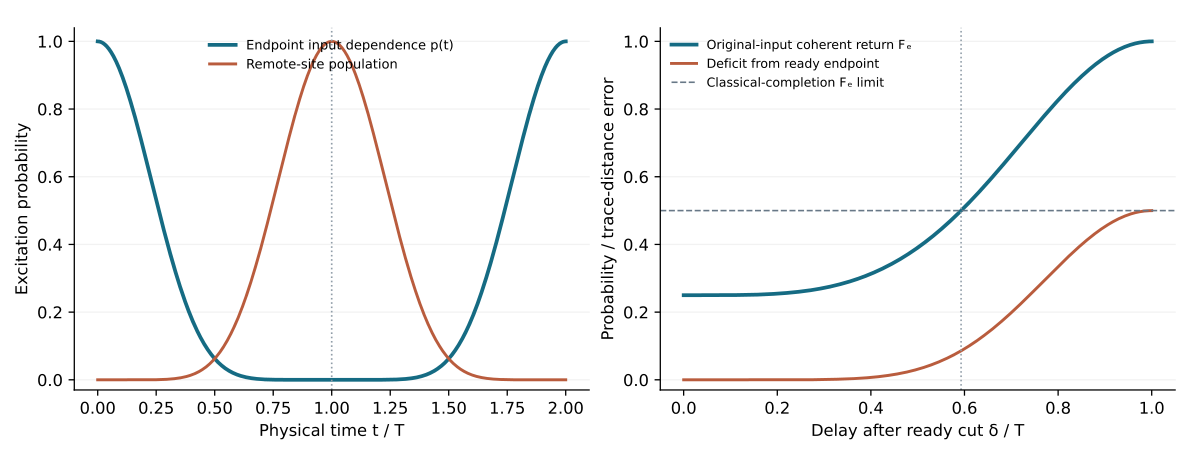
**Figure 1.** The prescribed five-spin source retains input globally while local population and coherent-return fidelity vary. The physical-postprocessing deficit follows from the populations. Classical-completion threshold and information location are distinct. These analytic curves were checked against matrix evolution; they are not laboratory observations.
## From delivery to directed use
## The relation must reach the operation that uses it
**Correctly stored ingredients do not determine their actual use.** This chapter follows source delivery, predecessor retention and a directed update through one resource-accounted programme. It obtains a necessary resource condition for a nominated functional interpretation and a conditional ideal-interface realization. A detached task device is not thereby an experiencer.
### A declared source-to-record programme
Prepare independent uniform bits $a,b$ in calibrated source slots: $a$ is predecessor and $b$ the later contribution. Include repeated features. In a relativistic embedding choose timelike-ordered source events. The local slot schedule is apparatus structure, not a universal simultaneous slice. The directed target is $D=b-a\in\{-1,0,+1\}$ under fixed provenance. The full ordered pair, equivalently $G=2b-a$, is a stricter target. No unordered-pair label or preparation archive is free information. Learned context and timing standards are independent of the randomized features.
Use two independent copies of the positive XX chain. Until collection cuts their Hamiltonians remain fixed. At far endpoint $i$,
$$
\rho_x(q_i)=(1-xq_i)|0\rangle\langle0|+xq_i|1\rangle\langle1|,\qquad q_i=\sin^{2N_i-2}(\Omega_it_i/2).
$$
This sine delivery profile differs from the original endpoint's cosine return profile, but both follow from the solved amplitudes. Choose source and collection times so the first record arrives first. Calibrated slots disclose provenance, not values.
Ready memory $M$ collects the first endpoint by SWAP; ready live register $L$ collects the second. At each cut, decouple the endpoint from the chain and protect endpoint and collector during the finite pulse. Keep the remaining source isolated afterward. No old port, preparation controller or remote environment supplies a later uncounted carrier. Count schedules, switches, ready stock and timing references. For a Hermitian involution $U$, $H_U=\pi(I-U)/(2\tau_g)$ enacts it over $\tau_g\gt0$. Charge isolation, switching and pulse durations to the deadline and every active memory exposure to retention. Switching transients or residual coupling enter the joint calibration budget. This composite scheduled programme is not the entire observer evolving autonomously under the original static chain Hamiltonian.
Retain $M$ through a ready inaccessible bath qubit $K$:
$$
H_{\mathrm{mem}}=\frac\kappa2(X_MX_K+Y_MY_K)+2\kappa(n_M+n_K),\qquad r=\cos^2(\kappa\Delta).
$$
For $\kappa\gt0$ the eigenvalues $0,\kappa,3\kappa,4\kappa$ give positivity and a unique ready ground. Tracing $K$ yields survival $r$ after active memory time $\Delta$. Coupling is off during collection and interpretive gates, on only for the declared retention interval; isolate it before the finite update. No bath return occurs before the target. The loss is reversible physical retention loss, not an assumed contraction law.
At use, the complete admitted code is
$$
\rho_{ab}^{ML}=\rho_a(p)\otimes\rho_b(q),\qquad p=q_Ar,\quad q=q_B.\tag{13}
$$
Independence, source-isolating collection and absence of cross-route/controller leakage establish the factorization. Separate marginal fits do not. The decoder may use a common instrument and fresh ancillas with $\rho_{ab}^{MLC}=\rho_{ab}^{ML}\otimes\sigma_C$. An input-independent ancillary marginal alone is inadequate. Correlated archives, incoming carriers, reference feedback or predictive context change the resources.
### The exact joint-access frontier
Assume the joint record is diagonal in the $M,L$ basis and has pointwise marginals
$$
\Pr(M=1\mid a,b)=ap,\qquad\Pr(L=1\mid a,b)=bq.
$$
Set $j=\Pr(M=L=1\mid a=b=1)$.
**Theorem 6.1: joint record frontier for directed interpretation.** For independent uniform features and the stated complete classical record,
$$
\max(0,p+q-1)\le j\le\min(p,q).
$$
Among all common quantum decoders with fresh fixed-factor ancillary resources, the exact optima are
$$
S_D^{\max}=\frac{1+j}{2},\qquad S_{\mathrm{pair}}^{\max}=\frac{1+p+q+j}{4}.\tag{14}
$$
Every feasible $j$ is attainable in this classical-record class. The independent prescribed source has
$$
j=pq=q_Arq_B,\qquad S_D^{\max}=\frac{1+q_Arq_B}{2},\qquad S_{\mathrm{pair}}^{\max}=\frac{(1+p)(1+q)}4.\tag{15}
$$
**Proof.** The premises force the complete conditional table:
| $ab\backslash ML$ | $00$ | $01$ | $10$ | $11$ |
| --- | --- | --- | --- | --- |
| $00$ | $1$ | $0$ | $0$ | $0$ |
| $01$ | $1-q$ | $q$ | $0$ | $0$ |
| $10$ | $1-p$ | $0$ | $p$ | $0$ |
| $11$ | $1-p-q+j$ | $q-j$ | $p-j$ | $j$ |
Nonnegativity is exactly the stated interval. A POVM's success on diagonal states depends only on its diagonal entries, an ordinary stochastic decoder. Deterministic maximum-a-posteriori decoding is therefore optimal even among quantum procedures. For observation $00$, multiply unnormalized posterior masses by four. They are $2-p-q+j$ for $D=0$, $1-q$ for $D=+1$, and $1-p$ for $D=-1$; the zero mass is maximal. At $01$, $q\ge q-j$ favors $+1$; at $10$, $p\ge p-j$ favors $-1$; $11$ permits only zero. Thus $D_{\mathrm{out}}=L-M$ attains the directed optimum. Summing the maximal masses gives $(1+j)/2$. Guessing the observed pair maximizes full-pair success; the four correct masses sum to $1+p+q+j$.
For sharpness choose input-independent joint survival flags $(E_A,E_B)$ with probabilities $j,p-j,q-j,1-p-q+j$, and set $(M,L)=(aE_A,bE_B)$. Every feasible table results. This establishes class sharpness, not arbitrary-source attainment. The prescribed independent programme selects $j=pq$.
The governing decision formula is standard Bayesian decision theory:
$$
S_f(P)=\sum_y\max_d\sum_{x:f(x)=d}\pi(x)P(y\mid x).
$$
The theorem evaluates it for this commuting four-preparation family [1,3]. The flag interval is the established Bernoulli coupling bound, also used for packet erasures [9]. Those erasures are visibly flagged; here a lost one resets to zero, an unflagged Z-channel. Functional compression and distributed function computation supply the larger context [7,53]. The contribution is the closed task value and its physical delivery/retention interpretation.
More co-retention improves these two targets, not every task. At $p=q=1/2$, $j=0$ perfectly distinguishes $00$ from $11$, whereas $j=1/2$ gives only $3/4$ on that binary task, reversing their directed-change ranking. Any common garbling must fix outcomes $00,01,10$ because their preparation rows agree, and then cannot transform either $11$ row to the other. The experiments are incomparable. No general Blackwell dominance follows.
Directed error at most $\epsilon\lt1/2$ requires $j\ge1-2\epsilon$. For the prescribed source this gives
$$
q_Arq_B\ge1-2\epsilon,\qquad
\Delta\le\kappa^{-1}\arccos\sqrt{\frac{1-2\epsilon}{q_Aq_B}}.\tag{16}
$$
This uses $0\le\kappa\Delta\le\pi/2$ and $q_Aq_B\ge1-2\epsilon$. Otherwise even perfect retention misses the target. Failure of delivery or retention now has an exact task consequence; it need not mean no experience. Uncertainty, fusion, an erroneous order or anticipation can still be taken up.
### Countermodels locate the assumptions
At $p=q=1/2$, a shared input-independent coin retains both features with probability $1/2$ and resets both otherwise. It gives $j=1/2$ and $S_D=3/4$, whereas independent loss gives $j=1/4$ and $S_D=5/8$. Marginals alone allow the sharp upper envelope $[1+\min(p,q)]/2$.
For preparation $a=b=1$ the two laws are
$$
(1/4,1/4,1/4,1/4),\qquad(1/2,0,0,1/2).
$$
Their TV distance is $1/2$, giving equal-prior one-shot identification error $1/4$. For $n$ independent trials with fresh flags the exact error is $2^{-n-1}$. The overlapping transcripts are the $2^n$ all-diagonal strings, with probabilities $4^{-n}$ and $2^{-n}$. Half their overlap sum yields the formula. Choose the product model after any off-diagonal outcome, otherwise shared loss. Conditional errors are $2^{-n}$ and zero. Finite trials never identify perfectly; all-diagonal data favor shared loss. Reused/correlated flags require a different law. Joint access or pooled records enlarge the experiment class. Separate one-port marginal experiments retain equivalence; no complete-law surrogate ceiling has been surpassed.
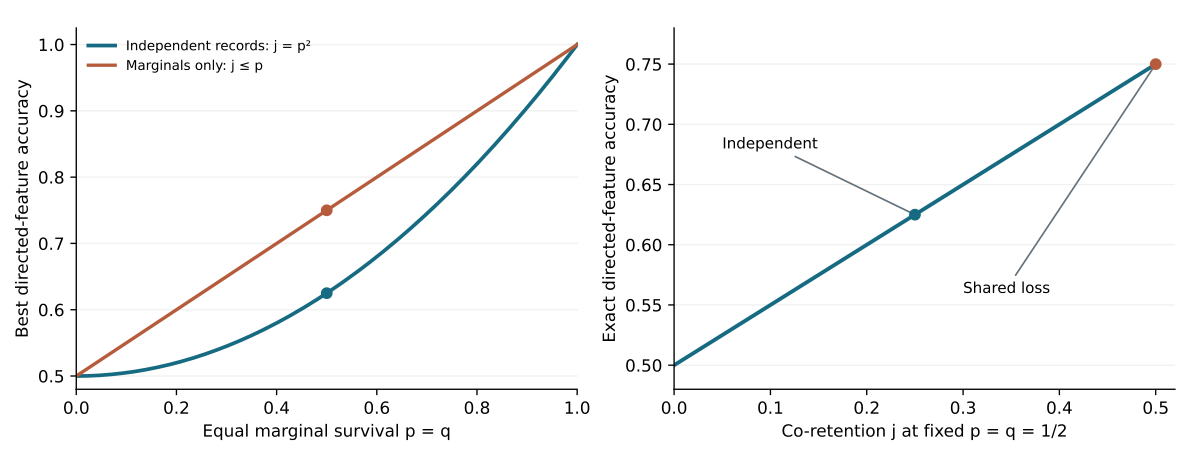
**Figure 2.** Equal local survivals can conceal different joint access. At $p=q=1/2$, varying $j$ moves the optimum from $1/2$ to $3/4$. These are analytic model curves, not fitted observations.
Joint diagonality matters too. Keep $p=q=1/2$, set $\rho_{00}=|00\rangle\langle00|$, $\rho_{01}=(|00\rangle\langle00|+|01\rangle\langle01|)/2$, $\rho_{10}=(|00\rangle\langle00|+|10\rangle\langle10|)/2$, and $\rho_{11}=|\Psi^+\rangle\langle\Psi^+|$. Then $j=0$, yet a POVM assigning zero to $\operatorname{span}\{00,11,\Psi^+\}$ and $+1$ to $\Psi^-$ attains $9/16\gt1/2$. Diagonal marginals do not imply a diagonal joint state. The prescribed product construction does supply it.
A hidden preparation archive also defeats a local-code bound. Restricting to nonrepeated pairs lets a perfect predecessor identify the pair before live input arrives. Both alter premises rather than improve interpretation of the unchanged task.
### Count the entire decoder input
A register $R$ may be marginally uniform under every preparation yet improve the task through correlations. Extend the product half-survival record as follows:
| $ab$ | Complete $(ML,R)$ conditional law |
| --- | --- |
| $00$ | $(00,0):1/2;\ (00,1):1/2$ |
| $01$ | $(01,0):1/2;\ (00,1):1/2$ |
| $10$ | $(10,0):1/2;\ (00,1):1/2$ |
| $11$ | $(00,0):1/4;\ (10,0):1/4;\ (01,1):1/4;\ (11,1):1/4$ |
Tracing $R$ gives the same product table and $R$ remains unbiased for every $ab$. Yet decoding $MLR$ gives $S_D=11/16$ and $S_{\mathrm{pair}}=5/8$, exceeding $5/8$ and $9/16$ from $ML$. In outcome order $(00,0),(00,1),(01,0),(01,1),(10,0),(10,1),(11,0),(11,1)$, maximal unnormalized masses are $(3/4,1/2,1/2,1/4,1/2,0,0,1/4)$ for $D$ and $(1/2,1/2,1/2,1/4,1/2,0,0,1/4)$ for the pair. Summing and multiplying by $1/4$ proves the optima. Timing and control metadata need the same scrutiny.
This is different from disclosing the independent survival flags in the attainment proof. Conditional on those flags, missing bits remain uniform; $L-M$ and zero guessing for absent bits remain MAP. Averaging gives the original optima. Those particular flags are harmless for these uniform targets, not a certificate for arbitrary auxiliaries.
**Proposition 6.2: harmless side-resource certificate.** If the entire available input is $\sigma_{ab}=\mathcal C(\rho_{ab}^{ML})$ for one common CPTP map, its task optimum cannot exceed Theorem 6.1. If one common recovery obtains $\rho_{ab}^{ML}$ from $\sigma_{ab}$, equality and the original attainer follow. Fresh fixed-factor ancillas meet both conditions.
**Proof.** Compose any decoder with $\mathcal C$ for the upper bound. Compose the original attainer with recovery for the reverse inequality. Appending and tracing a fixed ancillary factor give those maps in the fresh-resource case.
For extra classical records, the conditional law given $ML$ may simply be preparation-independent. This weaker data-processing certificate allows harmless correlation with $ML$. The counterexample fails it.
The product calculation is conditional on actual preparation, isolation and control interfaces. A positive Hamiltonian does not certify those interfaces. A scoring archive must be inaccessible before decision. Random preparation, switches and timing must introduce no hidden completion. Joint calibration must cover every accessible controller/reference or establish its harmlessness. Postselection and later lookup are not free. Charge all active memory time to $\Delta$, protected gate storage separately, and collection, isolation, latency and readout to deadlines. The gate's norm $\pi/\tau_g$ is an additional control resource, not bounded by the chain couplings. The model is not an exact relativistic speed-limit theorem or a built apparatus.
### Robustness and the operation actually performed
Let $\widetilde\rho_{ab}$ be actual complete conditional inputs and $\rho_{ab}^{\mathrm{ideal}}=\rho_{ab}^{ML}\otimes\sigma_C$. Bound their average joint trace distance, including all accessible side resources, by
$$
\bar\eta=\frac14\sum_{a,b}D(\widetilde\rho_{ab},\rho_{ab}^{\mathrm{ideal}}).
$$
Actual states may be coherent or correlated. Each correct-answer effect lies between zero and identity; its probability differs by at most trace distance. Taking suprema gives
$$
\widetilde S_D^{\max}\le(1+j)/2+\bar\eta.\tag{17}
$$
An independently justified confidence lower bound $L$ on success therefore requires $j\ge[2L-1-2\bar\eta]_+$. Contractivity and triangle inequalities combine compatible channel, preparation and finite-gate errors. Marginal bars do not establish this joint premise. The numerical examples are constructed, not human fits.
A finite native update uses ready registers:
$$
(M,L,0_D,0_G,0_{\mathrm{valid}})\mapsto(M,L,\operatorname{code}(L-M),\operatorname{code}(2L-M),1).
$$
Input-controlled flips, with Toffoli gates where needed, implement this reversibly in finite time. CNOT alone is not claimed sufficient for arbitrary output encodings. The XOR-on-output map is an involution and admits the stated finite Hamiltonian. $G$ may drive a fixed comparison or anticipation rule; prediction is current organization, not receipt from the future.
Closing the use gate preserves the archive but leaves the valid flag false and executes no directed update. Swapping actual predecessor/live bindings preserves records and total information but enacts $M-L$. In the product model its task success becomes $(2-p-q+2pq)/4$, rather than $(1+pq)/2$. Another decoder could repair the swap: the contrast is realized use, not a lower resource-class optimum. At ideal delivery, an unordered bag permits only $3/4$ for the directed target. Later addressed retrieval is separate; deletion after the update removes later access without undoing its occurrence.
For human application, delivered relations must actually enter an independently qualifying person's grounded uptake. The finite device does not select that person's experiential boundary. Under complete-enactment identity, an integrated predecessor/live/anticipatory relation belongs to the experience itself. No later output or moving present converts it. A third source event can occur after the update, so the transition is already enacted before the sequence ends.
The result is a source-to-functional-interpretation constraint with a conditional experiential application. Classical order success does not establish coherent completion. Reference-assisted tests use separate incompatible preparations and their own inert-reference and closed-cut conditions. Ordinary environmental memory survives both analyses; the exact joint-access, timing, intervention and calibration requirements make the nominated operation physically assessable.
## What coherent completion must retain
## Classical return and coherent return are different demands
**A bit can return through a classical archive. Entanglement asks more of the omitted completion.** At the ready cut prepare reference and subsystem in $|\Phi_d\rangle=d^{-1/2}\sum_{j=0}^{d-1}|j,j\rangle$ using parallel chains for $d=2^n$. In distance formulas $\Phi_d$ denotes the density operator. Keep $R$ inert and inaccessible before output formation; a joint final measurement supplies no earlier reference signal.
An $S$-only update at the exact ready cut outputs $I_R/d\otimes\sigma_S$. Its Bell probability is $1/d^2$, independent of $\sigma$, giving
$$
\inf_\sigma D(\Phi_d,I_R/d\otimes\sigma)=1-\frac1{d^2}.\tag{18}
$$
The Bell event supplies the lower bound. Choosing $\sigma=I/d$ attains it by direct eigenvalues. For a qubit the distance is $3/4$, rather than the binary task's $1/2$. Different targets require different bounds.
### A sharp readiness/completion frontier
Let $R,S$ each have dimension $d$. At a causal cut, count every later available carrier other than $S$ in $C,Q$. $C$ is genuinely classical: the whole joint state is block diagonal in one fixed $C$ basis. $Q$ has dimension $1\le k\le d$. Later processing is one common unconditional CPTP map on $S,C,Q$, with fresh ancillas initially a fixed tensor-product factor of the entire cut input. No access to $R$, other $R$-correlated input or uncounted coherent reference memory is allowed.
Independently calibrate readiness and final Bell probability:
$$
\Pr(S=0)=\operatorname{Tr}(P_0\rho)\ge1-\epsilon,\quad P_0=|0\rangle\langle0|_S\otimes I,\quad f=\langle\Phi_d|\rho_{RS}^{\mathrm{out}}|\Phi_d\rangle.
$$
Readiness is a local probability, not merely a product reduced marginal.
**Theorem 7.1: quantum completion across a nearly ready cut.** The sharp resource-class maximum is
$$
B_{k,d}(\epsilon)=
\begin{cases}
\left(\sqrt{\frac{k}{d}(1-\epsilon)}+\sqrt{(1-\frac{k}{d})\epsilon}\right)^2,&0\le\epsilon\le1-k/d,\\
1,&1-k/d\le\epsilon\le1.
\end{cases}\tag{19}
$$
Sharpness includes maximally mixed reference marginal and ranges over freely chosen pre-cut instruments and post-cut decoders. It is a benchmark for the counted resources, not an attainment promise for an arbitrary source.
**Proof, exact readiness.** The cut factors as $|0\rangle\langle0|_S\otimes\rho_{RCQ}$. In each classical branch, $RQ$ decomposes into pure states of Schmidt rank at most $k$. Local Kraus operators, fresh ready ancillas and forgetting flags cannot increase that rank bound. A normalized rank-$k$ vector with Schmidt weights $\lambda_j$ has
$$
|\langle\Phi_d|v\rangle|\le d^{-1/2}\sum_j\sqrt{\lambda_j},\qquad\left(\sum_j\sqrt{\lambda_j}\right)^2\le k.
$$
Its Bell overlap is at most $k/d$; convexity extends this to mixed outputs. This is the established Schmidt-number witness [18,48] applied across a counted causal cut.
**Proof, approximate readiness.** Purify the cut state to $|\psi\rangle$ and set $p=\langle\psi|P_0|\psi\rangle$. If $p\gt0$, the normalized projection $|\phi\rangle=P_0|\psi\rangle/\sqrt p$ has overlap $\sqrt p$ with $\psi$ and Bell probability $f_0\le a=k/d$ after the same channel. Realize the channel isometrically and the Bell test as projector $M$. Cauchy–Schwarz on $M,I-M$ gives
$$
\sqrt p\le\sqrt{ff_0}+\sqrt{(1-f)(1-f_0)}.
$$
With $\theta=\arccos\sqrt f$ and $\theta_0=\arccos\sqrt{f_0}$, $|\theta-\theta_0|\le\arcsin\sqrt\epsilon$. Since $\theta_0\ge\arccos\sqrt a$, for $\epsilon\le1-a$,
$$
f\le\cos^2(\arccos\sqrt a-\arcsin\sqrt\epsilon)=B_{k,d}(\epsilon).
$$
For larger $\epsilon$ use $f\le1$. Zero-probability projection and $k=d$ are immediate cases.
**Proof of sharpness.** For $k\lt d$ let $m=\binom dk$ and let classical $C$ label every $k$-subset $A$ of the computational basis. Choose isometry $V_A:\mathbb C^d\to S\otimes Q$ putting the basis in $A$ inside $|0\rangle_S\otimes Q$ and the rest in its orthogonal complement. Such an isometry exists because $\dim(S\otimes Q)=dk\ge d$. Let $D_A$ be diagonal with entries $\sqrt{(1-\epsilon)/k}$ on $A$ and $\sqrt{\epsilon/(d-k)}$ elsewhere, and define
$$
K_A=\sqrt{d/m}\,V_AD_A.
$$
Each basis vector belongs to fraction $k/d$ of subsets, so $\sum_AK_A^*K_A=I$. Applied to half of $\Phi_d$, each branch has probability $1/m$, readiness $1-\epsilon$ and Schmidt weights $(1-\epsilon)/k$ on $A$ and $\epsilon/(d-k)$ outside it. Decode by $V_A^*$ on its image, extending trace-preservingly elsewhere. Every branch gives
$$
f=\frac{[\sqrt{k(1-\epsilon)}+\sqrt{(d-k)\epsilon}]^2}{d}.
$$
Trace preservation keeps the reference maximally mixed. For larger $\epsilon$, choose $\epsilon'=1-k/d$ to attain one while satisfying the inequality. For $k=d$, store the input in $Q$ while $S$ is ready. This proves sharpness.
For a qubit with classical completion only, $k=1,d=2$,
$$
f\le\frac12+\sqrt{\epsilon(1-\epsilon)},\qquad0\le\epsilon\le\frac12.\tag{20}
$$
At exact readiness this is the entanglement-breaking benchmark $1/2$ [11]. Readiness $0.99$ permits at most $0.59950$, not near-perfect Bell return. A simpler consequence is $f\le k/d+\sqrt\epsilon$, hence $k\ge\lceil d(f-\sqrt\epsilon)\rceil$ when positive. Use confidence bounds and independent calibration margins, not only point estimates. Postselected success must charge acceptance probability; the theorem concerns unconditional outputs.
The frontier combines known Schmidt-number and purity constraints. In the qubit case its envelope also follows from singlet-fraction, negativity and marginal-purity inequalities [50,51]. The causal-cut formulation identifies their physical meaning: reliable return requires enough coherent completion, not just classical answers.
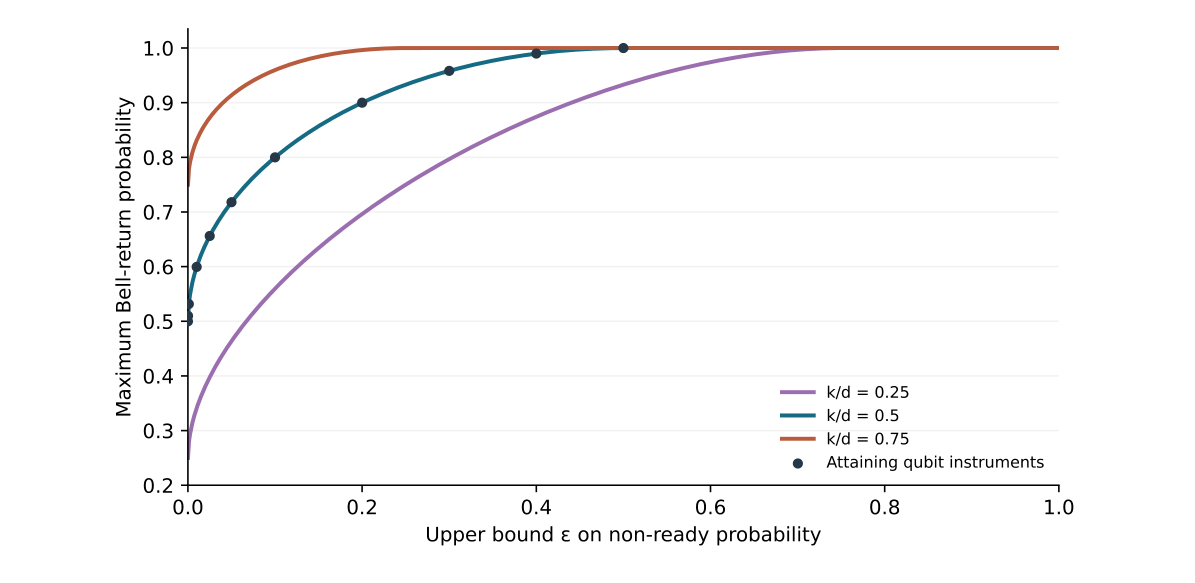
**Figure 3.** $k/d$ counts coherent dimensions outside the nominated subsystem; arbitrary classical flags are allowed. Points check explicit attaining qubit instruments. The frontier describes a resource class, not measured apparatus performance.
### A reduced product state does not locate the coherent resource
Apply a uniformly chosen Pauli $I,X,Y,Z$ to half a Bell pair and retain the classical key. Omitting that key gives $\rho_{RS}=I/4$, with $S=I/2$ having no marginal input dependence. Reading the key and undoing the Pauli recovers the Bell pair perfectly [16]. In this operational model no separate external quantum register is needed: coherent information remains in $S$ together with its classical-key correlations.
This does not contradict no-hiding for a fully purified unitary environment. It shows why an $RS$ product marginal alone cannot locate the quantum resource outside $S$. Pure readiness, or the quantified replacement above, does essential work.
### The discriminating protocol
Prepare an entangled reference input and calibrated chain. On separate identical preparations estimate midpoint readiness and test return without reference access before output. Preserve every outcome. Compare an independently bounded $f$ with (19). At ideal $T$, the chain returns $f=1$; an endpoint-only account gives Bell probability $1/4$, and a purely classical closed completion at most $1/2$. Under the declared quantum operational premises, this requires coherent completion outside the ready endpoint.
Replacing the already ready endpoint at $T$ leaves the ideal global state unchanged. Replacing or decoupling the remote carrying spin can remove the return. These are different proposed interventions on the causal route, not part of the unperturbed Hamiltonian proof. Actual interventions and their calibration could locate the memory mechanism; no experimental result is claimed.
Ordinary environmental quantum memory supplies the successful completion. A full process tensor supplies the multitime laws [19]. The test excludes the declared restricted repair, not every classical mathematical ontology or operational surrogate. Its source-specific content is the common calculation of loss, timing, recovery, approximate readiness and coherent resource requirements.
## A finite occasion for temporal use
## Availability needs a schedule, binding and actual use
The accuracy theorem concerns a code and a task. An actual temporal interpretation additionally needs executable timing, grounded source references and use. A correct stored pair does not supply those facts automatically.
### A finite joint-use opportunity
Let $a_1,a_2$ be arrivals on one local clock. The earlier trace survives to age $M$; consolidation requires latency $\lambda\gt0$ after the later arrival. A possible uptake occasion satisfies
$$
\max(a_1,a_2)+\lambda\le v\le\min(a_1,a_2)+M.
$$
Therefore
$$
|a_2-a_1|+\lambda\le M.\tag{21}
$$
is necessary. With guaranteed access through $M$ and an executable update of latency $\lambda$, it is sufficient for this schedule: choose its lower endpoint. It does not certify human experience. If both traces decay, both age constraints apply. For probabilistic memory the survival $r$ replaces the hard-window guarantee.
An illustrative RC trace has $r_V(\Delta)=V_0e^{-\Delta/(RC)}$, with detectable lifetime $M=RC\log(V_0/V_{\mathrm{th}})$ [36]. For $R=250\,\mathrm{k}\Omega$, $C=1\,\mu\mathrm F$, $V_0=1\,\mathrm V$, $V_{\mathrm{th}}=0.4\,\mathrm V$, the lifetime is $0.229073\,\mathrm s$. Voltage survival differs from quantum probability $r=\cos^2(\kappa\Delta)$. A capacitor or order detector does not automatically meet a coherent-completion theorem. Electronic components have precedents [39]; an embodied interpreter requires its own realization.
### Source order is calibrated, not freely supplied
For timelike source gap $\Delta_s$ and channel delays $\delta_1,\delta_2$,
$$
\Delta_a=\Delta_s+\delta_2-\delta_1,\qquad\widehat\Delta_s=\Delta_a-\widehat\delta_2+\widehat\delta_1.
$$
The interpreter has arrivals and learned delay estimates, not true timestamps as an oracle. If $|\widehat\delta_i-\delta_i|\le\eta_i$,
$$
|\widehat\Delta_s-\Delta_s|\le\eta_1+\eta_2.\tag{22}
$$
On a full rectangular bounded-error set, sign is guaranteed exactly when $|\widehat\Delta_s|\gt\eta_1+\eta_2$. Inside that band zero or contrary signs remain possible. A finite coincidence band should return unresolved order rather than assign it by arbitrary IDs. The directed-feature theorem assumes fixed earlier/live provenance. Establishing it is a separate apparatus requirement.
For example C emitted at $0\,\mathrm{ms}$ with $80\,\mathrm{ms}$ delay and E emitted at $50\,\mathrm{ms}$ with $10\,\mathrm{ms}$ delay arrive E then C. Correct calibration restores C-before-E. Learned order recalibration has empirical precedents [45]. It changes no physical cause or proper time, and establishes no absolute order for spacelike events.
### A transition before the sequence finishes
Use C,E,G at source times $0,100,200\,\mathrm{ms}$, reception delay $10\,\mathrm{ms}$ and integration delay $5\,\mathrm{ms}$. The C–E transition is usable at $115\,\mathrm{ms}$, before G arrives at $210\,\mathrm{ms}$. The activity can incorporate G at $215\,\mathrm{ms}$. These values demonstrate a schedule, not a universal measured human window.
The operative state distinguishes source reference, features, stream binding, represented order, live/retained/retrieved/anticipated mode, calibration and use. Joint availability retains ordered source roles. An illustrative C–E prefix supports probabilities $0.75$ for G and $0.25$ for D in different later environments, with subsequent surprises $0.287682$ and $1.386294$ nats. An omission changes expectation without becoming a received note. These probabilities and deadlines are stipulated.
A truth table or flag called $U$ does not establish human uptake. The transducer's use gate means the relation actually drives its declared continuation/action update; closing it leaves an archive without that effect. Experiential application requires entry into the qualifying person's grounded recognition, relating or response with other constitutive conditions intact. A separate later lookup cannot establish earlier use. This is an application condition, not another final conversion into experience.
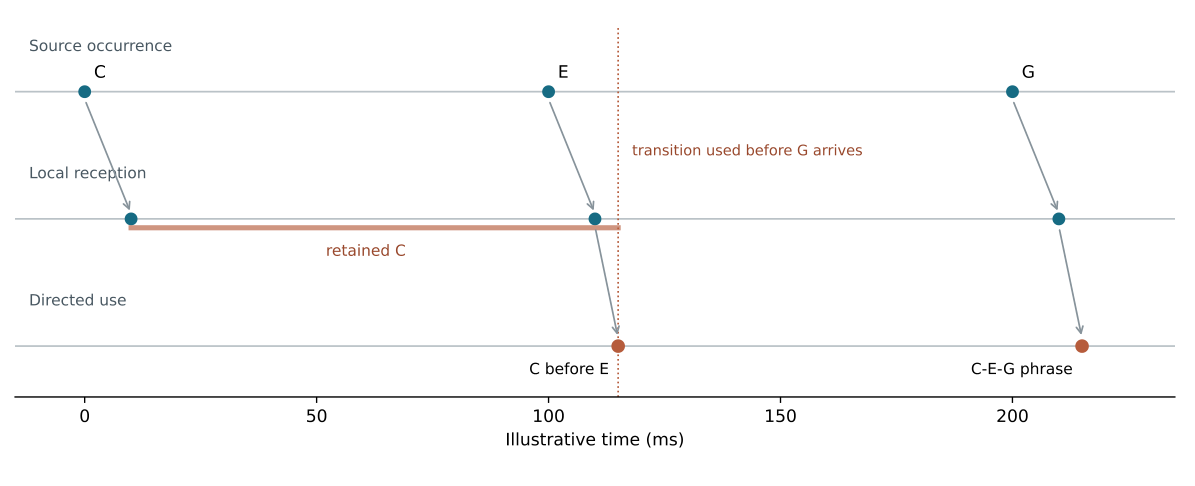
**Figure 4.** Source occurrence, reception and directed use are separate. The marked local occasion is not a universal present. Available retained C and live E preserve distinct represented temporal roles.
### What the empirical comparisons constrain
Auditory fusion shows that successive nonoverlapping tones can be reported as one synthetic vowel; identities and overlap do not uniquely fix succession [40]. Pitch, signed pitch change and contextual expectation have differentiable neural encoding [41]. Omission responses expose prediction beyond the received prefix [52]. Narrative-sensitive activity in a severely amnesic patient separates online integration from durable recall [54]. Each constrains a component; none alone establishes grounded uptake, universal formation requirements or complete experiential identity.
These sources are not a collection of independent repetitions. Stetson's behavioral and imaging samples overlap, including repeated participants across hand conditions. Zuo's controls reuse an earlier dataset. Sankaran's main recordings involve eight patients, not one independent participant per electrode; preprint and publication are one work. Mechanism evidence and constitutive interpretation retain separate warrants.
### Physical intervals, duration reports and felt pace
Proper time, record asymmetry, duration response and felt pace have different targets. The partial pace model [36] is
$$
D_\tau=\alpha B+\beta N,\qquad J_\tau=\kappa_p\log\frac{N/B}{\rho_0}+\eta\log\frac EB.
$$
$B$ is internal elapsed estimate, $N$ interpreted boundaries, $E$ expected endpoint and $\rho_0$ a learned reference rate. At fixed $B$, the Jacobian with respect to $(N,\log E)$ has determinant $\beta\eta$. For selected nonzero parameters it has rank two; human response rank has not thereby been measured. Density and endpoint studies motivate separate contrasts but do not fit this equation [15,46]. Shared participants and reused comparison conditions limit replication claims.
A local timer and watch both scaling with proper time keep their ratio fixed. Proper-time scaling alone cannot explain a changed local timing/watch ratio. A timing task's measured target must be specified before its response is interpreted as passage. These models provide constructed relations, not participant-data fits.
## Does the source extend beyond physical history?
## Locate the obstruction on the right map
### Local loss does not establish a lossy source-to-history map
A specified physical model may have a restricted presentation. Independent observations may then require distinctions beyond that presentation. The stronger claim that physical reality itself is readout of a particular richer source requires another argument. The source-to-use programme establishes the first result and supports a conditional empirical route to the second.
**Proposition 9.1: composition and the identity countermodel.** Let $F:S\to H$ be onto, $q:H\to Z$ a record and $f:H\to A$ a target. If $q(h_0)=q(h_1)$ but $f(h_0)\ne f(h_1)$, then $f$ does not descend through $q$ and $f\circ F$ does not descend through $q\circ F$. This implies neither noninjective $F$ nor a necessary source beyond $H$.
**Proof.** A common function of equal records cannot give different targets. Surjectivity provides source antecedents and lifts the same obstruction. Set $S=H,F=\mathrm{id}$ for the countermodel: local loss remains while the history map is injective.
Explicitly, $H=\{0,1\}^2$, $q(a,b)=a$, $f(a,b)=b$ suffice. The entire history is an adequate working source. Appending a silent coordinate creates a richer mathematical representation but provides no evidence of an additional physical bearer.
The integration remains useful without that inference: relativity constrains the access map and completion specifies what it must preserve. A deeper history realization can be established where independently warranted. No jump from $q$-loss to $F$-loss is licensed or needed.
### A complete passive path can still miss intervention laws
Take qubits $E,S$ initially $|\lambda,0\rangle$, $\lambda\in\{0,1\}$. During dwell $T\gt0$ use
$$
H_{ES}=\frac\pi T|11\rangle\langle11|,\qquad U_{ES}(T)=|0\rangle\langle0|_E\otimes I_S+|1\rangle\langle1|_E\otimes Z_S.
$$
The entire passive reduced trajectory is $\rho_S^\lambda(t)=|0\rangle\langle0|$ for both preparations, because $|\lambda,0\rangle$ has zero energy. Apply Hadamard $W$ to $S$, dwell, then apply $W$ again. Since $WZW=X$ and $W^2=I$,
$$
(I\otimes W)U_{ES}(T)(I\otimes W)|\lambda,0\rangle=|\lambda,\lambda\rangle.
$$
The same final $Z$ measurement distinguishes perfectly. A predictor given only the identical passive path must issue one Bernoulli parameter $m$, with conditional TV errors $m,1-m$ and minimax $1/2$. Final-law calibration errors $\eta_0,\eta_1$ reduce the bound to $[1-\eta_0-\eta_1]_+/2$ if passive equality stays exact. This applies the established half-TV obstruction [29,34], not a new universal inequality.
The preparation archive and $E$ are inaccessible before decision. Isolate coupling during finite pulses, counting pulse time, control strength, timing and protected storage. The positive involution generator $\pi(I-W)/(2\tau_g)$ realizes each pulse. Its norm is $\pi/\tau_g$; the sequence takes $T+2\tau_g$ with dwell norm $\pi/T$. The schedule is common and independent of $\lambda$. Joint interface/switching calibration remains required. The missing distinction is an ordinary environment state with a prescribed coupling, not an appended stochastic seed.
Thus an entire passive local path need not determine an active response. A process tensor or equivalent intervention-sensitive specification supplies the missing law [5,19]. This is an elementary physical illustration of an established distinction. Complete histories include $E$ and differ in $\lambda$, so $F=\mathrm{id}$ survives. The diagnostic does not prove a nonspatiotemporal source.
### Compare the strongest existing source results
| Result | What its premises establish | What the integration adds or leaves open |
| --- | --- | --- |
| Canonical descent and dynamics [24–26,28,29] | Target variation in a readout fibre requires completion; a noninvariant kernel obstructs autonomous projection. | Physical delivery and use instantiate the criteria without making them universal ontology results. |
| RS2 witness [30,42] | In an admitted bulk class, equal instantaneous brane data can have different later brane readouts. | A gravitational realization, distinct from loss in every full history; residues require physical testing. |
| Bell/resource results [34] | Under their exact source assumptions, a nominated classical initial readout leaves conditional information unresolved; finite resources bound access. | Stronger than ignorance, but no removal of outcome determinism, independence or no-signalling premises. |
| Global quantum-record theorem [23] | A source-carried future selector absent from preceding Tier-1 filtration and preserved by reduction yields maximally different record continuations from one present. | Pathwise nonclosure within a declared realization, not noninjectivity of source-to-entire-history. |
| Delivery, joint code and coherent completion | Calculated couplings and complete cuts bound particular future uses. | Source-specific operational constraints and conditional experimental routes, with ordinary environments still possible. |
The regular-branch global record theorem assumes a selector carried by source/preparation structure, nonmeasurability in the preceding Tier-1 filtration, conditional full support, measurement independence and reduction preserving distinctions that yield different objective records [23]. These support the pathwise witness. A nontrivial Born kernel alone gives a conditional law. Representing it by a uniform randomizer independently establishes no extra physical substrate. Distributional closure can coexist with failure to select a realized continuation from the present.
Its full-history theorem is separate: a lawful nonisomorphic inactive extension can preserve the entire Tier-1 history law, showing architecture non-identifiability in that class. Isomorphic active apertures suffice for equal laws; the converse needs another identifiability theorem. The warranted conclusion is operational/readout equivalence, not an inferred unique aperture isomorphism class or physical necessity of a silent sector.
### What would strengthen the physical inference
Let $\Xi(s)=(\mu_{e,s})_e$ collect record laws under all admitted experiments, including adaptive interventions. A description $r(s)$ supports the family exactly only when
$$
r(s)=r(s')\Rightarrow\Xi(s)=\Xi(s').
$$
Enlarged access can enlarge $\Xi$ and split previous equivalence classes, as the control and pooled-record protocols do. Yet canonical protocol equivalence and the complete-law surrogate result permit a history/process model reproducing the enlarged family [30,34]. Reconstructing causal history kernels does not evade that ceiling.
A stronger inference needs independently justified restrictions: a closed causal cut, finite coherent memory, locality/factorization, incompatible preparations or a specified dynamical law. The readiness/completion theorem provides one such inference without requiring source-level outcome determinism. A universal source-beyond-history claim would need a reason that every adequate whole-history realization fails a warranted condition, or evidence selecting one deeper physical model. Neither local experience nor a block interpretation supplies that reason here.
The advance is exact realization and explanation. A source-accurate temporal relation needs attainable completion when used; experiential significance follows under a separate constitution. The stronger source question remains precise, without confusing these achievements.
## What the integration establishes
## One relation, followed from source to lived use
**The combined account explains more than the observation that an observer knows less than a whole history.** Relativity supplies causal order, proper-time schedules and the difference between common existence and common availability. Target-relative mathematics identifies the missing relation. Physical realization determines whether it can arrive and survive until use. Enacted constitution supplies its conditional experiential significance. The same directed relation connects these stages in the source-to-use programme.
For the block account, this answers a definite explanatory demand. Retained predecessor, live contribution and anticipation differ within continuing activity. Their common availability does not make their sources simultaneous. Uptake can precede the sequence's end. Later forgetting does not undo it. Temporal hearing without psychological appropriation remains possible because useful bodily indexing and interpretation need not create an independent owner. An outside projector performs no additional required operation after the complete qualifying activity is admitted.
Removing eternalism leaves the resource theorems unchanged. Its contribution concerns actuality's interpretation, not a second experimental confirmation. Removing completion vocabulary leaves the quantum and relativistic mechanisms, but relinquishes the explicit target-fibre/attainability question and selected experiential constitution. The integration is explanatory without making every component logically dependent on the whole framework.
For Shadow Theory, the gain is disciplined realization. Source, history, record and interpretation cannot exchange roles. Preparation, communication, full joint calibration, finite retention, binding and use restrict presentation. The accuracy frontier and coherent-completion bound quantify those restrictions. An ordinary environment may carry an omitted distinction and later become a causal source for another readout. Reciprocal physical dependence inside a history is not reciprocal actuality by definition.
The direct reciprocal-pair theorem sharpens the ontological branch: translation, transitivity and the stated boost/spatial symmetries make one distinct mutual pair decisive without dilation or global symmetry. This weakens the classification route's premises. Yet a defensible fixed actuality relation and independent reciprocal witness are still needed. Process duration, causal dependence and covariant observer families do not supply them. Selector economy is also precise: where predictions, records and complete qualifying enactments factor through the retained history, no extra activation distinction is needed by minimal completion. Experiential equivalence uses identity; neither minimality nor forgetting an extra variable proves an exhaustive ontology or removes geometry-defined relations. Relational becoming remains a serious rival.
The physical argument excludes nominated closed descriptions and distinguishes constrained resource classes. It does not prove that every source-to-entire-history map is lossy. Identity realization survives the local and passive-history obstructions. Equal full experiment laws still admit complete operational surrogates. Existing source theorems retain their own assumptions and exact conclusions.
Two challenges therefore remain distinct: independent warrant and actual application of experiential constitution, and a physical/theoretical premise that excludes the nominated whole-history alternatives. Temporal explanation can advance without first solving a universal subject selector or proving the unknown Ground. This paper's result is the conditional, substantive bridge it actually constructs: a source-supported relation becomes locally operative and, under the selected constitution, experienced within a complete history.
## Direct reciprocal-pair proofs
## The mathematical implication in full
The proof concerns one fixed relation on real Minkowski events. It neither defines that relation as actuality nor assumes that an observer's indexed access relation is invariant while its observer index is fixed.
### A.1 The mutual core is an additive subgroup
A reciprocal witness and transitivity give $R(p_0,p_0)$. Translation by $p-p_0$ yields $R(p,p)$ for every event, so reflexivity follows. Define
$$
H=\{v:R(0,v)\land R(v,0)\}.
$$
Zero belongs to $H$. For $v\in H$, translating its two links by $-v$ gives $-v\in H$. For $v,w\in H$, translation yields $R(v,v+w)$ and $R(v+w,v)$. Compose these with the links between zero and $v$ to obtain both relations between zero and $v+w$. Hence $H$ is an additive subgroup.
Every assumed linear symmetry preserves $H$. Translating the original witness supplies $q_0-p_0\in H\setminus\{0\}$. Closure under arbitrary real scalar multiplication has not been assumed. It must be generated from the actual symmetries.
### A.2 Generation of real 1+1 space
For nonzero $v=(t,x)\in H$, reflection gives $Pv\in H$, and therefore
$$
v+Pv=(2t,0)\in H,\qquad v-Pv=(0,2x)\in H.
$$
At least one is a nonzero pure-axis vector. For every $s\in\mathbb R$, choose
$$
\ell=\frac{s+\sqrt{s^2+4}}2\gt0,\qquad\ell^{-1}=\frac{\sqrt{s^2+4}-s}2.
$$
Their product is one and $\ell-\ell^{-1}=s$. If $(a,0)\in H$ with $a\ne0$, opposite boosts give
$$
B_\ell(a,0)-B_{1/\ell}(a,0)=(0,a(\ell-\ell^{-1})).
$$
Since $s$ is arbitrary, this supplies the entire spatial axis. Fix $\ell=2$, whose boost coefficients are $c=5/4$ and $b=3/4$. Boost $(0,x)$ and subtract the available spatial vector $(0,cx)$; the result $(bx,0)$ spans the temporal axis. Starting instead with a nonzero pure spatial vector reverses the two steps. Add the axes to obtain $H=\mathbb R^2$.
For arbitrary $p,q$, $q-p\in H$ implies $R(0,q-p)$. Translating by $p$ yields $R(p,q)$ and universality. The algebra also works over an ordered field with positive square roots, though the direct formal modules here specialize to the reals.
A nonnull reciprocal displacement can be boosted to a pure axis, removing the need for reflection in that restricted witness class. A null-only witness cannot use that shortcut; the null-line countermodel below shows the role of reflection.
### A.3 Generation of real 3+1 space by proper half-turns
Write $v=(t,x_0,x_1,x_2)$. Let $H_i$ be the spatial half-turn fixing axis $i$ and reversing the other two spatial coordinates. Its determinant is $+1$. Assume translations, transitivity, all positive-parameter boosts along each coordinate axis and these three half-turns preserve $R$. These are proper-orthochronous transformations; full Lorentz invariance is stronger than the package used here.
The subgroup proof supplies nonzero $v\in H$. If $t\ne0$,
$$
(v+H_0v)+H_1(v+H_0v)=(4t,0,0,0)\in H.
$$
If $t=0$, choose $i$ with $x_i\ne0$. Opposite axis-$i$ boosts give
$$
B_{i,2}v-B_{i,1/2}v=(3x_i/2,0,0,0)\in H.
$$
Thus a nonzero pure temporal vector $ae_t$ is available in either case. Along each axis,
$$
B_{i,\ell}(ae_t)-B_{i,1/\ell}(ae_t)=a(\ell-\ell^{-1})e_i.
$$
This spans that whole spatial axis. Boosting one such vector with a fixed nonzero boost and subtracting its spatial component spans time. Finite addition gives $H=\mathbb R^4$, and translation completes universality. Proper half-turns require neither global parity nor dilation, continuity or an assumed real-linear subgroup.
### A.4 Countermodels identify the exact scope
| Omitted premise | Nonuniversal reciprocal relation |
| --- | --- |
| Boost invariance | $R(p,q)\Longleftrightarrow p^0=q^0$. |
| Translation invariance | Equality of Minkowski norm relative to a selected origin, a Lorentz-invariant equivalence. |
| Transitivity | Equality or spacelike separation; $(1,2)$ and $(1,-2)$ are spacelike but sum to timelike $(2,0)$. |
| Distinct reciprocal witness | Causal-past order remains transitive and invariant under the stated symmetries without being universal or symmetric. |
| Reflection in 1+1 | $p^0-p^1=q^0-q^1$, an equivalence by parallel null lines, invariant under translations and boosts. |
The direct implication is not a six-way classification without dilation. For fixed $L\gt0$ in null coordinates,
$$
R_L(p,q)\Longleftrightarrow p=q\ \text{or}\ u\lt0,\ w\lt0,\ uw\ge L^2,\qquad u=\Delta t+\Delta x,\quad w=\Delta t-\Delta x.
$$
It is translation/boost/reflection invariant and transitive. For two nonidentity links write positive past-coordinate magnitudes $(a,b),(c,d)$ with $ab,cd\ge L^2$. Their sum has $(a+c)(b+d)\ge ab+cd\ge2L^2$. A fixed active dilation may violate the threshold. The relation lies outside the dilation-based list but has no distinct reciprocal pair and leaves the direct theorem intact.
The classification-based reciprocal module eliminates the five nonuniversal classified cases by their trivial mutual cores. Its stronger invariant structure includes dilation. The two direct real modules instead prove the weaker-premise implications. All three are consistent and have different dependencies. None establishes an actuality interpretation or its witness by kernel checking alone.
The supplied standalone [Reciprocal source](/publications/consciousness/new-papers/block-universe/Reciprocal.lean) is the classification-based module. The matching publication's [complete verification supplement](/publications/consciousness/new-papers/block-universe/verification.zip) also contains `ReciprocalNoDilation.lean`, `ReciprocalThreePlusOne.lean`, their dependencies, exact toolchain pins and axiom audits. Its recorded Lean run is evidence of that archived execution. Independent formal reproduction requires the pinned toolchain and dependencies.
## Formative dependence and experiential admission
## A developmental recipe is not automatically a universal origin rule
A local interpretation recipe and a historical admission rule must be assessed separately. This appendix holds the nominated local and unit conditions fixed, including any developed reasoning and actual-uptake requirements. The problem is consistency and selection of experiential assignments, not a consciousness detector.
### B.1 Unanchored assignments
Let $L\subseteq V$ be locally qualifying activities. Write $u\to v$ for an eligible formative contribution from another unit, and define
$$
\operatorname{Post}_L(E)=\{v\in L:\exists u\in E,\ u\to v\}.
$$
The biconditional experiencing-contributor recipe requires
$$
E=\operatorname{Post}_L(E).\tag{23}
$$
A necessary-only rule instead says $E\subseteq\operatorname{Post}_L(E)$. It still requires an admitted predecessor for every admitted activity. Either rule excludes nonempty admission on well-founded ancestry. Only equality also requires every locally qualifying successor of an admitted contributor to be admitted. For $a\leftrightarrow b$ and $b\to c$, $E=\{a,b\}$ is a necessary-only solution strictly contained in $\operatorname{Post}_L(E)=\{a,b,c\}$.
**Proposition B.1: existence, uniqueness and finite classification.** Empty admission always solves (23). If ancestry inside a hypothetical nonempty solution is well founded, there is no such solution and empty admission is unique. On a finite graph, all solutions are forward-reachability closures of unions of cyclic strongly connected components in the graph induced by $L$. Nonempty admission exists exactly when that graph has a cycle. Empty admission is unique exactly when it is acyclic. Exactly one nonempty solution exists exactly when there is one cyclic SCC, with empty admission still present.
**Proof.** $\operatorname{Post}_L(\varnothing)=\varnothing$. A nonempty well-founded solution has a minimal member, contradicting its required admitted predecessor. In a finite fixed point, forward closure holds and every member has a predecessor. Repeatedly following predecessors reaches a cycle, so every member is reachable from a cycle inside the set. Forward closure includes its SCC and qualifying successors. Conversely the forward closure of any selected cyclic SCCs is closed under successors, and every member has a predecessor on a cycle or the path from one. It is therefore fixed. One cyclic SCC gives only its closure besides empty. With at least two, choose a terminal cyclic SCC in the condensation's cyclic reachability order; its closure omits another cyclic SCC, whose addition makes another nonempty fixed point.
The greatest finite solution consists of qualifying successors of qualifying cycles, equivalently vertices whose backward path stays entirely in $L$ and reaches a cycle. Descending iteration from $L$ computes it. A nonqualifying intermediate cannot transmit the justification. These are elementary monotone fixed-point consequences [47].
The incompatible combination is universal already-experiencing formative dependence, well-founded experiential ancestry and at least one experience. Temporal precedence need not be well founded on infinite domains, although finite strictly ordered event models are. On integers with $n-1\to n$, empty and all-vertex admission both solve the recipe without a cycle. Infinite ancestry removes a first element but supplies neither historical evidence nor a reason to select the nonempty assignment. Selecting the greatest fixed point adds a constitutive rule rather than deriving admission.
### B.2 Independent anchors and nonrecursive formation
Let $B\subseteq L$ contain independently admitted activities. The anchored rule explicitly changes the condition:
$$
E=B\cup\operatorname{Post}_L(E).
$$
Write $\mathcal R(S)$ for forward closure within $L$, including zero-length paths.
**Proposition B.2: anchored scope.** On a finite graph, the solutions are precisely $\mathcal R(B\cup C)$ for unions $C$ of cyclic SCCs. The least is $\mathcal R(B)$ and is unique exactly when the graph induced on $L\setminus\mathcal R(B)$ is acyclic. On a well-founded formative relation the unique anchored solution is $\mathcal R(B)$.
**Proof.** A fixed point contains $B$ and is forward closed, hence contains $\mathcal R(B)$. A member outside that closure cannot have a predecessor inside it. In a finite excess, predecessor iteration reaches a cycle there, yielding the stated representation. Conversely those closures satisfy the equation. A residual cycle makes a larger solution; no residual cycle leaves only the least. On well-founded ancestry, a minimal excess member can have a predecessor neither inside nor outside the closure, a contradiction.
An adult independently assumed to experience is thus a conditional anchor, not a product of the unanchored rule. Section 4 does not derive a universal origin by assuming its example. Thin fundamental awareness is not silently promoted to an individuated experiential anchor.
Another possible formulation requires relational development without experiential admission of every contributor:
$$
D_{\mathrm{rel}}(A,J):=\exists B\ne A\;\operatorname{CausalFormation}(B\to\operatorname{Scaffold}_A\text{ operative in }J).
$$
Combined with reasoning and local/unit requirements, it is a scoped proposed constitution for reasoning-organized episodes. It changes the contributor premise. Mandatory relational formation applies only if this variant is chosen; it is not established universally and is not conjoined here to SPC-2. Human language, broader conceptual inference and uptake remain separate. Agrammatic adult calculation can survive severe acquired grammatical loss, but does not prove developmental independence from language [49]. Social-learning benefit also does not prove universal experiential-contributor necessity [14].
### B.3 Mutual learning without circular experiential justification
Two organizations can acquire a particular reasoning scaffold together without inserting consciousness predicates into learning equations. Give them all sixteen binary truth functions. One sees grounded examples $00\mapsto0,01\mapsto1$; the other $10\mapsto1,11\mapsto0$. Each has four consistent hypotheses. Positive-delay exchange supplies all four examples and uniquely identifies XOR. Induction on novel left-associated bit expressions yields $\sum_i x_i\bmod2$. Three through nine leaves provide $1016$ enumerated cases. Withhold the other's evidence and four candidates remain under the same protocol.
Initial concepts, grounding, memory, labels, inference architecture and composition capacity are counted. The model learns one scaffold, not all reasoning from nothing. It does not establish that early contributors lack all possible experience. It supplies the nonrecursive developmental predicate without a consciousness threshold. Under the unchanged well-founded experiencing-contributor recipe, universal assignment stays empty.
Feedback across extended activities does not repair that obstruction. $A_{t_1}\to B_{t_2}$ and $B_{t_3}\to A_{t_4}$ with $t_1\lt t_2\lt t_3\lt t_4$ remain causally ordered even if their encompassing intervals form a two-cycle. If each contributing token must already experience, well-founded obstruction remains. If later qualification admits an entire earlier interval, that adds a whole-interval admission principle. A physical feedback cycle is not automatically a cycle of experiential justification.
Having experience, interpreting an occurrence and explicitly defining or reporting it are therefore different. The adult temporal construction uses actual interpretation while leaving universal admission, complete character and nested/larger bearers distinct. The source-to-functional-use results are independent of every assignment choice examined here.
## Where the missing distinctions can live
## Ordinary physical mechanisms can carry the omitted distinction
These are specified-model witnesses and applications of established identification bounds. Their physical content is substantial without becoming a universal ontology theorem.
### C.1 Causal release in a relativistic field
Take a free massive Klein–Gordon field on 3+1 Minkowski space, vacuum $\omega_0$, and real smooth compactly supported test functions $f,g$. Adopt
$$
[\Phi(f),\Phi(g)]=i\Delta(f,g)I,\qquad W(af)=\exp(ia\Phi(f)).
$$
Prepare $\omega_\pm(A)=\omega_0(W(\pm af)^*AW(\pm af))$. If $\operatorname{supp}f$ is spacelike to the whole bounded early observation region $O$, microcausality gives $[W(af),A]=0$ for every early local observable. Therefore $\omega_+(A)=\omega_-(A)=\omega_0(A)$.
Admit finite adaptive early protocols with the same independent initial apparatus and random-seed laws, causal composition and a complete transcript effect in $\mathcal A(O)$ for every transcript. Every effect commutes with preparation, so all early transcript probabilities agree. Local probe couplings and induced instruments give a framework for checking these localization/composition obligations [8]. Merely calling an instrument local does not establish them. No tensor-product factorization of local QFT algebras is assumed.
Choose later $g$ with $\Delta(f,g)\ne0$. The scalar commutator terminates Baker–Campbell–Hausdorff:
$$
W(af)^*\Phi(g)W(af)=\Phi(g)+a\Delta(f,g)I.
$$
Vacuum $\Phi(g)$ is centered Gaussian with variance $v=\omega_0(\Phi(g)^2)\gt0$. Thus the prepared laws are $N(\pm\mu,v)$, $\mu=a\Delta(f,g)$. Thresholding zero has equal-prior error and distance
$$
\delta=\Phi_N(-|\mu|/\sqrt v),\qquad\operatorname{TV}(N(\mu,v),N(-\mu,v))=1-2\delta.\tag{24}
$$
$\Phi_N$ is the standard normal CDF. Smooth coherent excitations have finite energy at finite amplitude. A material detector, resource bounds and retained threshold record are additional engineering assumptions. An ideal observable is not a completed experiment.
The independently prescribed dynamics thus permit equal early local statistics and unequal later statistics. A common early-information forecast fitting both conditional later laws must have worst-case TV error at least $(1-2\delta)/2$. This applies the half-TV result in Sealed or Leaky, Theorem 5.2 [34], and Constituted Agency §7.1, printed p.26 [20]. It does not invalidate the correct marginal forecast for one fixed prior mixture. An ordinary field excitation outside the early tube supplies the extra structure; another dimension or external observer is not required.
The time-slice axiom concerns a neighborhood of a Cauchy surface, with formal renormalized perturbation theory in the interacting result [4]. It does not grant a finite observer the entire surface's degrees of freedom. Conversely, complete Cauchy data in a well-posed classical model refute a universal assertion that every present description is dynamically incomplete.
### C.2 Unitary retrieval after local forgetting
Prepare qubits $S,E,R$ in $|x,0,0\rangle$, $x\in\{0,1\}$. Apply $\operatorname{CNOT}_{S\to E}$ then $\operatorname{SWAP}_{S,R}$, obtaining $|0,x,x\rangle$. The reduced $S$ state is ready for either input. The same later $\operatorname{CNOT}_{E\to S}$ gives $|x,x,x\rangle$, restoring the distinction exactly.
The whole unitary state preserved the input while the present local state failed to determine the later operation. Ready registers and the schedule are resources. Any Hermitian involution $U$ has a positive generator
$$
H=\frac{\pi\hbar}{2\tau}(I-U),\qquad e^{-iH\tau/\hbar}=U.
$$
This implements a gate over finite $\tau$ but does not build an autonomous clock or relativistic material apparatus. Autonomous quantum-record programmes have their own assumptions [22]; they do not turn this schedule autonomous retrospectively.
The operational quantum Markov comparison is familiar: a causal break in the local system can leave future statistics dependent on earlier operations through the environment [19]. One reduced density matrix does not specify all multitime laws. The circuit instantiates that mechanism without a priority claim.
### C.3 The RS2 gravitational witness
Take positive-tension, $\mathbb Z_2$-symmetric RS2 with pure five-dimensional Einstein gravity, negative bulk cosmological constant and no extra bulk matter. The readout is gauge-reduced instantaneous induced-brane Cauchy and brane matter data. The bulk initial-data class admits finite-energy transverse-traceless wave packets. Under precisely these premises,
$$
G_{\mu\nu}=-\Lambda_4g_{\mu\nu}+\kappa_4^2T_{\mu\nu}+\kappa_5^4\Pi_{\mu\nu}-E_{\mu\nu}.\tag{25}
$$
Projected bulk Weyl $E_{\mu\nu}$ need not be determined by instantaneous brane data [30,42]. Paper 7 already provides the bulk-wave nonclosure witness and adaptive protocol equivalence. Expressing it as a block history is an application, not a new hidden-dimensions proof. Unequal futures distinguish the complete histories. The field and qubit examples show that access/nonclosure is broader than RS2; this branch adds a specified gravitational realization and conditional residues.
### Prepared record persistence needs its own condition
For deposited $\rho_i$, holding requires $\Phi_t(\rho_i)=\rho_i$ throughout the interval. This is not generally conservation of its Heisenberg projection. Under amplitude damping $L=\sqrt\gamma|0\rangle\langle1|$, $P_0$ is stationary but $\mathcal L^*(P_0)=\gamma P_1\ne0$. An ideal zero record Hamiltonian/channel gives both stationarity and projection conservation. Specify the intended property rather than deriving either from the other without hypotheses.
### Reproducible supporting calculations
The matching publication [verification archive](/publications/consciousness/new-papers/block-universe/verification.zip) contains sixteen numerical scripts, pinned requirements and the Lean project. Its README maps checks to §§5–9 and Appendices A–C. Numerical checks corroborate constructed quantities, not a manufactured device, human uptake, the Ground or an actuality witness. The Gaussian script checks probability arithmetic rather than simulating QFT. The temporal scripts independently implement the displayed models; they are not the separate temporal paper's original unavailable code package.
Use the archive's pinned environment and `python3 run_checks.py` to reproduce numerical checks. Formal reproduction uses its pinned Lean 4.36.0-rc1 project and mathlib commit, following the included instructions. Historical result logs are labeled by their own run; extracting the archive is not a new formal verification.
## References and publication sources
## References
The complete bibliography supports the inherited mathematics, physical models, experiential constitution and empirical comparisons. Numbering matches the publication.
### [1]
David Blackwell. Equivalent comparisons of experiments. Annals of Mathematical Statistics, 24(2):265-272, 1953. [DOI 10.1214/aoms/1177729032](https://doi.org/10.1214/aoms/1177729032).
### [2]
Samuel L. Braunstein and Arun K. Pati. Quantum information cannot be completely hidden in correlations: Implications for the black-hole information paradox. Physical Review Letters, 98:080502, 2007. [DOI 10.1103/PhysRevLett.98.080502](https://doi.org/10.1103/PhysRevLett.98.080502).
### [3]
Francesco Buscemi. Comparison of quantum statistical models: equivalent conditions for sufficiency. Communications in Mathematical Physics, 310:625-647, 2012. [DOI 10.1007/s00220-012-1421-3](https://doi.org/10.1007/s00220-012-1421-3).
### [4]
Bruno Chilian and Klaus Fredenhagen. The time slice axiom in perturbative quantum field theory on globally hyperbolic spacetimes. Communications in Mathematical Physics, 287: 513-522, 2009. [DOI 10.1007/s00220-008-0670-7](https://doi.org/10.1007/s00220-008-0670-7).
### [5]
Giulio Chiribella, Giacomo Mauro D’Ariano, and Paolo Perinotti. Theoretical framework for quantum networks. Physical Review A, 80:022339, 2009. [DOI 10.1103/PhysRevA.80.022339](https://doi.org/10.1103/PhysRevA.80.022339).
### [6]
Matthias Christandl, Nilanjana Datta, Artur Ekert, and Andrew J. Landahl. Perfect state transfer in quantum spin networks. Physical Review Letters, 92:187902, 2004. [DOI 10.1103/PhysRevLett.92.187902](https://doi.org/10.1103/PhysRevLett.92.187902).
### [7]
Vishal Doshi, Devavrat Shah, Muriel Medard, and Michelle Effros. Functional compression through graph coloring. IEEE Transactions on Information Theory, 56(8):3901-3917, 2010. [DOI 10.1109/TIT.2010.2050835](https://doi.org/10.1109/TIT.2010.2050835).
### [8]
Christopher J. Fewster and Rainer Verch. Quantum fields and local measurements. Communications in Mathematical Physics, 378:851-889, 2020. [DOI 10.1007/s00220-020-03800-6](https://doi.org/10.1007/s00220-020-03800-6).
### [9]
Willie K. Harrison, Joao Almeida, Steven W. McLaughlin, and Joao Barros. Physical-layer security over correlated erasure channels. [https://arxiv.org/abs/1102.3641v1](https://arxiv.org/abs/1102.3641v1), 2011.
### [10]
James B. Hartle. The physics of ‘now’. American Journal of Physics, 73:101-109, 2005. [DOI 10.1119/1.1783900](https://doi.org/10.1119/1.1783900).
### [11]
Michael Horodecki, Peter W. Shor, and Mary Beth Ruskai. Entanglement breaking channels. Reviews in Mathematical Physics, 15:629-641, 2003. [DOI 10.1142/S0129055X03001709](https://doi.org/10.1142/S0129055X03001709).
### [12]
Jenann Ismael. Temporal experience. In Craig Callender, editor, The Oxford Handbook of Philosophy of Time. Oxford University Press, 2011. [DOI 10.1093/oxfordhb/9780199298204.003.0016](https://doi.org/10.1093/oxfordhb/9780199298204.003.0016).
### [13]
Jenann Ismael. From physical time to human time. In Yuval Dolev and Michael Roubach, editors, Cosmological and Psychological Time, pages 107-124. Springer, 2016. [DOI 10.1007/978-3-319-22590-6_6](https://doi.org/10.1007/978-3-319-22590-6_6).
### [14]
Patricia K. Kuhl, Feng-Ming Tsao, and Huei-Mei Liu. Foreign-language experience in infancy: Effects of short-term exposure and social interaction on phonetic learning. Proceedings of the National Academy of Sciences, 100(15):9096-9101, 2003. [DOI 10.1073/pnas.1532872100](https://doi.org/10.1073/pnas.1532872100).
### [15]
M. Lamprou-Kokolaki, Y. Nédélec, S. Lhuillier, and V. van Wassenhove. Distinctive features of experiential time: Duration, speed and event density. Consciousness and Cognition, 118: 103635, 2024. [DOI 10.1016/j.concog.2024.103635](https://doi.org/10.1016/j.concog.2024.103635).
### [16]
Michele Mosca, Alain Tapp, and Ronald de Wolf. Private quantum channels and the cost of randomizing quantum information. [https://arxiv.org/abs/quant-ph/0003101v2](https://arxiv.org/abs/quant-ph/0003101v2), 2000.
### [17]
Wayne C. Myrvold. Relativistic quantum becoming. British Journal for the Philosophy of Science, 54(3):475-500, 2003. [DOI 10.1093/bjps/54.3.475](https://doi.org/10.1093/bjps/54.3.475).
### [18]
Ryo Namiki and Yuuki Tokunaga. Schmidt-number benchmark for genuine quantum memories and gates. Physical Review A, 85:010305(R), 2012. [DOI 10.1103/PhysRevA.85.010305](https://doi.org/10.1103/PhysRevA.85.010305).
### [19]
Felix A. Pollock, César Rodríguez-Rosario, Thomas Frauenheim, Mauro Paternostro, and Kavan Modi. Operational markov condition for quantum processes. Physical Review Letters, 120:040405, 2018. [DOI 10.1103/PhysRevLett.120.040405](https://doi.org/10.1103/PhysRevLett.120.040405).
### [20]
Jeremy Rodgers. Constituted agency: Self-authorship, local control, and conscious participation. [https://doi.org/10.5281/zenodo.23581587](https://doi.org/10.5281/zenodo.23581587), 2026. Manuscript dated 22 October 2026.
### [21]
Jeremy Rodgers. Experience as enacted scaffolding: A relational constitutive account within shadow theory, 2026. Revised first manuscript, revision 3.
### [22]
Jeremy Rodgers. Autonomous quantum measurement chains with faithful equilibrium records. [https://doi.org/10.5281/zenodo.23131069](https://doi.org/10.5281/zenodo.23131069), 2026.
### [23]
Jeremy Rodgers. Global non-source reality in the source-to-readout construction: A joint-readout, objective-record, history-space, and geometric non-terminality theorem, 2026.
### [24]
Jeremy Rodgers. Source-readout non-equivalence: Descent and equivariant reconstruction obstructions. [https://doi.org/10.5281/zenodo.21369967](https://doi.org/10.5281/zenodo.21369967), 2026.
### [25]
Jeremy Rodgers. Target-relative necessity of completion: When readout loss obstructs, and what a sufficient extension must retain. [https://doi.org/10.5281/zenodo.21370501](https://doi.org/10.5281/zenodo.21370501), 2026.
### [26]
Jeremy Rodgers. Canonical minimal source completion: The coarsest readout extension on which a nominated family of source relations becomes well defined. [https://doi.org/10.5281/zenodo.21370763](https://doi.org/10.5281/zenodo.21370763), 2026.
### [27]
Jeremy Rodgers. Geometric realization of completed source relations. [https://doi.org/10.5281/zenodo.21370985](https://doi.org/10.5281/zenodo.21370985), 2026.
### [28]
Jeremy Rodgers. Observable quotients and exact projected dynamics: Closure, memory, minimal dynamical completion, and effective field operators. [https://doi.org/10.5281/zenodo.21371251](https://doi.org/10.5281/zenodo.21371251), 2026.
### [29]
Jeremy Rodgers. Non-source projection and internal identifiability. [https://doi.org/10.5281/zenodo.21371451](https://doi.org/10.5281/zenodo.21371451), 2026.
### [30]
Jeremy Rodgers. Bulk-to-brane projection, dynamical nonclosure, and observable residues in randall-sundrum gravity. [https://doi.org/10.5281/zenodo.21371861](https://doi.org/10.5281/zenodo.21371861), 2026.
### [31]
Jeremy Rodgers. Tier-1 source-readout non-identity: An admission-presentation non-identity theorem, 2026.
### [32]
Jeremy Rodgers. Reflective mathematics and source-lift formalism, 2026.
### [33]
Jeremy Rodgers. Physics as readout: Recasting tier-1 physical law, 2026.
### [34]
Jeremy Rodgers. Sealed or leaky: The source tetralemma, bell-certified hidden information, and finite-resource witnesses. [https://doi.org/10.5281/zenodo.23077474](https://doi.org/10.5281/zenodo.23077474), 2026. Version 3.1.
### [35]
Jeremy Rodgers. Shadow theory and consciousness: Awareness, perspectival realization, and the source-to-experience problem. [https://doi.org/10.5281/zenodo.22853774](https://doi.org/10.5281/zenodo.22853774), 2026. Version 2, publication edition, 20 September 2026.
### [36]
Jeremy Rodgers. Experienced temporal passage: Enacted scaffolding and the organization of succession. [https://doi.org/10.5281/zenodo.23591626](https://doi.org/10.5281/zenodo.23591626), 2026. Manuscript dated 23 October 2026.
### [37]
Jeremy Rodgers. A source-to-readout architecture for a theory of everything. [https://doi.org/10.5281/zenodo.21366204](https://doi.org/10.5281/zenodo.21366204), 2026. Version 1.0.
### [38]
Jeremy Rodgers. Shadow theory: Framework, paper index, consciousness and research status. [https://www.everythingequation.com](https://www.everythingequation.com), 2026.
### [39]
M. J. Rozenberg, O. Schneegans, and P. Stoliar. An ultra-compact leaky-integrate-and-fire model for building spiking neural networks. Scientific Reports, 9:11123, 2019. [DOI 10.1038/s41598-019-47348-5](https://doi.org/10.1038/s41598-019-47348-5).
### [40]
J. D. Saija, T. C. Andringa, D. Başkent, and E. G. Akyürek. Temporal integration of consecutive tones into synthetic vowels demonstrates perceptual assembly in audition. Journal of Experimental Psychology: Human Perception and Performance, 40(2):857-869, 2014. [DOI 10.1037/a0035146](https://doi.org/10.1037/a0035146).
### [41]
N. Sankaran, M. K. Leonard, F. Theunissen, and E. F. Chang. Encoding of melody in the human auditory cortex. Science Advances, 10(7):eadk0010, 2024. [DOI 10.1126/sciadv.adk0010](https://doi.org/10.1126/sciadv.adk0010).
### [42]
Tetsuya Shiromizu, Kei ichi Maeda, and Misao Sasaki. The einstein equations on the 3-brane world. Physical Review D, 62:024012, 2000. [DOI 10.1103/PhysRevD.62.024012](https://doi.org/10.1103/PhysRevD.62.024012).
### [43]
Howard Stein. On einstein-minkowski space-time. The Journal of Philosophy, 65(1):5-23, 1968. [DOI 10.2307/2024512](https://doi.org/10.2307/2024512).
### [44]
Howard Stein. On relativity theory and openness of the future. Philosophy of Science, 58(2): 147-167, 1991. [DOI 10.1086/289609](https://doi.org/10.1086/289609).
### [45]
C. Stetson, X. Cui, P. R. Montague, and D. M. Eagleman. Motor-sensory recalibration leads to an illusory reversal of action and sensation. Neuron, 51:651-659, 2006. [DOI 10.1016/j.neuron.2006.08.006](https://doi.org/10.1016/j.neuron.2006.08.006).
### [46]
R. Tanaka and Y. Yotsumoto. Passage of time judgments is relative to temporal expectation. Frontiers in Psychology, 8:187, 2017. [DOI 10.3389/fpsyg.2017.00187](https://doi.org/10.3389/fpsyg.2017.00187).
### [47]
Alfred Tarski. A lattice-theoretical fixpoint theorem and its applications. Pacific Journal of Mathematics, 5(2):285-309, 1955. [DOI 10.2140/pjm.1955.5.285](https://doi.org/10.2140/pjm.1955.5.285).
### [48]
Barbara M. Terhal and Paweł Horodecki. Schmidt number for density matrices. Physical Review A, 61:040301(R), 2000. [DOI 10.1103/PhysRevA.61.040301](https://doi.org/10.1103/PhysRevA.61.040301).
### [49]
Rosemary A. Varley, Nicolai J. C. Klessinger, Charles A. J. Romanowski, and Michael Siegal. Agrammatic but numerate. Proceedings of the National Academy of Sciences, 102(9):3519-3524, 2005. [DOI 10.1073/pnas.0407470102](https://doi.org/10.1073/pnas.0407470102).
### [50]
Frank Verstraete and Henri Verschelde. Fidelity of mixed states of two qubits. Physical Review A, 66:022307, 2002. [DOI 10.1103/PhysRevA.66.022307](https://doi.org/10.1103/PhysRevA.66.022307).
### [51]
Guifré Vidal and Reinhard F. Werner. A computable measure of entanglement. Physical Review A, 65:032314, 2002. [DOI 10.1103/PhysRevA.65.032314](https://doi.org/10.1103/PhysRevA.65.032314).
### [52]
C. Wacongne, E. Labyt, V. van Wassenhove, T. Bekinschtein, L. Naccache, and S. Dehaene. Evidence for a hierarchy of predictions and prediction errors in human cortex. Proceedings of the National Academy of Sciences, 108(51):20754-20759, 2011. [DOI 10.1073/pnas.1117807108](https://doi.org/10.1073/pnas.1117807108).
### [53]
Hans S. Witsenhausen. The zero-error side information problem and chromatic numbers. IEEE Transactions on Information Theory, 22(5):592-593, 1976. [DOI 10.1109/TIT.1976.1055607](https://doi.org/10.1109/TIT.1976.1055607).
### [54]
X. Zuo, C. J. Honey, M. D. Barense, D. Crombie, K. A. Norman, U. Hasson, and J. Chen. Temporal integration of narrative information in a hippocampal amnesic patient. NeuroImage, 213:116658, 2020. [DOI 10.1016/j.neuroimage.2020.116658](https://doi.org/10.1016/j.neuroimage.2020.116658).