# Section 9: What a phenomenal bridge adds
## 9 What a phenomenal bridge adds
### 9.1 A logical boundary with a restricted premise
The preceding mathematics does not assume that fundamental awareness exists, nor that it does not. It concerns functional organizations and experimental access. An awareness-first interpretation can give those organizations a proposed experiential meaning, but that interpretation must be specified rather than inferred from the presence of a recurrence equation.
**Proposition 9.1 (Unconstrained phenomenal predicates).**
Fix a nonempty functional model and a set of premises concerning its states, operations, records and laws. An optional global awareness postulate A0 may be fixed. Suppose these premises impose no connection to a new local predicate ${P_{\mathrm{loc}}}(C,x)$. Then changing only the interpretation of that predicate leaves every functional premise and record law unchanged. In particular, the premises entail neither its truth nor its negation at an unconstrained eligible pair.
**Proof.**
Expand the same functional model with any assignment of the new predicate. None of the stipulated functional formulas or the unconstraining global postulate changes truth value when that assignment changes. Two expansions differing at a nominated pair therefore satisfy the same premises and disagree there. If there are $n$ independently eligible operational classes, even restricting binary labels to be constant on those classes leaves $2^n$ assignments in the absence of further relations. Fixing $k$ independent class labels leaves $2^{n-k}$. Additional symmetry or bridge axioms can reduce this count, but are additional premises.
□
This is a conservative-extension observation, not a physical-zombie construction. It does not show that an actual physical system can keep its complete realization while losing experience. It also must not be applied to the *full* SPC-2 constitution as though A1 were absent: A1 already connects qualifying organization to local phenomenal presence. The theorem diagnoses what a functional reduct alone leaves open.
### 9.2 Three analytical bridge roles
The following roles organize the possible commitments. They are neither proved exhaustive nor mutually exclusive.
#### B-S: physically silent constitutive or identity bridge.
A postulate can identify a qualifying organization with local presence, schematically
$$
\mathrm{A0}\ \land\ L_{\mathrm{fun}}(O,C)
\ \Longrightarrow_{\text{bridge}}\ {P_{\mathrm{loc}}}(O,C).
$$
Equation (9.1).
If no physical operation or report kernel changes, this is an interpretive or constitutive extension of the functional law. It can be ontologically substantial without introducing another force. Measuring $L_{\mathrm{fun}}$ then checks the antecedent, not an independent derivation of the implication.
#### B-E: empirically constrained psychophysical identification.
A proposed identity or realization relation may be compared with independently elicited experience-facing relations under fixed report, calibration and reliability premises. Competing assignments can be constrained without postulating new physical forces. But if a comparison class deliberately includes identical complete record laws with rival phenomenal interpretations, those records alone cannot select the interpretation. Repetition does not remove the need to justify what a report measures. This role can coexist with physical conservativity and hence with B-S.
#### B-C: a bridge entering altered record laws.
A proposed status variable can enter a causal transition or detector law. As a purely illustrative construction, a registered bit might have probability $1/2+gL_{\mathrm{fun}}$, rather than $1/2$, with $0
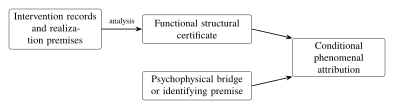
Figure 4. Functional evidence and phenomenal attribution have different premises. The first arrow is conditional on the realization and access contract; the final attribution requires a connecting premise. New evidence or identifying assumptions can constrain that premise, but its validity is not supplied by relabeling a functional certificate.
### 9.3 Relation to functional, structural and double-aspect approaches
The distinction is compatible with taking the philosophical lineage seriously. Levine's explanatory-gap argument distinguishes an epistemological difficulty in explanation from a demonstrated metaphysical falsity of materialism [[17](/consciousness/research/paper-2/references#bib-Levine1983)]. Our conservative-extension proof is narrower still: it concerns what follows when a particular predicate has not been constrained. It does not convert that formal omission into a universal impossibility of a psychophysical explanation.
Lewis provides an important counterpoint [[18](/consciousness/research/paper-2/references#bib-Lewis1972)]. His identification strategy combines a characterization of mental states by their causal roles with a scientific identification of the states occupying those roles. The role-defining and empirical premises can then support an identity. Such a theory is not refuted by [Proposition 9.1](/consciousness/research/paper-2/what-a-phenomenal-bridge-adds#p2-30), because the relevant semantic characterization is precisely a connecting premise absent from the proposition's functional reduct. The substantive dispute concerns the adequacy of that characterization, not the elementary possibility of freely interpreting an unmentioned predicate.
Chalmers's structural-coherence, organizational-invariance and double-aspect proposals already articulate a route in which experiential principles accompany physical organization [[7](/consciousness/research/paper-2/references#bib-Chalmers1995)]. SPC-2 continues that broad strategy rather than originating it. Its A2 is a more specific commitment: after primitive presence and the complete nominated endogenous predictive organization are fixed, the constitution posits no additional manifested qualitative remainder. The structural copy supplies a determinate conditional assignment, not evidence that the assignment captures every independently experienced distinction.
The question of which mathematical relations appropriately describe experience is itself a subject of current formal work [[14](/consciousness/research/paper-2/references#bib-KleinerLudwig2023)]. Kleiner's broader model framework treats the non-collatability of aspects of experience and the associated freedom of description [[12](/consciousness/research/paper-2/references#bib-Kleiner2020)]. That issue is related to, but not identical with, the operational quotient here: [Theorem 8.1](/consciousness/research/paper-2/operational-identification-and-its-ceiling#p2-27) compares model/preparation pairs by admitted record laws, rather than assuming that experiential labels are directly interchangeable between subjects. Here the new mathematics concerns the functional side of a proposed comparison. It does not license adjusting an independently nominated phenomenal target, its labels or its calibration merely to force agreement with a physical object.
Integrated information theory 4.0 identifies experience with an irreducible cause–effect structure of a maximally existing substrate and includes explicit integration and exclusion postulates [[1](/consciousness/research/paper-2/references#bib-AlbantakisEtAl2023)]. It is not merely a scalar consciousness score. The present cut radius uses a declared experiment family and permitted simulators; A1 uses a native recurrent-core assignment. Neither the equality of these constructions nor a derivation of IIT's selection postulates is established here. Their shared interest in integrated organization is motivation for comparison, not a mathematical equivalence.
There is also a directly relevant debate about falsification. Kleiner and Hoel distinguish a theory's experiential predictions from the evidence used to infer experience, and analyze substitutions under explicit independence assumptions [[13](/consciousness/research/paper-2/references#bib-KleinerHoel2021)]. Ganesh argues that a broad class of functionalist theories does not admit the substitutions needed for those conclusions [[10](/consciousness/research/paper-2/references#bib-Ganesh2021)]. The present paper does not resolve that disagreement or inherit its universal claims. Its restrictions are narrower: the alternative class and full experiment family are fixed in [Theorem 8.2](/consciousness/research/paper-2/operational-identification-and-its-ceiling#p2-28), and the phenomenal predicate is explicitly unconstrained in [Proposition 9.1](/consciousness/research/paper-2/what-a-phenomenal-bridge-adds#p2-30). Whether a particular psychophysical theory satisfies those premises must be checked separately.
The resulting position is therefore neither automatic functional attribution nor automatic rejection of artificial or unfamiliar vessels. Biology, emotion, language and a will to survive are not hypotheses of the finite operational theorems. Their absence does not prove phenomenal absence; their presence does not prove a bridge. A0 supplies one ontological interpretation, A1–A3 make specific constitutive identifications, and the present analysis clarifies what their functional evidence does and does not decide.