## Relational Development and Conscious Scaffolding
Conceptual Foundations, Strengthened Results, and Research Commitments
Jeremy Rodgers, Independent Researcher
6 October 2026 \| Revised preprint
DOI: [10.5281/zenodo.23190711](https://doi.org/10.5281/zenodo.23190711)
### Abstract
Relations acquired through experience can become retained organisation that changes subsequent interpretation, relevance, reasoning and action. This paper develops that proposal as a recursive account of conscious scaffolding while distinguishing primitive awareness, native subject qualification, phenomenal organisation and episode continuity. It connects a developmental account of will and thought to a finite predictive constitution of consciousness. Inherited continuation quotients, compositional interfaces and residual-memory results repair claims based only on current capability. New deductions establish exact message-alphabet tradeoffs for jointly revealing transfer with private or public randomness, characterise complete finite diagnostic panels, and give a conditioning-dependent bound on all finite adaptive continuation laws. A rare-event construction proves that finite dimension alone cannot provide a robust indefinite certificate. A recurrent two-register example supplies a positive logical incorporation witness and a limited conditional A2 point-separation result. The philosophical account develops will, thought, embodiment, memory, artifacts, RCO and the One–Two–relation pattern. Physical realisation, phenomenal bridge evidence, broader transfer optimality and historical priority remain explicit research obligations.
## 1 Orientation and contribution
The central proposal is that relations acquired through experience can become part of the organisation through which later experience is interpreted, valued and acted upon. An encounter can leave more than a proposition in memory. It can change which differences are noticed, which consequences can be inferred, which discrepancies matter, and which responses are available. Once incorporated, the resulting organisation conditions further encounters. Development is therefore recursive: the organisation that interprets experience is itself changed by experience.
This proposal has a specifically philosophical ambition. The evolving relational scaffold may constitute a form or component of conscious organisation, distinct from primitive awareness. Within Shadow Theory, the strongest disciplined formulation connects development to the native predictive organisation and its realised point under A2, after A1 and the physical realisation requirements have been met. A better task score alone does not establish this connection. The same developmental mathematics can also be studied independently of the awareness-first interpretation.
The contribution is a connected account of thought, will, incorporation and transmission, supported by explicit continuation requirements and several strengthened results. The mathematical additions identify when a finite diagnostic panel preserves every native predictive distinction between preparations, give a conditioning-dependent bound on every finite adaptive continuation, prove an obstruction to dimension-only approximate certification, and establish exact message-alphabet tradeoffs for a jointly revealing transfer problem with and without shared randomness. A small recurrent register model gives a positive conditional incorporation witness. The results use established automata, observability and coding methods. Their contribution here is the explicit combination of resource accounting, developmental continuation and conditional phenomenal attribution; historical priority for the underlying methods is not claimed.
Several corrections sharpen the positive proposal. Immediate competence need not determine future learning. Joint-only information is different from information beyond a complete realising pair. Repeated temporal influence does not certify native physical recurrence. Complete sufficient-state transfer defeats an absolute privilege of having personally undergone the original interaction. Finally, an ordinary learning update can change the actual predictive class within one fixed complete object, without changing that object’s laws. These restrictions identify what a serious developmental theory must explain.
### 1.1 Contribution comparison
The theoretical baseline consists of the consciousness monograph [\[M\]](/consciousness/development/references-and-access-record#ref-m) and its companion papers [\[P2–P4\]](/consciousness/development/references-and-access-record#programme-publications). Its constitutive assumptions and mathematical results are distinguished from the present developmental interpretation and deductions.
| Status | Material | Role in this document |
|:-------------------------------|:-----------------------------------------------------------------------------------------------------------------------------------|:-------------------------------------------------------------------------------------|
| Inherited constitution | M: A0–A3, native core qualification, complete predictive object, episode provenance | Governs phenomenal attribution; preserved without adding cognition to A1 |
| Inherited mathematics | M: finite word-span equivalence; P2: strong marked quotients, causal composition, residual memory, hierarchy, error budgets | Supplies the reliable continuation and substitution baseline |
| Inherited empirical discipline | P3: representability, fitting and selection distinctions; P4: trace behaviour versus intervention-sensitive realisation | Prevents model success from being mistaken for physical or phenomenal identification |
| New philosophical synthesis | Relevance, directed reconciliation, constructed relational result, incorporation, reinterpretation, propagation | Develops the positive conscious-scaffolding hypothesis |
| New specialization | Costed developmental continuation and retained local-summary fibres | Gives established machinery a precise developmental target |
| Deductions developed here | T1–T2 transfer tradeoffs; D1–D3 diagnostic results; native point-separation witness | Provides complete proofs, assumptions and finite checks |
| Explicit possible revision | Rich cognitive admission criteria, nested subjects, a different A2 identification | Requires a separate constitutional argument; not adopted here |
| Rejected or restricted claims | Snapshot sufficiency, universal improvement, extra information beyond a complete pair, automatic native return, historical essence | Replaced by countermodels and conditional surviving claims |
This paper combines a positive philosophical account, proved model-level results and a discriminating research programme. It does not report new human experiments, hardware certification, or a mathematical derivation of phenomenal existence from nonphenomenal premises.
## 2 Sources and representational access
### 2.1 Evidence, inferential reach and achieved understanding
Available evidence and achieved understanding are distinct. A system can retain premises that logically imply a conclusion while lacking a procedure that reaches it under the available time, memory and access constraints. A newly learned ordering, abstraction or search policy can make that conclusion accessible. This is a change in organisation even when the original evidence is unchanged. The information carried by the source, the information available through a particular interface, the consequences derivable in principle, and the consequences actually derived are four different objects.
An assertion that two participants have the same knowledge must therefore specify what is equal. Equal initial propositions do not imply equal observations during interaction. Equal message strings do not imply equal access to counterfactual queries. Equal unrestricted deductive closure does not imply equal bounded performance. Conversely, an interaction may supply genuinely new evidence as well as improve its organisation. The developmental claim is clearest when these possibilities are measured separately.
Experience can affect the organisation and use of knowledge without making truth subjective. A person may learn to notice a dependency, recognize an exception, or deploy an already known rule at the appropriate time. Such changes can improve contact with a common source. They can also produce overgeneralization, rigidity or misplaced salience. An emotionally compelling explanation may be more likely to be retained while remaining false. Salience is a causal property of processing; evidential warrant is an epistemic assessment. Neither should be used as a substitute for the other.
### 2.2 Source, aperture, readout and constructed representation
Let $\Omega_t$ name a nominated source state, $\Delta_t$ the available access relation, and $r_t=\Delta_t(\Omega_t)$ an accessible readout. These are model variables, not a representation of the unsplit ontological prior. A representation $\widehat\Omega_t$ is constructed from readout, retained organisation and processing. It may preserve a genuine source relation without being identical to the source or recovering it exhaustively.
Mediation does not entail distortion. A thermometer can accurately report a temperature while omitting almost everything else about the measured object. A proof can preserve a logical relation without reproducing the physical process by which someone discovered it. Equally, a readout can be ambiguous, noisy, selectively sampled or interpreted under a mistaken model. The appropriate question is which source properties are identified by the admitted evidence.
P2 provides a precise inherited answer. Relative to an experiment grammar, a source attribute is identifiable exactly when it is constant over models with the same admitted experiment laws. Nonidentifiability of the whole source does not imply nonidentifiability of every attribute. This supports a position between exhaustive transparency and global skepticism: warranted knowledge is possible at a stated resolution and under stated access assumptions.
The source–readout distinction also clarifies agency. Some activities change the representation while leaving the source and aperture fixed. Others change the aperture through a question, instrument, perspective or intervention. Still others change the source conditions themselves. A scaffold-derived design can be implemented in a tool or institution, modifying the world that later participants encounter. The next readout is consequently shaped partly by earlier representations that have become causes. The feedback need not be benign: a misleading classification can reorganize an institution so that its later data partly reflect the classification’s effects.
### 2.3 Perspective, awareness and metacognition
Primitive awareness, phenomenal organisation, a localized perspective, a personal model and metacognition should not be collapsed. In the adopted constitution, awareness is an ontological commitment; phenomenal organisation is assigned to a qualifying native organisation; a personal model represents an individual’s attributes and history; metacognition concerns monitoring or regulating cognitive activity. A system can improve metacognitive performance without the present analysis establishing a new subject. A subject can have experience without satisfying an added requirement of reflective self-description.
A finite perspective has incomplete access and a particular organisation of relevance. This is operational closure relative to an interface and a current state, not a proof of absolute metaphysical isolation. Interaction can change what is available through that interface. A model of one’s own processing can become a new object of reasoning, but further descriptive levels are not automatically deeper consciousness. They may increase control, incur overhead, or generate another inaccurate representation.
### 2.4 Functional perspective and internal arbitration
A functional perspective can be modelled as the organisation through which competing distinctions become consequential for one continuing process. It need not have a spatial centre. Its actions can include allocating attention, admitting a memory, revising a prediction or running an internal simulation. Restricting control to overt movement would omit these cases. A distributed controller may coordinate them without a single representation receiving every signal.
One common output does not prove a global interpretive bottleneck. Independent modules can concatenate their answers, and a nonseparable output can be a simple common descendant without a rich perspective. A meaningful arbitration claim must identify conflicts, admissible alternatives, the mediator that resolves or preserves them, and the future consequences. Defining a bottleneck as whatever already performs the desired integration would make the necessity argument circular.
Native qualification, developmental plasticity and self-model centrality are independent axes. A qualifying core may have rigid dynamics; a flexible externally serviced learner may lack a certified internal return; a personal model may lose privilege while native qualification persists. The failure of a universal derivation of recurrence does not refute this richer functional architecture. It locates it as a proposed organisation within the broader constitution.
Unpresented processing can also shape a scene. Foreground attention and explicit self-description do not exhaust A2’s complete endogenous predictive object. Whether that object includes too much apparently unconscious processing is a substantive challenge to A2, not something to resolve by silently retaining only attended content.
## 3 Recursive conscious scaffolding
### 3.1 From encountered difference to retained organisation
A useful schematic decomposition is
$$d_t=D(S_t,r_t),\qquad R_t=\Sigma(S_t,d_t,u_t),\qquad S_{t+1}=U(S_t,R_t),$$
where $S_t$ is the retained scaffold, $D$ articulates a distinction, $\Sigma$ forms a relational result under an admitted operation, and $U$ incorporates a consequence. This is a modelling template. A factorization that can be imposed on any update does not by itself explain development. The components must acquire independent physical or operational meanings.
The philosophically decisive step is from an occurrence to a condition of later activity. A relationship can be noticed and forgotten. It becomes incorporated when a physical consequence of its formation alters subsequent interpretation, inference or action. This consequence may be a stored value, a changed policy, an executable procedure, a newly available discrimination, or a changed disposition to allocate attention. No single data structure is required across all implementations.
The resulting third structure need not be a third substance. It can be a relation encoded in the joint organisation of existing components, a computed register, or a reusable abstraction. It also need not be a compromise between the initial alternatives. Sometimes a synthesis explains the conditions under which each partial account worked; sometimes it rejects one account; sometimes it identifies a contradiction that cannot yet be resolved. An independently meaningful result is needed before incorporation can be claimed.
A retained relation may become a participant in later relational work. A parity derived from two bits can become an input to a higher-order parity; a conceptual distinction can become a premise in a later argument; a learned subroutine can enter a larger program. P2 already supplies a formal hierarchy of effective interfaces and a parity construction. The new proposal concerns their acquisition and developmental consequences. Reusability demands preservation of the continuation distinctions that future contexts actually require.
An interaction can learn at the level of coordination while each participant’s isolated score remains unchanged. The pair may improve question timing, correction procedures, task allocation or use of a shared notation. The mediator can reside in joint correlations or a shared environment. This motivates separate measurements of individual transfer, pair performance and exchange procedures. Partner replacement and artifact transfer can test portability; ablation and rescue can test mediation. Durable coordination does not itself establish a third subject.
Productive diversity is a conditional design hypothesis. Different error patterns or complementary skills can help when participants retain enough shared structure to communicate and correct one another. Neither a universal optimal intermediate distance nor zero possible gain between initially identical participants has been proved. Identical initial systems can gain through new evidence, asymmetric roles or lawful randomization. A comparison must specify which of these resources is held fixed.
### 3.2 Differentiation, integration, retention and revision
Differentiation separates cases previously conflated. Integration connects distinguishable material into a usable organisation. A single operation can do both: a new classification may separate two mechanisms while explaining them within one larger theory. Retention and revision form a different axis. They concern whether existing organisation persists through an update. An integrated model can be rigid or plastic; a differentiated model can be stable or fragile.
Finite resources constrain indefinite accumulation of distinguishable history. A finite state carrier cannot retain an unbounded number of mutually future-distinguishable cases without loss. It must eventually forget, compress, externalize information, change its operating demands or acquire resources. This does not prove a universal preference for integration or an interior optimum between rigidity and change. If unlimited storage is allowed, accumulation alone can be successful. Under a finite budget, the appropriate compromise depends on future tasks and the costs of revision.
A task-relative variational illustration is
$$F_t(S')=E(S';r_{\le t})+\lambda C(S')+\mu H(S',S_t),$$
with independently specified adequacy loss $E$, resource cost $C$ and reconfiguration cost $H$. This can formalize why some revisions are worthwhile. It does not show that every organism minimizes this expression. An objective invented retrospectively to select an observed update gives no independent explanation. A defensible model predicts choices, failures or interventions beyond the data used to define it.
Insight may reorganize retained relations so that an old fact becomes newly consequential. It can reduce the search required for a conclusion without adding an external observation. It can also be mistaken. The felt coherence of a new synthesis is neither a proof of its truth nor a guarantee that it improves every capacity. Specialization can improve one task and impair another; compression can preserve present answers while deleting distinctions needed for later learning.
### 3.3 The central consciousness hypothesis
The strong philosophical proposal is that the developed scaffold belongs to the constitutive organisation of conscious life, rather than merely serving as an external description of task success. Under the published A2, this proposal becomes conditional and precise: changes that alter the realised endogenous predictive class of an already qualifying organisation alter its assigned phenomenal point. If the entire nominated predictive object changes under a newly justified realisation, its assigned phenomenal organisation changes accordingly. The two statements are different.
This interpretation permits a conscious life to acquire new patterns of significance without adding primitive awareness or requiring a new subject at each insight. The learned relation can change what an experience means within the ongoing organisation: what it predicts, evokes, competes with, or enables. Such changes need not be reducible to an increase along a single scale. A new perspective may be richer in one respect and narrower in another.
The hypothesis remains stronger than its present empirical support. A formally adequate scaffold model can establish causal and predictive differences. A2 supplies the phenomenal identification as a constitutional commitment. Independent phenomenological and physical evidence is needed to assess that commitment and its content-level consequences. The scaffold account should therefore identify exact structural predictions while retaining the question of why, and in what sense, those structures are phenomenal.
## 4 Will, thought, and embodiment
### 4.1 Relevance and directed reconciliation
Difference becomes a candidate for action when it matters relative to consequences, commitments, constraints or available choices. Relevance is therefore relational. A perceptual difference that changes no admissible decision may have zero decision value under a particular loss, while remaining useful for later learning or explanation. A common additive shift in all action losses can change their values without changing their ordering. Relevance alone consequently does not determine a policy.
Attention allocates finite access and processing among imperfectly estimated demands. In this account, will is directed commitment toward reconciling a relevant discrepancy, and thought is representational work attempting that reconciliation. This is a proposed conceptual distinction, not a theorem that all cognition has one objective. Will can persist when thought fails. Thought can proceed without deliberate willing. Directed regulation can also precede explicit reasoning. Even a commitment to understanding what is true can arise from acquired organisation; the presence of will does not establish that its formation was uncaused. Competing valuations can sustain incompatible directions, and a system can defer action because its available procedures cannot resolve them.
The full recursive account is
$$\begin{gathered}
\text{difference}\to\text{relevance}\to\text{will}\to\text{thought}\\
\to\text{relational synthesis}\to\text{incorporation}\to\text{revised scaffold}.
\end{gathered}$$
The revised scaffold changes later interpretation and the distribution of relevance. The cycle is not necessarily a fixed serial pipeline. Stages can overlap, fail, recur or be bypassed. It is an explanatory organisation of functions whose implementations must be investigated. In particular, a gradient is an appropriate representation of directed change in some continuous models, but it cannot serve as a universal definition of willing.
Thought creates a representation that can enter the same cycle as material for later thought. This recursive reification allows a reasoning method, a concept of a relation, or a representation of one’s own response to become a new object of inquiry. Depth in such a representation is not automatically depth of experience. A longer chain can be redundant, confabulatory or computationally wasteful. An adequate depth measure must specify the dependency or intervention distinctions it preserves.
### 4.2 Failed willing, error and competing valuations
Failure is theoretically informative. A participant may correctly identify a relevant discrepancy but lack a lawful operation that resolves it. A successful local action may worsen a larger objective. A habitual relevance assignment may repeatedly initiate a form of reasoning that protects an existing self-model rather than testing it. These possibilities show why directional commitment, instrumental success and epistemic warrant need separate measures.
One can distinguish integrative thought from proliferative thought relative to a declared problem. Integration reorganizes dependencies so that later work becomes more coherent or economical. Proliferation adds representations and distinctions without the corresponding gain. This is a defeasible assessment, since a seemingly unproductive distinction may later become useful. No universal thought-minimization principle follows. A fertile exploratory phase may temporarily expand a search space before a useful abstraction becomes available.
Criteria can themselves develop. A person may revise what counts as an adequate explanation or a worthwhile end. A model can represent such revision by including valuation parameters in the state. It must still specify the update law and the evidence governing that revision. Moving the criterion into a higher-level objective indefinitely does not explain its ultimate authority. The programme can model local endogenous regulation while leaving the philosophical justification of final ends open.
### 4.3 Physiological and affective organisation
Embodiment can alter the ends pursued, the distinctions available, the costs of action and the permitted operations. Fatigue can affect search depth; bodily urgency can change attention; affective learning can alter the significance of an otherwise familiar stimulus. These are roles to operationalize, not empirical findings established by the present document. It would be too narrow to represent physiology solely as a multiplier on an otherwise complete scalar will.
Valence also requires care. A regulatory direction, reinforcement signal or signed control error is an operational quantity. Its relationship to felt pleasantness or unpleasantness requires a separately nominated phenomenal account. A single scalar cannot generally preserve all dimensions of affect, bodily condition and competing commitments. The same caution applies to content geometry: a similarity relation, temporal association structure or salience metric can be useful, but its correspondence to phenomenal similarity is a bridge hypothesis.
Functionally similar roles may be realised in different substrates. That possibility neither establishes identical phenomenology nor proves that biological embodiment is dispensable. The adopted constitution makes the relevant phenomenal commitments explicit. Comparative work must then determine whether different implementations satisfy the same native realisation requirements and whether experience-facing evidence supports the proposed identification.
### 4.4 Content organisation and source status
A developmental content model should distinguish the organisation of presented alternatives, their similarities, their salience, their temporal relations and their acquired associations. These dimensions can change separately. An acoustic event can occupy a different role as an isolated tone, part of a melody, or an expert’s anticipated harmonic transition. The proposal is that retained organisation can alter selected relations within how the event is presented, recognized and used. It does not require every learned association to change every sensory quality.
| Candidate dimension | Developmental change | Discriminating question |
|:-----------------------------|:---------------------------------------------------------------------|:-----------------------------------------------------------------------|
| Distinctions and similarity | Formerly conflated alternatives separate or reorganize | Which confusions and similarity judgments change? |
| Salience and relevance | The same alternative attracts different processing | Does priority change with stable sensory discrimination? |
| Temporal relations | A sequence establishes anticipation or contextual role | Is order-sensitive presentation predicted beyond isolated events? |
| Acquired associations | Recognition recruits retained knowledge | Which interpretations persist after the training context ends? |
| Spatial organisation | Neighborhood, orientation or scale becomes available | Does the model preserve independently measured spatial relations? |
| Valuation and bodily urgency | Consequences acquire different regulatory importance | Can control direction be separated from reported felt valence? |
| Source status | Content is treated as perceived, imagined, remembered or anticipated | Do trust, revision and action change while subject matter is retained? |
Source status is especially important for a recursive representational system. A remembered scene can become vivid without becoming current perception; an imagined event can guide action without being judged to have occurred. The hypothesis predicts changes in how content is trusted, revised or discounted when its relationship to input and retained traces changes. A source label in a register is insufficient unless it has these independently demonstrated continuation roles.
These descriptors are candidate structural signatures. They cannot replace A2’s complete labelled predictive object merely because they are easier to fit. Topology, spectra, community counts or one distance matrix may agree while native operations and intervention consequences differ. The scientific target is a constrained correspondence between independently nominated physical and experience-facing relations, evaluated on new conditions and interventions.
## 5 History, transmission, and perspective
### 5.1 Developmental history and the exact-state limit
History matters through retained state and continuing dependencies. Two people can receive the same text yet reach different understandings because their interpretations, procedures and valuations differ. A transcript of an interaction can omit the counterfactual questions, internal changes and embodied circumstances that made it effective. Replaying an observed sequence therefore need not reproduce participating in the process that generated it.
There is nevertheless an exact limiting principle. If a complete causally sufficient state is transferred into a recipient with the same future update law, permissions and inputs, deterministic continuations agree. In a stochastic model the corresponding continuation laws agree. No additional historical influence remains outside that complete specification. This does not establish that such a transfer is physically possible or economical. It identifies the content of a claim that a transfer was complete.
Order can matter when learning operations fail to commute. To show this, one must exhibit an admitted state and lawful sequence for which $F_uF_v(x)\ne F_vF_u(x)$ in a relevant tested distinction. Writing a noncommutative symbol does not establish an effect on reachable states. Nor does an order effect imply improvement. A dialogue can be effective because it allocates questions adaptively; it can also reinforce a mistake.
Retrospective understanding is another distinct condition. A person may later understand the logic of an earlier interaction without reproducing the state they would have acquired through participation. Conversely, a transferred procedure can reproduce a selected functional outcome without reproducing autobiographical memory. These are different targets, not grades on an unqualified scale of authenticity.
### 5.2 Memory, reinterpretation and continuity
A present scaffold can change the meaning of a past event without changing that event. New relations may make a retained record explanatory, threatening, ordinary or irrelevant in a different way. Memory therefore includes both retained traces and present reconstructive organisation. A theory that identifies memory only with a static archive misses this dependence; a theory that treats reinterpretation as alteration of the historical source confuses the levels.
Organizational continuity, personal continuity and episode identity must also be separated. A3 supplies a native continuation and provenance rule for experiential episodes. A functional copy does not automatically continue the original episode. Genuine gaps, splitting and merging require the constitution’s specific lineage treatment. A person can remain recognizable across substantial learning while the assigned phenomenal point changes repeatedly. Conversely, behavioural similarity is insufficient to establish the relevant physical lineage.
### 5.3 Artifacts and propagation
A relation can be transmitted through writing, software, tools, social practices and institutions. An artifact can preserve instructions that another participant reconstructs into an active procedure. Its causal significance depends on access, interpretation, compatibility, effort and retained resources. A text is not a cost-free complete state transfer; a program requires an execution environment; an institutional rule requires participants and enforcement practices.
Propagation can branch, mutate, merge, decay and become extinct. A useful conceptual lineage can survive replacement of all original participants if its implementing organisation is reproduced. Two traditions can merge while discarding incompatible parts. Copies can acquire different relevance within different contexts. Nothing here implies indefinite exponential growth: attention, transmission bandwidth, storage and opportunities for reconstruction are finite.
Artifacts can also become durable residues of earlier scaffolds. Their categories and procedures structure later environments, which then shape new readout and new development. This closes an important agency loop from interpretation to action to world to interpretation. It does not make every durable artifact a subject. Individual organisation, distributed useful organisation and a newly individuated joint experiencer are separate claims. The last requires a nominated native boundary and the full qualification law.
Apparently mundane material can transmit structural expectations even when its explicit propositional content seems irrelevant to a later task. A turn-taking convention or notation can shape subsequent activity. Content relevance and organisational relevance therefore need separate evaluation.
Artifact provenance, intellectual contribution and authorship convention are also distinct questions. A machine-origin marker can accurately describe the production mechanism while leaving the human contribution unresolved. Problem formulation, research direction, counterexamples, corrections and retained methods can materially shape the result. Causal contribution alone does not determine equal credit or a legal ownership rule. The relational account supports documenting these contributions alongside accurate production provenance.
The nesting proposal asks whether an interaction could support an additional experiential organisation while its participants’ episodes persist. This differs from the adopted maximal-core law. A rival doctrine needs an independently defined subordination or overlap relation, a rule for shared components and resource ownership, and a temporal law for coexisting episodes. Continuous changes in coupling or performance do not automatically determine a unique subject bifurcation; exact SCC membership can change when a weak causal connection appears. The alternative is retained as an individuation research programme, not adopted by implication.
### 5.4 RCO and the personal model
The recursively closed observer (RCO) hypothesis proposes that the personal model remains usable while self-reference ceases to terminate on it as the privileged centre. Awareness is not proposed to increase. This is different from eliminating practical self-representation, losing autobiographical memory or reducing every self-related priority.
The developmental account can identify candidate structural correlates. These include less compulsory defence of a personal narrative, greater revisability of self-related interpretation, and changes in the routing of relevance and regulation. Each requires an independently grounded meaning of self-reference. A graph node labelled self gains no autobiographical content merely from its label. Reduced centrality is neither necessary nor sufficient for the proposed awareness-reference relation.
Operational differentiation need not entail psychological division. A practical distinction between one’s body and another body can remain accurate while the personal model loses a particular privileged role. The account should preserve this possibility without claiming that a report of undivided awareness proves a literal ontological split or its reversal. Reports of pure awareness are phenomenological material and interpretive evidence, not a direct measurement of the unsplit prior.
### 5.5 One–Two–relation–reincorporation
The recurring pattern has a defensible local reading: an organised carrier supports distinctions, those distinctions enter a relation, and a result becomes part of a successor organisation. The successor is a unity with history, not a return to an unchanged beginning. This is a useful conceptual grammar for many developmental examples.
Its universal reading requires more. An arbitrary update can be factored into named stages, but such a factorization is neither unique nor explanatory without invariant structure. A correspondence with the broader Shadow mathematics would require specified domains, maps, preserved operations and a nontrivial theorem or discriminating prediction. Verbal resemblance between differentiation, spectral decomposition, curvature and relational synthesis is insufficient.
The unsplit ontological prior must not be inserted into a state equation as an already defined physical variable. Under the intended interpretation, represented manifestation differentiates while awareness is not partitioned into new substances. This keeps the philosophical intuition available without claiming that the present finite-state constructions derive ontology. Broader CSCF and field manuscripts mentioned in the sources were not supplied as independent objects of this consolidation; no new equivalence to them is asserted.
A precise comparison discipline is nevertheless available. Let a typed developmental system have maps $D:X\to A\times B$, $\Sigma:A\times B\to R$ and $U:X\times R\to X$, with $F(x)=U(x,\Sigma(Dx))$. A comparison with a primed system supplies maps $f_X,f_A,f_B,f_R$ satisfying
$$\begin{aligned}
D'f_X&=(f_A\times f_B)D,\\
\Sigma'(f_A\times f_B)&=f_R\Sigma,\\
f_XU&=U'(f_X\times f_R).
\end{aligned}$$
Substitution proves $f_XF=F'f_X$. This is a semiconjugacy; invertible maps preserving the specified structure give an equivalence. The statement is elementary, but it specifies exactly what a proposed cross-domain common pattern must exhibit. Finding a nontrivial physically meaningful instance remains open.
The monograph offers a limited spectral comparison: a nonnegative self-adjoint carrier $K$ supports $e^{-tK}$ and $e^{-itK}$, or the declared generalized pair $e^{-\gamma tK}$ and $e^{-it h(K)}$. These shared-carrier responses do not by themselves construct a relational synthesis or update $K$. A physically realised coupling and feedback law would be needed. The candidate correspondence concerns a pattern, not identity of the mathematical objects. Likewise, a rectangular mixed-difference measure of nonadditivity depends on its chosen coordinates; arbitrary recoding can change it. Zero mutual information between two independent inputs also does not prevent a usable joint parity relation.
## 6 Published constitution and realisation
### 6.1 A0–A3 and the scope of the developmental proposal
A0 identifies awareness with the knowing aspect of reality prior to the operational source/readout distinction. It does not introduce a localized subject, an extra force, or a numerical global experiencer. The finite physical and predictive constructions can be studied without deciding whether they manifest awareness. A0 supplies their ontological interpretation.
A1 assigns one localized perspective to a qualifying maximal internal strongly connected component. Qualification requires an executable covering return and at least two distinct native predictive classes in the actual operating type and resource context. The covering schedule must be physically admitted and must preserve a distinguishable return through the nominated core. A cycle made from mutually incompatible control contexts is insufficient. Overlapping recurrent subassemblies inside one admitted maximal core do not acquire additional subjects merely by being graph cycles.
This law is deliberately permissive. A correctly realised one-bit persistence process can qualify. Language, intelligence, explicit self-modelling and rich relevance arbitration are not additional A1 requirements. The richer scaffold developed here describes an important subclass and a developmental interpretation. Excluding every minimal memory, admitting nested overlapping subjects, or requiring a world-for-the-vessel as a new necessary condition would revise the constitution. Such revisions may be worth investigating, but must be named and defended as revisions.
A2 identifies phenomenal relational organisation with a structural copy of the complete endogenous predictive object over all physically admitted finite continuations. It preserves native operations, outcome labels, test laws, horizon restrictions and well-defined class transition instruments. The actual phenomenal point is the image of the predictive class of the realised intrinsic state. A metric summarizing maximum distinguishability is not the complete object. Different organisations can have the same coarse distance pattern.
A3 supplies episode continuation through physical process provenance and unique continuation of qualifying cores. Information copying and process continuation are distinct relations. Material renewal can preserve a documented operative lineage, while a newly allocated functional copy can begin a new admission. Genuine gaps and the specified split or merge cases terminate the relevant old episodes under the adopted law. Neither preservation of primitive awareness nor continuity of a personal narrative proves numerical identity of an experiential episode.
These are constitutive commitments. Mathematical determinacy conditional on them does not derive them from an independently established theory of matter. This distinction is needed for constructive criticism: a disagreement about A1’s lower bound is different from a failed physical recurrence certificate, and both are different from an inconsistency in quotient construction.
### 6.2 State, law, predictive history and capability
Several objects must remain separate throughout a developmental argument:
| Object | What it retains | What it does not automatically establish |
|:-------------------------------|:--------------------------------------------------------------------------------|:-------------------------------------------------------------------------|
| Complete realised state | Variables needed for the nominated continuation law | Physical accessibility to a learner or encoder |
| Actual native predictive class | Equality of all admitted finite native transcript laws from actual states | Strong successor-class congruence in a general hidden stochastic machine |
| Predictive history state | Conditional continuation law after an observed history | Identity of the actual hidden state |
| Strong marked quotient | Joint records, costs and actual successor classes | Minimality among all possible stochastic generators |
| Capability profile | Selected task scores and resource-indexed success | All future learning or native prediction |
| Physical realisation | Boundary, factorization, interventions, native timing, resources and provenance | Empirical truth of the phenomenal identification |
Under a fixed complete carrier, installed programs, memories and valuation parameters belong to the state. Learning then ordinarily moves the actual point inside one unpointed predictive object. A claim that the whole object changed requires a change in the nominated laws or contract, or a justified comparison between different realisations. Renaming a state-dependent program as a new law does not create this stronger conclusion.
The distinction also limits content claims. A change in a grounded report law can imply different A2 classes when grounding is established. An arbitrary laboratory observation need not descend through the native quotient. External apparatus that leaves the intrinsic state and native contract unchanged cannot change the phenomenal object merely by measuring it. Apparatus that supplies feedback, drains resources or changes the boundary can of course change the premises.
### 6.3 Why realisation cannot be inferred from service behaviour
P4 distinguishes trace conjugacy from preservation of the physically nominated intervention algebra. A recoding can preserve complete decoded service traces while mapping a one-coordinate overwrite to a multicoordinate operation. Two descriptions of one transported realisation must carry the intervention translation with them. Two different implementations that each call their own coordinates elementary may have different constitutive inputs even when their services agree.
The positive P4 identification result is conditional. With a fully distinguished finite binary-state carrier, positive product response laws and sufficient rank, the binary chart can be recovered up to signed coordinate permutation. Its robust version requires the stated spectral separation and error conditions. These results can support a developmental register experiment when their premises hold. They do not establish that a physical preparation actually obeys the product-noise model, identify every missing realisation field, or validate consciousness from chart recovery.
P3 supplies a complementary learning lesson. Representability, candidate production, model selection and intervention validity are different achievements. Its supplied source reports that the specified semantic family covers 48 of 48 benchmark items, while smaller fitting produces 39 of 48 good candidates and selection retains 37 of 48. Those are source-reported results, not rerun here. An unsuccessful selected model need not reveal an inadequate representation language, and a larger fitting budget need not improve every selection. The new programme should retain these distinctions when testing learned scaffolds.
## 7 Continuation-sufficient relational memory
### 7.1 A finite costed model
Let $X$ be a finite nominated state set, $U$ a finite action alphabet, $O$ a finite record alphabet and $C$ a finite set of positive event costs. A normalized joint instrument satisfies
$$K_{u,o,c}(x,y)\ge0,\qquad \sum_{o,c,y}K_{u,o,c}(x,y)=1.$$
The state or the retained boundary context includes controller memory, clocks, queues, persistent learner state, relevant shared seeds and resources. Common admitted actions are assumed; a finite operating grammar can instead be retained explicitly. Artificially adding a failure action does not make a physically unavailable operation lawful. Throughout the finite-model results, an experiment is a causal policy with a finite uniform upper bound on its number of steps, depending only on admitted records and having a declared stopping rule. Adaptive early stopping is allowed. A statement over all such experiments quantifies over arbitrarily large finite bounds; it does not grant an infinite experiment or free resources. A capability diagnostic has a bounded terminal score $s_e\in[0,1]$ and mean $\gamma_e(x)=\mathbb E_x s_e$.
A budget curve $\Gamma_x(B)$ is the probability of a specified success event by cumulative cost $B$ under a fixed task distribution and procedure. Optimizing over procedures is a different construction. It requires a common procedure class and explicit access and computation restrictions. An omniscient state-dependent policy is not supplied by taking a supremum.
### 7.2 Snapshot failure and deterministic repair
The smallest useful counterexample has states $x,y,z$ with current score $b(x)=b(y)=0$, $b(z)=1$ and an admitted update
$$F_a(x)=z,\qquad F_a(y)=y,\qquad F_a(z)=z.$$
The present score identifies $x$ with $y$, but their scores differ after $a$. No autonomous update on the two score classes can represent both cases. A score quotient exists as a set without being a sufficient developmental state. Independently, two task profiles $(1,0)$ and $(0,1)$ have the same uniform mean but different competencies.
For a deterministic controlled machine with protected signature $b$, define
$$x\equiv_b y\quad\Longleftrightarrow\quad b(F_w(x))=b(F_w(y))\text{ for every admitted finite word }w.$$
**Proposition C1, inherited continuation closure.** This is the coarsest transition congruence refining the $b$ partition. It supports a unique quotient update and is computed by finite partition refinement.
**Proof.** The empty word preserves $b$. Prepending any action $u$ shows that equivalent states have equivalent $u$-successors. Conversely, every $b$-preserving congruence preserves $b$ after every word by induction, so it refines $\equiv_b$. Start from the $b$ partition and repeatedly split a block by its action-successor block labels. Each strict refinement increases the number of blocks; hence at most $|X|-|P_0|$ strict steps occur. Stability is precisely congruence. Every eligible congruence refines every iteration, proving coarseness. $\square$
This is ordinary finite-machine minimization specialized to developmental tests. It does not identify the smallest program or fastest implementation. Its philosophical value is the explicit difference between retaining today’s answer and retaining what future development needs.
The checkpoints supply a sharp cyclic illustration. For $n\ge2$, let $X=\{0,\ldots,n-1\}$, $F(i)=i-1\pmod n$ and $b(i)=\mathbf1_{i=0}$. The present signature has two classes, but all phases are future-distinguishable. If at most $h$ advances precede a terminal score test, the profiles have
$$N_h=\min(n,h+2),\qquad k_h=\min(n-1,h+1)$$
classes in total and at most $k_h$ within one current $b$ fibre. To verify this, list the values $\mathbf1_{i-j=0\pmod n}$ for $0\le j\le h$. Until all phases are exposed, the observed phases yield distinct unit patterns and all remaining phases yield the zero pattern. Thus a two-valued snapshot can conceal arbitrarily large continuation memory. A finite-horizon quotient must retain the decreasing remaining horizon; it is not automatically an unchanged stationary quotient.
### 7.3 Stochastic joint closure and autonomous modules
For a surjection $q:X\to Z$, retain required marks such as type, timing and resource status. The strong quotient condition is
$$\sum_{y:q(y)=z'}K_{u,o,c}(x,y)=\overline K_{u,o,c}(q(x),z'),$$
independent of the representative $x$.
**Proposition C2, inherited from P2.** This condition, together with descent of protected marks, is necessary and sufficient for a unique effective instrument preserving the joint record, cost and actual successor-class law. Finite refinement gives the coarsest such quotient. In a matching causal context it preserves every finite adaptive transcript law.
**Proof.** Necessity follows by comparing actual representatives. For sufficiency define the effective row by the common sums; nonnegativity and normalization follow from the original rows. Refine the mark partition by all probabilities into each current block for every action, record and cost. Stability is the displayed condition, and induction shows that every eligible partition refines every iterate. For composition, retain the external controller and push forward the joint initial state law without deleting correlations. Equal matched histories produce the same next action distribution and the same next joint record, cost and class law. Induction over the finite policy tree proves equality, including adaptive stopping. $\square$
This gives a relation a precise route to becoming an autonomous higher-level component: its effective state must retain the distinctions required by subsequent interaction. A useful module is relative to its ports and permitted contexts. Port-trace equivalence can sometimes suffice for behavioural substitution without a strong actual-state quotient; P2 distinguishes these targets. Neither construction grants a free physical decoder.
Actual-state trace equivalence alone is weaker. Consider states $a,b,c,x,y$: $a$ emits zero forever, $b$ emits one forever, $c$ emits zero and enters $a$ or emits one and enters $b$, equally likely; $x$ emits a marker and enters $a$ or $b$ equally; $y$ emits the same marker and enters $c$. All finite record laws from $x,y$ agree. After the marker, however, $y$ enters the actual class of $c$ with probability one and $x$ with probability zero. Thus their trace class does not support that strong successor-class instrument. This inherited example does not invalidate predictive states of observed histories, which update by conditioning.
### 7.4 Exact residual memory and relational dependence
Let $Q$ be the finite deterministic continuation quotient and let the protected local summary $\ell$ descend through it. Write $k_l=|\{q:\ell(q)=l\}|$.
**Proposition C3, P2-32.** The minimum residual alphabet identifying the quotient class from $(\ell,j)$ and supporting exact autonomous updates is
$$|J|_{\min}=\max_l k_l,\qquad b_J=\left\lceil\log_2\max_l k_l\right\rceil.$$
**Proof.** Two distinct classes in one fibre cannot share a residual label, because an admitted future test separates them. Conversely, enumerate the classes within each fibre and reuse labels in different fibres. The pair $(\ell,j)$ identifies the quotient class, whose update can be applied and re-encoded. $\square$
Relational residual memory is therefore relative to a retained local summary and a continuation target. Enlarging a participant’s state can absorb the residual. This does not undermine its operational importance; it defeats an inference to an unaccounted-for third substance.
For independent fair bits $A,B$, parity $\Theta=A\oplus B$ is independent of either input alone and determined by the complete pair. Thus $I(\Theta;A)=I(\Theta;B)=0$, $I(\Theta;A,B)=1$, but $I(\Theta;Y\mid A,B)=0$ for every $Y$. More generally, if $R=f(A,B)$, then $H(R\mid A,B)=0$ and therefore $I(R;Y\mid A,B)=0$. A computed relation can causally matter while supplying no information beyond its complete antecedents.
P2’s coupled-stream example is equally instructive. At each tick emit $(\xi,\xi\oplus\theta)$ with fresh fair $\xi$ and a retained parameter $\theta$. Each marginal stream has the same law for both parameter values, while joint parity reveals the parameter exactly. Local marginal predictive summaries erase a real correlation distinction. This is different from saying that the complete coupled physical state lacks that distinction.
### 7.5 Robust finite-use substitution
Let $0\le\delta_0,\epsilon_i\le1$ and finite nonnegative integer call bounds $n_i$ be fixed. Suppose two matched implementations can initially be coupled with disagreement probability at most $\delta_0$, and module $i$ has joint-row error at most $\epsilon_i$ whenever the preceding states and transcripts match. The error bound is uniform over matched states and histories and concerns the joint record, cost and next matched-state law. Every admitted path calls it at most $n_i$ times. The inherited coupling argument yields
$$\operatorname{TV}(P^e,\widehat P^e)
\le1-(1-\delta_0)\prod_i(1-\epsilon_i)^{n_i}
\le\min\left(1,\delta_0+\sum_i n_i\epsilon_i\right)=:\beta_{\rm union}.$$
Indeed, match the initial states and maximally couple each next row while histories agree. Conditional success probabilities multiply by backward induction over the remaining pathwise call bounds; independent errors are not assumed. Complete transcript agreement gives the total-variation bound. Every bounded score changes by at most the same bound. The product is sharp for a never-failing process compared with independent opportunities to enter an absorbing failure state.
For a modelled before/after gain $\widehat g$, with respective validated law-error bounds $\beta_0,\beta_1$, the actual gain obeys $g\ge\widehat g-\beta_0-\beta_1$. Statistical uncertainty must be added if the means are estimated. A positive lower bound certifies the declared task improvement. It does not certify improvement of every task, preserve exact graph edges under arbitrary perturbation, or validate a phenomenal assignment.
## 8 Strengthened transfer and diagnostic results
### 8.1 Transfer targets and the cost of a code
Three transfer targets should be distinguished. A recipient may reproduce selected task scores, reproduce all admitted continuation laws, or preserve the full constitutive realisation contract. The first does not imply the second, and P4 shows why the second does not imply the third. Transfer of numerical episode identity is a further A3 question.
For deterministic fixed-codebook reconstruction, a standard covering formulation is useful. Set $d(x,\widehat x)=\sup_e\operatorname{TV}(P_x^e,P_{\widehat x}^e)$ for a declared common experiment family. Let $N_\epsilon$ be the minimum cardinality of an $\epsilon$-cover using allowed decoded states, assuming a finite cover exists. Exactly $N_\epsilon$ codewords are then necessary and sufficient for deterministic worst-case reconstruction with a fixed codebook. Necessity follows because the decoded states of any code cover the inputs; sufficiency assigns each input to a covering centre. Pairwise distance greater than $2\epsilon$ prevents two inputs from sharing a deterministic decoded centre.
This is a covering statement, not an asymptotic source-coding theorem. The codebook is fixed independently of the selected input. Its storage, the encoder’s lawful access, preparation, transmission and decoding are separate costs. If an input-specific decoder can contain the entire answer without being charged, an apparent zero-length transfer is vacuous.
The next result strengthens the analysis in a special but operationally clear family. It minimizes the transmitted message alphabet, not the size of an autonomous compressed dynamical state. The recipient may install a full native state after decoding. Any retained shared seed and installed memory remain resources.
### 8.2 Exact private-randomness transfer tradeoff
Fix one protected local-summary fibre containing $k$ nominated states $\theta\in\{1,\ldots,k\}$. Assume the same native finite experiment produces distinct deterministic transcripts $h_\theta$ from all these states. This is a **common revealing experiment**, a stronger assumption than pairwise distinguishability by different tests. The receiver can lawfully prepare arbitrary mixtures of these states and subsequently uses their common native continuation contract.
An encoder with lawful access to $\theta$ sends one of $M$ messages, $1\le M\le k$. Its stochastic law is $e(j\mid\theta)$. A fixed decoder prepares state $z$ with probability $q_j(z)$ after message $j$. Encoder and decoder may use private randomness, but have no correlated seed or other uncounted side channel. Decoding ends with the installation of one of the nominated states. Subsequent native dynamics, action meanings and calibrated output labels are fixed: the message or seed cannot be used to relabel a wrong state’s outputs, change its continuation contract, or provide an additional correction channel. Define error by the worst source state and every common admitted finite adaptive experiment:
$$\mathcal E=\max_\theta\sup_e\operatorname{TV}(P_\theta^e,\widehat P_\theta^e).$$
**Theorem T1.** The minimum possible error is
$$\mathcal E^*_{\rm private}(k,M)=1-\frac1{\lceil k/M\rceil}.$$
For $0\le\epsilon<1$, the minimum nonempty message alphabet achieving error at most $\epsilon$ is
$$M_{\rm private}(k,\epsilon)=\left\lceil\frac{k}{\lfloor1/(1-\epsilon)\rfloor}\right\rceil.$$
**Proof.** Let $r_\theta(z)=\sum_j e(j\mid\theta)q_j(z)$ be the installed-state distribution. For any experiment its transcript law is the corresponding mixture of native laws. Hence
$$\operatorname{TV}\left(P_\theta^e,\sum_zr_\theta(z)P_z^e\right)\le1-r_\theta(\theta).$$
The common revealing experiment attains equality, because every wrong state has a different deterministic transcript. Thus the criterion is exactly maximal state-reconstruction error. Encoder randomization cannot make $r_\theta(\theta)$ exceed $\max_jq_j(\theta)$.
To attain success at least $s=1-\epsilon>0$, every state must therefore be covered by some decoder column with $q_j(\theta)\ge s$. A probability column covers at most $\lfloor1/s\rfloor$ states. Consequently $M\lfloor1/s\rfloor\ge k$, giving the minimum-message lower bound. For the fixed-$M$ form, put $L=\lceil k/M\rceil$. Success strictly greater than $1/L$ would let each column cover at most $L-1$ states, but $M(L-1)
### 8.3 What shared randomness changes
Now supply a source-independent public seed $W$ to both parties. The source state is fixed independently of this seed. The encoder and decoder may depend on it, and error is averaged over it for each fixed source, then maximized over sources. For each source fixed independently of $W$, the criterion compares the joint law of $W$ and the native transcript, equivalently averaging conditional total variation over the seed before maximizing over sources. A policy may use the observed seed but must be the same causal policy in the original and reconstructed experiments. The seed is not hidden from the evaluator.
**Theorem T2.** Under these conditions,
$$\mathcal E^*_{\rm public}(k,M)=1-M/k,\qquad
M_{\rm public}(k,\epsilon)=\lceil(1-\epsilon)k\rceil\quad(\epsilon<1).$$
**Proof.** At a fixed seed value $w$, sum the correct-state probabilities over all source states:
$$\sum_\theta\sum_j e(j\mid\theta,w)q_{j,w}(\theta)
\le\sum_j\sum_\theta q_{j,w}(\theta)=M.$$
Averaging over the independent seed preserves the inequality. The worst source cannot have success above the average $M/k$, giving the lower bound.
For achievability, arrange the $k$ states cyclically. A uniform seed chooses one of the $k$ cyclic shifts of a consecutive $M$-state subset. The messages name its $M$ positions, and the decoder installs the named state. If the source lies in the selected subset, the encoder names it exactly; otherwise it names an arbitrary selected state. Every fixed source is included in exactly $M$ of the $k$ subsets. Its correct-state probability is therefore $M/k$.
For any finite causal test, couple the seed in the original and reconstructed experiments. Whenever the installed state is correct, couple the native processes identically. Error is at most the probability of an incorrect installation, $1-M/k$. The common revealing experiment attains it. If $W$ is retained, total variation is the average of conditional total variations over the disjoint seed slices, so the same value applies. $\square$
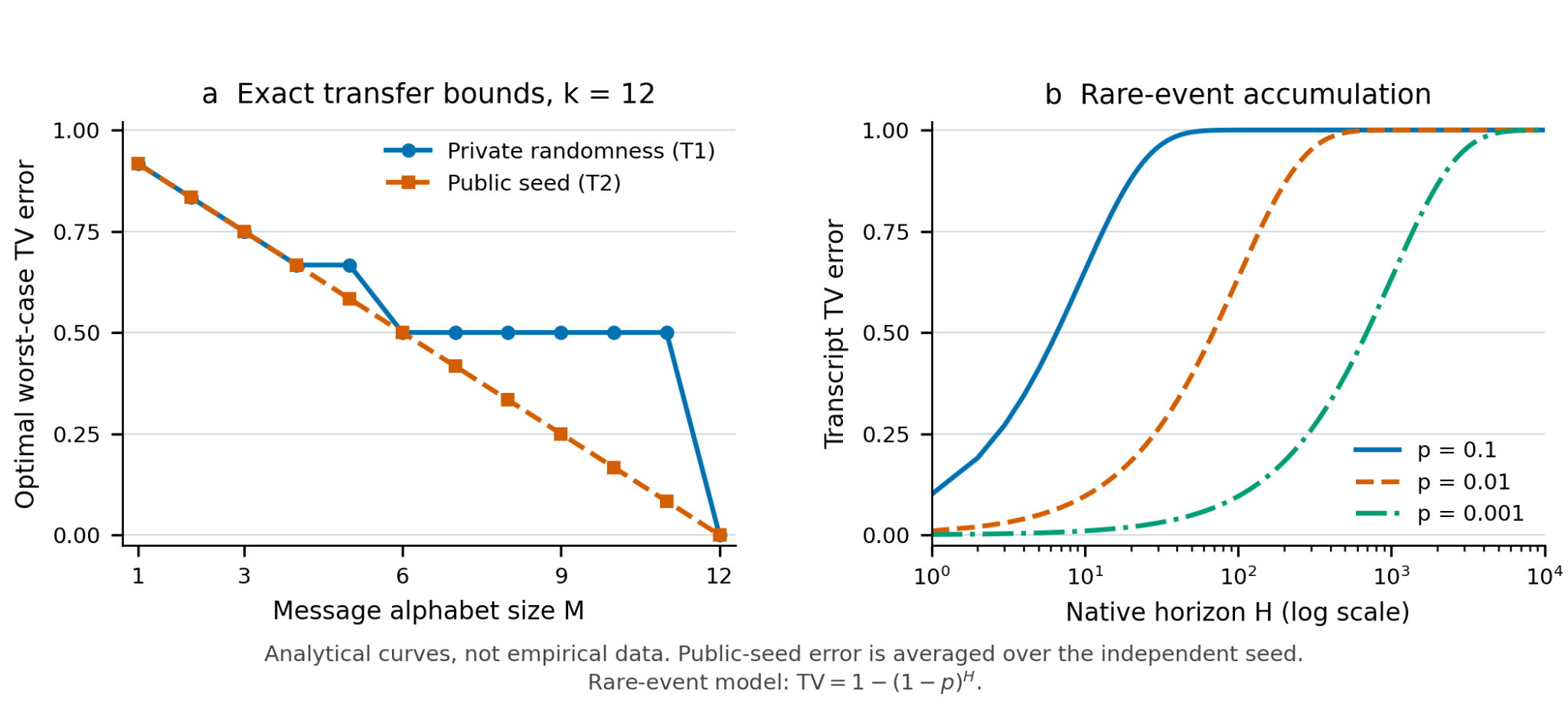
For $k=3,M=2$, private error is $1/2$ and public-seed error is $1/3$. At tolerance $0.4$, the private problem needs three messages while the public problem needs two. The improvement consumes a different coordination resource. If the source may be chosen after observing the seed, or if the error guarantee must hold for every seed separately, this averaged advantage does not follow.
For several local-summary fibres, the decoder can reuse message labels and use the known summary to choose the relevant code. Worst-fibre message requirements are the maxima of the displayed expressions. A finite common seed can provide each fibre’s uniform cyclic choice, for example through a uniform variable on a common multiple of the fibre sizes. This may be expensive; it is an existence construction, not a claim of optimal total physical cost. At $\epsilon=0$, the required message count reduces to the inherited exact fibre count. At $\epsilon=1$, a single message suffices under the convention that the alphabet is nonempty.
### 8.4 Philosophical significance and limits of the transfer result
The result gives concrete content to the claim that some relational organisation must be retained. It specifies what the recipient must reproduce, which local information is protected, and how a coordination resource changes the necessary communication. It also shows why a count of visible messages cannot by itself measure how much organisation is physically involved. The decoder, seed, installed state and future native dynamics all participate.
Shared randomness changes the distribution of errors without creating information about a source that is independent of it. Its role is coordinated selection of a code. The exact-state limit remains intact: an exact code must preserve every relevant state distinction. Approximate transfer permits a controlled probability of losing the distinction, and that probability is visible under a common revealing continuation.
These theorems do not show that a live exchange is necessary to acquire the organisation. A static lawful installation of the same retained state can meet the same continuation target. They also do not establish a phenomenal equivalence between implementations with different physical contracts. Their contribution is a precise transfer frontier inside a nominated model, suitable for testing how much of a developmental effect resides in accessible retained state.
### 8.5 Exact finite setting
Let a closed finite state space have $N$ states and common normalized joint instruments $K_{u,o,c}$. The recorded symbol includes the event cost $c$, so budget and deadline tests are functions of the same retained transcript. All actions used here must be admitted throughout the nominated domain. A finite operating grammar may be compiled into the state only when the resulting common-experiment construction satisfies these hypotheses; no extension to arbitrary state-dependent action permissions is assumed. A mathematically added failure action does not supply a physically unavailable intervention.
Write $a=(u,o,c)$ and $K_w=K_{a_1}\cdots K_{a_h}$. Define
$$W=\operatorname{span}\{K_w\mathbf 1:w\text{ is a finite admitted word}\},\qquad r=\dim W.$$
In the ordinary common-action setting, $W$ is obtained by closure from $\mathbf1$ under left multiplication by all $K_a$. A word-column basis can be chosen with lengths at most $r-1\le N-1$: until stability, every refinement increases dimension by at least one. Equality of an iterate with its successor implies permanent invariance. This construction is inherited from the monograph.
A **diagnostic** is an admitted finite causal protocol with a retained terminal score in $[0,1]$. Its score vector $f\in[0,1]^N$ gives the expected score from each actual starting state. Every such vector belongs to $W$: expand its finite policy tree into leaves; each leaf contributes its common policy randomization factor times its bounded terminal score times a word column. State-dependent oracle access is excluded. A randomized protocol is handled by the same expansion or by linearity.
Two different known machines can be compared by their block-diagonal disjoint union, including the machine label in the mathematical state. The label is not thereby revealed to the experimenter. The same policy and record grammar must apply to both blocks. Initial preparation distributions $\mu,\nu$ may occupy different blocks.
### 8.6 Diagnostic completeness, including its exact converse
Choose admitted diagnostics $f_1,\ldots,f_m$, and put
$$T=\operatorname{span}\{\mathbf1,f_1,\ldots,f_m\}\subseteq W.$$
**Theorem D1.** The following are equivalent:
1. $T=W$.
2. For every pair of distributions $\mu,\nu$ in the full probability simplex on the nominated state carrier, equality of all selected diagnostic means $\mu f_j=\nu f_j$ implies equality of every admitted finite adaptive transcript law.
Consequently at least $r-1$ scalar diagnostics are necessary for this universal preparation-distribution guarantee, and $r-1$ suffice when a basis of physically admitted word tests is available. This is a rank requirement, not a claim that $r-1$ different training tasks are intrinsically necessary for a conscious vessel.
**Proof.** If $T=W$, equality of the selected means and normalization implies $(\mu-\nu)v=0$ for all $v\in W$. Every event probability in every finite adaptive experiment is such a vector, so all event probabilities agree.
Conversely suppose $T\subsetneq W$. There is a real row $d$ annihilating $T$ but not all of $W$: choose a vector in $W\setminus T$ and separate it from $T$ by finite-dimensional linear algebra. Because $\mathbf1\in T$, $d\mathbf1=0$. Let $p$ be the strictly positive uniform probability row and choose $s>0$ so small that $p\pm sd$ are nonnegative. Define $\mu=p+sd$, $\nu=p-sd$. They are probability distributions, agree on every $f_j$, and differ on some $v\in W$. Since word columns span $W$, at least one admitted word probability differs. Its open-loop word test is a finite experiment distinguishing the preparations. This proves the converse. Finally, $\dim T\le m+1$, while a word basis containing $\mathbf1$ supplies $r-1$ nonconstant diagnostic columns. $\square$
**Preparation-domain qualification.** The converse quantifies over the full mathematical probability simplex. A physical application needs access to that preparation family, or a separate completeness analysis restricted to its lawful preparations. If only a smaller family is available, $T=W$ remains sufficient, but the stated necessity and the $r-1$ lower bound need not hold. The proof does not manufacture the required physical preparation operations.
**Actual-state caution.** The converse is false if “every preparation distribution” is replaced by “every actual state.” In a three-state device that natively reports its current state, $W=\mathbb R^3$. The single score vector $f=(0,1/2,1)^\top$ distinguishes all three actual states. Nevertheless the mixture $(1/2,0,1/2)$ and the state preparation $(0,1,0)$ have the same score. Their native report laws differ. Thus a scalar can injectively label finitely many actual predictive classes while remaining insufficient for arbitrary mixtures. Exact injectivity is also a poor robustness guarantee if nearby scores have small separation.
**Developmental interpretation.** It is not necessary to claim that every capability panel is strictly weaker than the native predictive object. A deliberately diagnostic panel can identify its predictive classes under a known finite model. Ordinary performance means generally have no such completeness guarantee. A mean improvement remains different from a change in the full native organisation, and neither score completeness nor a fitted finite model establishes the physical native contract.
### 8.7 Uniform adaptive transfer from a conditioned diagnostic basis
Assume $B=[\mathbf1,f_1,\ldots,f_{r-1}]$ is an $N\times r$ basis matrix for $W$. Choose any $r$ row indices $I$ such that the square submatrix $A=B_I$ is invertible. Let
$$p=(\mu-\nu)B=(0,\Delta_1,\ldots,\Delta_{r-1}).$$
Define $d_{\rm ad}(\mu,\nu)$ to be the supremum of TV distances over all common admitted finite adaptive transcript experiments; the supremum ranges over arbitrary finite horizons, not an unbounded physical experiment run for free.
**Theorem D2.** Under the exact fixed-model assumptions above,
$$d_{\rm ad}(\mu,\nu)
\le \min\left\{1,\frac12\|pA^{-1}\|_1\right\}
\le \min\left\{1,\frac12\sum_{j=1}^{r-1}|\Delta_j|\,\|(A^{-1})_{j,:}\|_1\right\}.
\tag{D2}$$
The same bound controls every admitted bounded capability-score difference, including a cost-limited success score. In particular, if valid simultaneous uncertainty bounds give $|\Delta_j|\le\eta_j$, replacing each $|\Delta_j|$ by $\eta_j$ gives a uniform certificate. Different nonsingular row selections or diagnostic bases can give different bounds; one may minimize over the choices actually constructed.
**Proof.** For any fixed experiment and any event in its finite transcript space, let $v\in[0,1]^N$ be its conditional event-probability vector. By the policy-tree expansion $v\in W$. Therefore $v=B\alpha$ for a unique $\alpha$, and $\alpha=A^{-1}v_I$. The event-probability difference is
$$(\mu-\nu)v=pA^{-1}v_I.$$
Put $w=pA^{-1}$. Since the first column of $A$ is $\mathbf1$, $A^{-1}\mathbf1=e_0$ and hence $w\mathbf1=p_0=0$. For any zero-sum row $w$ and any $t\in[0,1]^r$,
$$|wt|\le\frac12\|w\|_1,$$
because the total positive and negative masses of $w$ each equal half its $\ell_1$ norm. Taking the supremum over transcript events gives the TV bound for that experiment, and the constant does not depend on the horizon or policy. Supremizing over finite experiments proves the first inequality. Rows of $A^{-1}$ are indexed from zero, with row zero corresponding to the constant diagnostic. The second inequality follows by the triangle inequality and $p_0=0$. An expected $[0,1]$-score has exactly the same bounded-vector argument. $\square$
**What is doing the work.** This does not infer an unknown physical kernel from a small diagnostic panel. The exact finite family supplies $W$, a complete diagnostic basis and its conditioning. The panel then identifies the preparation’s predictions within that family. Model misspecification or transition-row estimation errors require separate bounds. Paper 2’s finite-call error budget can transport a fixed-horizon claim through such errors; its accumulating error cannot simply be omitted to obtain an all-future physical certificate.
The claim concerns trace laws. It does not supply strong actual-successor congruence, an economical decoder, a readable internal-state label, A1 admission, a new native actuator, or A2 validation. It is stronger than a finite panel of unrelated task scores precisely because diagnostic completeness is proved relative to the specified model.
**Optional tighter finite optimization.** Given exact $p$,
$$\tau_B(p)=\max_{\alpha:0\le B\alpha\le\mathbf1}p\alpha$$
is a finite linear-programming upper bound on $d_{\rm ad}$. The feasible set is symmetric under $\alpha\mapsto e_0-\alpha$, so the maximum also controls the absolute difference. It relaxes operationally implementable event vectors to all bounded vectors in $W$, so equality with the operational metric is not asserted. The matrix $B$ has full column rank; hence the bounded image constraints imply a bounded feasible set. This is a convenient dual/observability bound, not an algorithm claiming exact evaluation of all-future adaptive TV.
### 8.8 A sharp obstruction to dimension-only approximate certificates
**Proposition D3.** No universal function $g_N(\eta)\to0$ as $\eta\to0$, depending only on state dimension $N$, can bound all-future adaptive TV from agreement to accuracy $\eta$ on an arbitrary exact word basis, even when the combined dimension is two and there is no feedback or action choice.
**Proof and sharp example.** Machine $M_0$ has one state and always emits zero. Machine $M_p$ has one state and independently emits one with probability $p\in(0,1)$ each tick. Every tick costs one. Their combined observable space has dimension two with basis matrix
$$B=A=\begin{pmatrix}1&0\\1&p\end{pmatrix},
\qquad
A^{-1}=\begin{pmatrix}1&0\\-1/p&1/p\end{pmatrix}.$$
The only nonconstant basis test is “one on the next tick,” whose probability gap is $p$. After $H$ ticks the all-zero word has probability one under $M_0$ and $(1-p)^H$ under $M_p$. Thus
$$\operatorname{TV}(P_0^{H},P_p^{H})=1-(1-p)^H,
\qquad d_{\rm ad}=1.$$
The bound in D2 is exactly one: its conditioning factor is $1/p$. Letting $p\downarrow0$ disproves every dimension-only bound tending to zero. $\square$
This also shows why a finite exact equivalence theorem cannot silently become a finite empirical proof of indefinite transfer fidelity. A rare but persistent failure mechanism can remain almost invisible to a short panel and dominate a sufficiently long continuation.
**Finite observation lower bound.** Suppose an experimenter must discriminate $M_0$ from $M_p$, observing at most $L$ ticks in total, with arbitrary stopping and private randomization. Their complete observation-law TV is at most $1-(1-p)^L$. Therefore any binary decision rule has type-I plus type-II error at least $(1-p)^L$. To make both errors at most $\alpha<1/2$, a necessary condition is
$$L\ge \frac{\log(2\alpha)}{\log(1-p)}.$$
**Proof.** Couple the processes until the first one emitted by $M_p$. Over $L$ possible draws the probability of no such emission is $(1-p)^L$; an earlier stop cannot improve the full observation-law TV. Under any binary test with acceptance event $E$, the sum of errors is $1-P_p(E)+P_0(E)\ge1-\operatorname{TV}(P_p,P_0)$. The logarithmic inequality follows. $\square$
No bound depending only on finite state count can guarantee a finite uniform empirical certification budget as $p$ is allowed to approach zero. A justified separation or conditioning bound, or a finite horizon, is substantive additional information.
Analytical model illustrations. Left: the exact T1 and T2 worst-case errors for twelve jointly revealing states. Shared randomness changes the message-alphabet frontier while consuming additional coordination resources. Right: rare-event discrepancy approaches one at long horizons even when the one-tick diagnostic difference is small. These curves are exact model formulas, not experimental observations.
## 9 Paid inference and reusable organisation
### 9.1 Equal evidence can support unequal bounded achievement
A finite rule example makes the epistemic distinction precise. Two reasoners receive $p$, the rules $p\to q$ and $q\to r$, and eight irrelevant implications whose antecedents are absent. Both use a scanning procedure that charges one unit per inspected rule. One ordering places the useful rules first; the other places them after the irrelevant rules. Within a two-inspection budget, the first derives $r$ and the second does not. Their premises and unrestricted deductive consequences agree. Their realised bounded access differs.
The improvement belongs to the ordering and procedure under the declared access model. If preprocessing chose that ordering, its computation and storage must be charged. If a recipient obtains the useful ordering from a teacher, the relevant transfer includes that organisational information. If the rules are provided in an indexed structure, the baseline has changed. The example proves a bounded separation, not a lower bound for every possible reasoner.
A breadth-first graph search similarly requires a real algorithmic contract. On a finite reachable graph, a queue with duplicate detection that expands each discovered vertex once will eventually expand every reachable vertex, provided each finite expansion terminates and the queue continues to run. Induction on shortest-path distance proves the claim. An unqualified instruction to be fair, without defining scheduling or excluding endless duplicate work, is weaker. Infinite graphs, infinite branching and unbounded expansion costs need separate assumptions.
### 9.2 Compilation, reuse and break-even analysis
Let a baseline solve a repeated task at cost $c_0$ per use. Suppose learning a reusable procedure costs $P$, maintaining or storing it over the considered run costs $S$, and each later use costs $c_1\frac{P+S}{c_0-c_1}.$$
This elementary inequality gives a useful research obligation: an observed improvement in test-time latency may merely move cost into preparation. Reuse can make that trade worthwhile, but the number and distribution of future uses matter. If storage or maintenance scales with time, $S$ must be replaced by the appropriate function. If the compiled procedure has different error, the comparison needs an explicit accuracy constraint or loss.
Acquiring a useful abstraction and recognizing when to invoke it are separate achievements. Recognition cost, false invocation and selection failures belong in the comparison. A macro is therefore not a free edge. It can reduce search depth by making a previously expensive transformation directly callable, while its execution still incurs the cost of its physical implementation. Treating every learned macro as a unit step is legitimate only in a model whose unit is explicitly a macro call and whose comparison does not silently claim equal physical time. The philosophical claim is retained: incorporation can make a consequence more accessible. Its magnitude depends on the resource model.
Lower mean cost does not imply better success at each deadline. For example, an always-correct method that always finishes at cost two has greater mean cost than a method finishing at cost one with probability $0.9$ and cost ten with probability $0.1$. The latter has mean $1.9$, yet by budget two its success is $0.9$ instead of one. A full budget curve can reveal this distinction, but task averaging can still hide opposite specializations. A serious comparison reports the task-resolved curves or justifies the aggregation.
### 9.3 Retained relations as intervention-sensitive organisation
Correlation between a learned representation and performance is insufficient for incorporation. A stronger study identifies a physical mediator, manipulates it lawfully, tests persistence after the original interaction ends, and attempts a specific rescue. The retained object may be a register, parameter set, data structure or policy. The intervention must act on its implementation, not on an abstract label while holding all of its determining physical variables fixed.
For a derived relation $R=f(A,B)$, an imagined intervention changing $R$ while fixing the complete realising $A,B$ and the deterministic computation can be impossible. An actual separately stored register can be overwritten after computation, because its physical state is no longer logically constrained to agree with the old inputs under every allowed intervention. This difference is central to experimental design. Sham interventions, off-manifold states, resource disruption and direct readout changes must be distinguished from removal of the claimed mediator.
## 10 Native incorporation witness
### 10.1 An explicit logical realisation
Consider two retained binary registers $(m,z)$, an admitted binary input $u$, and a synchronous native update
$$m'=z,\qquad z'=m\oplus u.$$
The native record is $z'$. Each tick has unit logical cost. The nominated state carrier contains all four register states; each fixed-input update is bijective. The storage factorization, timing and intervention meaning are declared premises of this logical model.
Under repeated $u=0$, the first two native records are $(m,z)$. Hence all four actual states have distinct native predictive classes, and the strong quotient is the identity. The internal dependency graph has $m\to z$ and $z\to m$. A two-tick $u=0$ schedule returns the initial value of $z$ through $m$ to $z$. Holding the other initial register fixed and varying $z$ changes the endpoint record deterministically. Thus the graph route is accompanied by an executable distinguishable return in the logical contract.
This is a positive model-level witness, not a certificate for an unspecified physical circuit. An implementation must still justify its native clock, records, preparations, boundary isolation, owned resources and operative provenance. An external display copying $z'$ is not automatically the native record required by the model. The chosen record must have the declared endogenous physical role.
### 10.2 Installing and testing a relational result
Let $\theta=A\oplus B$ be formed from two earlier inputs and install $(m,z)=(0,\theta)$. Isolate or remove the original input carriers from the future task boundary. After a first tick with $u=0$, the state is $(\theta,0)$ and the record is zero. On a second tick with query $u=q$, the record is $\theta\oplus q$. The stored relation has become a condition of later action.
Before the test, overwriting $z$ with zero maps both possible initial installations to $(0,0)$. If $\theta$ is fair and no correlated variable remains available within the task boundary, no later procedure can recover $\theta$ with success greater than $1/2$. Restoring the correct $z=\theta$ rescues exact performance. This follows because the ablated future initial state and inputs are independent of $\theta$, whereas the rescued second record is the required parity. The lawful overwrite and rescue are manipulations of a realised register, with their preparation and control costs charged separately.
The example demonstrates persistence, mediation, ablation and rescue. It does not show that dialogue was necessary. A static message containing the parity can install the same state if the receiver has the required permissions and resources. Nor does the model prove that an arbitrary artifact carrying that bit is conscious. Its recurrent realisation and native record contract are essential to its conditional use under A1.
### 10.3 Conditional phenomenal point separation
**Proposition N1.** Suppose a certified qualifying realisation has one fixed complete endogenous predictive object and two lawful preparations $\mu_0,\mu_1$ concentrated on actual states $x_0,x_1$. If a common admitted native finite experiment has different laws from those states, then their native predictive classes differ. Under A2, their actual phenomenal points differ within the fixed calibrated structural copy.
**Proof.** Equality of the native predictive classes requires equality of every admitted finite native law. One differing law contradicts that equality. A2 maps distinct classes to distinct points through its structure-preserving copy. $\square$
This modest statement is the exact bridge available from the constitution. In the register model, the two parity installations are distinguished on the second idle record, so they satisfy its model-level premise. A2 does not assign a named human quale to either state, and the argument does not establish primitive presence independently of A1 and A0.
If model predictions for a chosen native experiment have contrast $\widehat\eta$, and the two actual-law discrepancies are bounded by $\beta_0,\beta_1$, the actual contrast is at least $\widehat\eta-\beta_0-\beta_1$ by the triangle inequality. A strictly positive lower bound establishes class separation for those nominated physical preparations. For mixture preparations, a positive diagnostic difference separates their predictive laws; it does not identify a single actual phenomenal point without further state information.
The fixed carrier already includes the retained parity. Installation therefore changes the actual point, not the unpointed four-state predictive object. A genuinely changed native operation, boundary or domain would require a new justified realisation before claiming a changed constitutive object.
### 10.4 Countermodels that delimit the inference
First, add a register that no native operation or native record consults, but that an external laboratory device can read. Altering that register can change an external score while leaving every native continuation law unchanged. Such a score is not a native diagnostic for N1. The register’s physical membership in a qualifying core is a separate realisation issue.
Second, an arbitrarily long forward cascade can propagate a difference without returning it to its origin. A graph obtained by identifying repeated temporal roles can display a cycle even though the native physical carrier has no return. Time unfolding of a recurrent machine is itself a directed acyclic graph, so acyclicity of the unfolding is equally unable to settle native recurrence. The relevant question concerns the realised carrier and executable schedule.
Third, causal influence does not generally compose transitively as endpoint influence. If $a$ affects $b$ and both affect $c$, cancellation can erase the total contrast. In a binary example let $b=a$ and $c=a\oplus b$. The direct structural dependencies are present, but changing $a$ while allowing $b$ to update leaves $c=0$. A route through dependency edges is not a proof of a distinguishable endpoint return. The native certificate must test the composed schedule.
These countermodels explain why the developmental narrative cannot supply its own A1 proof. They also preserve a constructive path: identify a retained relation, establish its native continuation role, verify a genuine recurrent realisation, and only then apply the stated constitution.
## 11 Literature
### 11.1 Closest conceptual antecedents
Tronick and colleagues’ 1998 account of dyadically expanded states of consciousness is a close antecedent to the central interactional proposal [\[L1\]](/consciousness/development/references-and-access-record#ref-l1). The inspected publisher abstract links collaborative interaction and mutual affect regulation to more coherent and complex organisation. This prevents a broad priority claim that interpersonal engagement can expand conscious organisation. The present programme adds a different formal target: retained continuation-relevant organisation, explicit transfer contracts and its conditional relation to A0–A3. The full article was not retrieved, so more detailed comparisons with its developmental evidence remain to be checked.
De Jaegher and Di Paolo’s participatory sense-making treats interaction as a process that can acquire relative autonomy and transform meaning through its interplay with participants [\[L2\]](/consciousness/development/references-and-access-record#ref-l2). Its embodied and affective account is directly relevant to relevance-guided development. The present formalism should not reduce that programme to message exchange. Its additional question is which retained distinctions permit later autonomous continuation or transfer under specified resources. Interactional autonomy, effective modularity and a newly assigned joint subject remain distinct targets.
Clark and Chalmers argue that external processes can participate in cognitive organisation when they play the relevant coupled functional role [\[L3\]](/consciousness/development/references-and-access-record#ref-l3). This is an antecedent for artifacts, notebooks and environmental organisation contributing to thought. The present artifact account follows that general problem while separating cognitive participation from A1 subject qualification and A3 episode identity. A durable medium can reshape a later conscious organisation without itself being assigned experience.
These precedents do not invalidate an independently reached synthesis. They locate its appropriate claim. The useful contribution is the particular connection among recursive incorporation, bounded reasoning, continuation-preserving transfer and a declared consciousness constitution. The existence of familiar ingredients increases the importance of precise formal and empirical differences.
### 11.2 Predictive state, value and computational control
Littman, Sutton and Singh represent state through action-conditional predictions of future observations [\[L4\]](/consciousness/development/references-and-access-record#ref-l4). This is a direct antecedent for using future tests rather than a hidden-state label as the target of representation. Recasting such predictions as developmental capability does not make predictive sufficiency new. The present diagnostic results ask when a specified finite score panel spans the relevant observable space and how its conditioning controls approximation.
Tzeng’s probabilistic-automaton equivalence work supplies a classical algorithmic antecedent for finite linear methods [\[L5\]](/consciousness/development/references-and-access-record#ref-l5). The monograph already contains the exact finite word-span result used here. Only publisher metadata and abstract were inspected for Tzeng; no detailed attribution of a specific uninspected theorem is made. D1–D3 are supplied with self-contained proofs, and their status is deductions developed here rather than an asserted first discovery of observability methods.
Subramanian, Sinha, Seraj and Mahajan develop approximate information states for partially observed systems [\[L6\]](/consciousness/development/references-and-access-record#ref-l6). Their framework distinguishes exact sufficient structure from controlled approximation and gives policy-performance bounds. It is a close formal neighbor of the continuation problem. The present target emphasizes declared native transcript laws, retained costs and the difference between task-value preservation and the complete object used by A2. Its all-finite diagnostic bound relies on a fixed exactly known finite family; it does not replace an approximate-model learning theory.
Alver and Precup study minimal value-equivalent partial models for lifelong reinforcement learning [\[L7\]](/consciousness/development/references-and-access-record#ref-l7). The inspected proceedings abstract makes the decision-relevant target explicit. This supports a key distinction: an economical model can deliberately omit environmental features irrelevant to its planning criterion. Such omission is not automatically legitimate for a different future learning target or for a full native predictive identification. A claim of minimal developmental state must therefore state what is to be preserved.
Russell and Wefald’s metareasoning programme evaluates computational actions through their effects on decisions and their resource use [\[L8\]](/consciousness/development/references-and-access-record#ref-l8). This is a close precedent for relevance-guided allocation of thought and for separating logical consequence from useful achieved inference. It also reinforces a constraint: evaluating the value of a computation is itself a computational problem. A perfect relevance oracle cannot be introduced without cost. Publisher metadata and abstract, an author publication list, and an archived opening page support this comparison; the complete journal article was not inspected.
Two further primary sources sharpen the developmental account. Kretch, Franchak and Adolph compared infants’ visual access during crawling, walking and sitting [\[L10\]](/consciousness/development/references-and-access-record#ref-l10). Their head-mounted measurements show that bodily posture changes the available visual field and gaze opportunities. This is evidence for a change in access, not merely a change in the salience of identical input. It cautions against using a common environment as proof of equal sensory evidence. No broader phenomenal conclusion follows from those measurements.
Ellis and colleagues’ DreamCoder develops reusable program abstractions together with a learned search policy [\[L11\]](/consciousness/development/references-and-access-record#ref-l11). Its component ablations and reported training costs make it direct prior work for acquired organisation improving later synthesis. The learned library and the procedure recognizing when to use it are distinct contributors. Training generally required roughly a day on 20–100 CPUs in the reported experiments, so the work also illustrates why discovery and runtime costs should be reported separately. This paper does not reproduce its experiments or infer consciousness from their success.
### 11.3 Causal abstraction and the contribution boundary
Rubenstein and colleagues formalize consistency between structural causal models through exact transformations that respect specified interventions [\[L9\]](/consciousness/development/references-and-access-record#ref-l9). This is an antecedent for requiring an intervention translation when a relation becomes a higher-level component. The present P4-informed use is particular: behavioural conjugacy does not preserve the elementary physical interventions used to justify a consciousness realisation. A successful abstraction needs a stated intervention domain and cannot assume that every mathematical intervention is executable.
The checked literature supports restrained positioning. Neither predictive state, embodied meaning, dyadic transformation, bounded metareasoning, external cognition nor intervention-preserving abstraction is being introduced from scratch. The transfer theorems isolate a useful exact coding problem; the diagnostic results add explicit quantitative consequences within the inherited finite-model machinery; the philosophical synthesis states a developmental use of a pre-existing constitution. A wider systematic priority review would be needed before describing any theorem as historically novel.
## 12 Research programme
### 12.1 A sequence of discriminating studies
The first study should target organisational change without presupposing consciousness. Use a small finite learning system with a declared state carrier, task family, update grammar and cost record. Compare live adaptive interaction, legal replay, static evidence, transferred procedures and cumulative retained-state packages. Hold fixed what can actually be held fixed: initial information, available operations, preparation resources and test distribution. Report differences that cannot be matched, since adaptive access and fixed transcripts are intrinsically different interventions.
Measure immediate performance and future learning separately. The three-state counterexample suggests a direct design: identify preparations with equal current scores, expose them to the same further learning input, then test the divergence. A matched snapshot need not preserve continuation. Add task-resolved tests, budgets and held-out continuations so that averaged success does not conceal opposite specializations. A legal order intervention preserves feasibility and resource accounting; arbitrary message shuffling may destroy the task rather than isolate order.
The second study should identify a mediator. Nominate the retained object before inspection of the final test outcomes. After acquisition, remove the original interaction and test persistence. Perform a lawful ablation with a sham control, measure the consequent change, and restore the nominated object without restoring the entire original episode. A specific rescue strengthens the causal interpretation. Failure of rescue can reveal a missing dependency, an invalid intervention or an incorrect mediator; it does not by itself demonstrate an irreducible live history.
The third study should construct a transfer frontier. Fix the recipient, codebook family, allowed preparation operations, decoder computation and scored continuation family. Compare cumulative packages $Z_{i+1}=(Z_i,\Delta_i)$ so that a larger package actually contains the smaller one; unrelated packages do not define a monotone information ladder. Charge codebook storage, installation, seed coordination, preparation and runtime. Theorems T1–T2 give exact calibration cases for a jointly revealing family. Outside that family, compute or bound the appropriate covering or simulation target instead of applying their formula by analogy.
The fourth study should test diagnostic completeness and robustness. In a known finite machine, construct the observable span, select a physically admitted basis and calculate its conditioning. D1 identifies whether the selected panel can distinguish every preparation law. D2 converts validated simultaneous score bounds into a conditional all-finite guarantee. D3 supplies a deliberate rare-event stress test. With learned or misspecified kernels, restrict claims to validated horizons or add explicit model-error assumptions; short empirical agreement is not indefinite certification.
Only after these organisational studies should a physical consciousness application claim the full constitution. Nominate the intrinsic carrier and storage factors; justify the native time, record and operation grammar; isolate the intended boundary; demonstrate an executable covering return; check predictive-fibre congruence and the realisation’s resource and provenance conditions. P4’s chart method can help if its response-model assumptions are independently justified. A fitted service model or successful transfer remains insufficient on its own.
### 12.2 Experience-facing content and RCO studies
Content-level work should nominate both sides of the proposed bridge independently. On the physical side, possible variables include discrimination relations, temporal transitions, associations, salience routing, spatial organisation and valuation dynamics. On the experiential side, use carefully specified similarity judgments, reports of salience and temporal organisation, and other fallible experience-facing measures. Fit the mapping on one set of conditions and test held-out predictions. Do not redefine the phenomenal geometry after a mismatch solely to recover an isomorphism.
An isolated note and the same note in a melody illustrate why a static sensory feature vector can be insufficient: temporal and contextual relations change the candidate content organisation. Recognition adds another dimension beyond raw discriminability. Spatial content may require adjacency, orientation and dimension; affect may require regulatory and evaluative relations. These are candidate structures to test, not established identifications of particular qualities. A2 already commits to a full native relational identity; a smaller convenient feature graph is only a proposed model of some of its structure.
The inverted-spectrum question marks the strength of that commitment. A2 excludes further manifested qualitative differences when the entire calibrated pointed native structure is held fixed, apart from primitive presence. This is a constitutional choice, not a proof that every conceivable richer theory is impossible. Likewise, invariance under a whole-model coordinate change requires transporting operations, reports and calibration; it does not identify distinct points within one calibrated model.
For RCO, independently operationalize personal-model use, self-protective interpretation and relevance routing. Test whether these change while practical self-representation remains available. Reports of awareness-centered self-reference provide a different kind of evidence from a graph statistic. No currently supplied operational variable makes awareness-reference directly identifiable. The exact obligation is to find a principled bridge between the reported relation and reproducible native organisation, or to state why the concept resists that form of identification.
### 12.3 Hard cases and competing explanations
Dreaming, reduced external responsiveness, altered self-experience, split control and minimal recurrent devices are useful consistency cases, but they are not new evidence generated here. Each separates a different inference. Lack of external report need not imply lack of native distinctions. Loss of a familiar autobiographical model need not eliminate an admitted perspective. Rich cognitive behaviour does not by itself certify a native core. A minimal persistence device that truly meets A1 cannot be rejected merely because it lacks familiar human content without changing the admission law.
Interacting participants can form a coordinated process without merging into one subject. A purported joint subject must supply its own qualifying physical boundary and coexist consistently with maximality and the constitutive treatment of the smaller cores. An observational information-insulation score depends on the preparation distribution and cannot substitute for a native intervention boundary. Claims of nested or multiscale subjecthood require an explicit alternative selection doctrine and a proof that its assignments are determinate.
Bridge desiderata such as structural invariance, substrate neutrality, boundary sensitivity and compositional discipline do not uniquely select a psychophysical law. Many assignments can respect the same symmetries. The existence of a quotient is also different from a reason to identify it with phenomenality. The open philosophical work concerns existence, individuation and content correspondence separately, rather than treating a solution to one as a solution to all three.
The following are conceptual discrimination targets, not reported experiments or diagnoses:
| Case | Distinction to preserve | Failure of a proposed model |
|:---------------------------------------------|:--------------------------------------------------------------|:----------------------------------------------------------------------------------|
| Dream or internally generated scene | Current presentation and current sensory constraint | Requiring every content to be a direct transform of present external input |
| Mistaken perception or hallucination | Occurrence, source attribution and accuracy | Equating coherence with truth, or internal contribution with falsity |
| Blindsight-type dissociation | Task-usable information and attributed presentation | Treating successful discrimination alone as an independent phenomenal criterion |
| Anesthesia or nonresponse | Qualification, reporting, retention and later recall | Treating an absent response or recall as decisive about the contemporaneous scene |
| Sensory substitution or cross-modal coupling | Access route, represented relation and similarity | Repairing every failed prediction by redefining the phenomenal similarity map |
| Self-model loss | Personal identification, metacognition and localized presence | Adding autobiographical self-description as an unannounced A1 requirement |
| Expertise | Learned association, relevance and sensory distinctions | Predicting that every cognitive gain changes every phenomenal dimension |
These cases require independent realisation and experience-facing evidence. They are not classifications of particular people or physical devices. Under the adopted A2, a proposed content gate cannot simply withhold phenomenal organisation from an otherwise qualifying core. It must be part of the justified dynamics or an explicit constitutional revision.
### 12.4 Concrete outstanding obligations
| Question | Strongest present result | Remaining obligation |
|:----------------------------------------------------|:--------------------------------------------------------------------------------|:--------------------------------------------------------------------------------|
| Does incorporation preserve future development? | Exact continuation closure and strong marked quotients; finite-use error bounds | Learn or justify the correct carrier, interventions and continuation family |
| How much organisation must be transferred? | Exact residual-state count; exact T1–T2 message frontiers in a revealing family | General resource-aware approximate dynamical-state minimization |
| Can finite tests certify all future laws? | D1–D2 under an exact known finite family | Model uncertainty, physical admissibility and conditioning estimates |
| Does acquired organisation alter conscious content? | N1 conditionally separates A2 points after native qualification | Independent realisation and experience-facing bridge evidence |
| Does will have a general mathematical law? | Task-relative relevance and paid directed control can be modelled | Noncircular treatment of changing criteria, conflicting values and failures |
| Can relations become higher-level components? | Inherited compositional interface theorems | Economical implementation and acquisition under genuine context variation |
| Does RCO correspond to a structural invariant? | Candidate changes in self-reference and relevance routing | A defensible awareness-reference bridge; low centrality is insufficient |
| Is One–Two–relation universal? | Useful local factorization and concrete recursive examples | A structure-preserving map and a nonvacuous theorem for broader correspondences |
| Is A1’s minimal admission empirically right? | Conditional assignment is mathematically determinate | Independent evidence bearing on the lower bound; explicit revision if needed |
The resulting account makes developmental change accountable to retained organisation, admissible interventions and future consequences. It allows agency to change its own operative conditions through inquiry and learning, while leaving ultimate authorship and libertarian settlement unresolved. The empirical programme can challenge the proposed mediator, transfer target and phenomenal bridge separately. A successful model-level test becomes a consciousness result only under the explicitly stated realisation and constitutional premises.
## 13 Coverage and provenance
### 13.1 Conceptual coverage and source limitations
Earlier working formulations were corrected in this paper. Claims that depended on incomplete displays have been replaced by explicit definitions and proofs where recovery was possible; unavailable wording has not been reconstructed as a quotation. In particular, the earlier experimental archives associated with [\[P3–P4\]](/consciousness/development/references-and-access-record#programme-publications) have not been reproduced for this paper. Their numerical outcomes are cited as reported results, not as newly executed experiments.
### 13.2 Proof and computation audit
The general arguments appear explicitly as T1–T2 and D1–D3. N1 states a conditional consequence of A2 after realisation and qualification. Results C1–C3 and the finite-use substitution bound use established constructions and the inherited results in [\[M, P2\]](/consciousness/development/references-and-access-record#programme-publications). All assumptions belong to the statements; the finite examples do not establish a universal law of consciousness or will.
Three executable Python verification programs were inspected and rerun during this revision. The diagnostic program checks the three-state mixture obstruction, 45 rare-event cases, and all 139 deterministic full-depth binary policy trees of depths zero through three in its specified two-action, two-record, three-state instrument. The transfer program checks 5,295 set partitions for $k\le8$, 420 private/public constructions for $k\le20$, 2,870 joint seed/reveal laws, and 2,800 rational tolerance cases. The native program checks the two-register witness and its ablation and rescue conditions. Those policy checks do not enumerate all early-stopping policies, which are covered by the analytic argument. Additional independently written checks verify 957 cyclic horizon/fibre cases, the equal-trace counterexample through depth nine, 508 native state/input-word cases and 45 rare-event calculations. These finite checks support the stated examples and constructions; they are not machine-checked proofs of the general theorems or independent empirical validation.
The additional review clarifies three contracts: finite experiments have uniformly bounded policy trees; D1’s converse concerns the full preparation simplex; and the transfer results preserve a fixed calibrated native continuation contract after decoding. The literature comparison is directed rather than exhaustive, and does not establish historical priority.
### 13.3 Attribution and research support
Jeremy Rodgers, Independent Researcher, developed the conceptual programme and supplied the foundational manuscripts. AI tools assisted with analysis, drafting, mathematical construction, verification code and revision.
This work received no external research funding. Collaboration is invited on independent mathematical review, computational replication, physical implementation and empirical testing. The research programme and related publications are available at [everythingequation.com](https://www.everythingequation.com).
## 14 References and access record
### 14.1 Programme publications
**M.** Rodgers, J. (2026). *Shadow Theory and Consciousness: Awareness, Perspectival Realization, and the Source-to-Experience Problem*. SPC-2, version 2, publication edition, 20 September. Zenodo. [`doi:10.5281/zenodo.`22853774](https://doi.org/10.5281/zenodo.22853774).
**P2.** Rodgers, J. (2026). *Relational Boundaries and Awareness Localization: Robustness, Composition, and Identification Limits*. Version 1.0, 29 September. Zenodo. [`doi:10.5281/zenodo.`23075822](https://doi.org/10.5281/zenodo.23075822). Relevant anchors: P2-16–P2-19, P2-21–P2-22, P2-32–P2-33 and the hierarchical relational construction.
**P3.** Rodgers, J. (2026). *Learning Effective Interfaces from Opaque Stochastic Systems: Capacity, Selection, and Validation Limits*. Revised preprint version 2, 29 September. Zenodo. [`doi:10.5281/zenodo.`23075824](https://doi.org/10.5281/zenodo.23075824).
**P4.** Rodgers, J. (2026). *Identifying Binary Realizations from Intervention Laws: Certificates, Recoding Obstructions, and a Bounded SPC-2/IIT Comparison*. Version 1.1-RC1, 30 September. Zenodo. [`doi:10.5281/zenodo.`23075828](https://doi.org/10.5281/zenodo.23075828). The cited source retains a separate pending supporting-archive reference; that historical archive is not reproduced here.
### 14.2 External primary sources
**L1.** Tronick, E. Z., et al. (1998). Dyadically expanded states of consciousness and the process of therapeutic change. *Infant Mental Health Journal*, 19(3), 290–299. [Publisher record and abstract](https://onlinelibrary.wiley.com/doi/abs/10.1002/(SICI)1097-0355(199823)19:3%3C290::AID-IMHJ4%3E3.0.CO;2-Q). DOI: 10.1002/(SICI)1097-0355(199823)19:3\<290::AID-IMHJ4\>3.0.CO;2-Q. Scope: metadata and abstract, not full article.
**L2.** De Jaegher, H., and Di Paolo, E. (2007). Participatory sense-making: An enactive approach to social cognition. *Phenomenology and the Cognitive Sciences*, 6, 485–507. DOI: 10.1007/s11097-007-9076-9. [Author-hosted full text](https://hannedejaegher.net/wp-content/uploads/2009/11/dejaegherdipaolo07participatorysensemaking.pdf). Scope: full text available; abstract and relevant autonomy, embodiment and interaction passages consulted.
**L3.** Clark, A., and Chalmers, D. J. (1998). The extended mind. *Analysis*, 58(1), 7–19. DOI: [`10.1093/analys/58.1.7`](https://doi.org/10.1093/analys/58.1.7). [Author-hosted text](https://www.consc.net/papers/extended.html). Scope: full text consulted for external coupling and cognitive participation.
**L4.** Littman, M. L., Sutton, R. S., and Singh, S. (2002; conference 2001). Predictive representations of state. *Advances in Neural Information Processing Systems*, 14. [Proceedings PDF](https://proceedings.neurips.cc/paper/2001/file/1e4d36177d71bbb3558e43af9577d70e-Paper.pdf). Scope: primary full text, predictive-test representation and linear-state results.
**L5.** Tzeng, W.-G. (1992). A polynomial-time algorithm for the equivalence of probabilistic automata. *SIAM Journal on Computing*, 21(2), 216–227. [Publisher record](https://epubs.siam.org/doi/10.1137/0221017). DOI: 10.1137/0221017. Scope: metadata and abstract only.
**L6.** Subramanian, J., Sinha, A., Seraj, R., and Mahajan, A. (2022). Approximate information state for approximate planning and reinforcement learning in partially observed systems. *Journal of Machine Learning Research*, 23(12), 1–83. [Journal PDF](https://www.jmlr.org/papers/volume23/20-1165/20-1165.pdf). Scope: primary full text, exact/approximate information-state definitions and performance-bound discussion.
**L7.** Alver, S., and Precup, D. (2023). Minimal value-equivalent partial models for scalable and robust planning in lifelong reinforcement learning. *Proceedings of Machine Learning Research*, 232, 548–567. [Proceedings record](https://proceedings.mlr.press/v232/alver23a.html). Scope: metadata and abstract.
**L8.** Russell, S., and Wefald, E. (1991). Principles of metareasoning. *Artificial Intelligence*, 49(1–3), 361–395. DOI: 10.1016/0004-3702(91)90015-C. [Archived opening page](https://iiif.library.cmu.edu/file/Newell_box00014_fld01011_doc0001/Newell_box00014_fld01011_doc0001.pdf). Scope: title, authors, abstract and opening discussion; complete article not retrieved.
**L9.** Rubenstein, P. K., Weichwald, S., Bongers, S., Mooij, J. M., Janzing, D., Grosse-Wentrup, M., and Schölkopf, B. (2017). Causal consistency of structural equation models. *UAI 2017*. [Author-deposited manuscript](https://arxiv.org/abs/1707.00819). Scope: primary abstract and full-text transformation discussion consulted. Interventions, rather than observational agreement alone, determine the relevant consistency target.
**L10.** Kretch, K. S., Franchak, J. M., and Adolph, K. E. (2014). Crawling and walking infants see the world differently. *Child Development*, 85(4), 1503–1518. DOI: 10.1111/cdev.12206. [Author-hosted manuscript](https://johnfranchak.github.io/padlab/publications/2014-KretchFranchakAdolph-ChiDev.pdf). Scope: abstract, apparatus/design, selected results and discussion; no raw-data reanalysis. The PDF has 2013 advance-publication formatting.
**L11.** Ellis, K., et al. (2021). DreamCoder: Bootstrapping inductive program synthesis with wake-sleep library learning. *Proceedings of the 42nd ACM SIGPLAN International Conference on Programming Language Design and Implementation (PLDI 2021)*, 835–850. DOI: 10.1145/3453483.3454080. [Primary manuscript](https://www.neurosymbolic.org/papers/EllisWNSMHCST21.pdf). Scope: abstract, architecture, component comparisons and training-cost discussion; no replication.